Gaza Humanitarian Response. Dec. 11

Gaza Humanitarian Response
Situation Report No. 44

11 December 2025
(As of 18:00 on 10 December 2025, unless otherwise noted)

HIGHLIGHTS

  • An eight-month-old infant passed away due to the severe cold in the Mawasi area of Khan Younis, while heavy rains and flooding are currently affecting hundreds of households. The UN and partners on the ground have set up a system for rapid, joint response to flooding alerts, working side-by-side to distribute tents, tarpaulins, warm cloths, blankets and dignity kits.

  • Three additional Temporary Learning Spaces able to accommodate over 800 children were established over the past two days, as work continues to set up ten more learning spaces in southern Gaza.

SITUATION OVERVIEW

Persistent heavy rainfall and extremely low temperatures are compounding dire conditions, at a time when there is no access to gas or electricity, extremely limited wood supplies, and limited distribution of shelter items to displaced people due challenges with the entry of supplies. On 10 December, at least 465 households (2,731 people) residing in 260 tents were affected by flooding, with the figure continuing to rise. Tragically, an eight-month-old infant passed away due to the severe cold in the Mawasi area of Khan Younis. In a single day, more than 1,500 people were observed to have moved from Khan Younis to Gaza city.

In the areas at highest risk of flooding, all family tents experienced flooding to varying degrees, forcing many families to seek temporary refuge in Designated Emergency Shelters (DES) after fleeing inundated areas. Site Management Cluster partner assessments confirmed that all tents and some classrooms inside DESs were flooded. The sanitation and hygiene committees have been actively clearing gullies and manholes, marking their second effort this week to mitigate the impact of the rainfall. Along the seashore, all families that had not previously moved were displaced by flooding and are now being accommodated by relatives at external sites. Coordination between municipal winter emergency committees and Site Management teams is ongoing throughout the Gaza Strip, especially in high-risk sites and DESs, to manage and alleviate the effects of this rain cycle. The need for winterization items including tents, tarps, winter clothing, blankets, and other non-food items remains extremely high.

Across Gaza, UN agencies and partners on the ground have set up a system to respond jointly to flooding alerts as they come in, working side-by-side to distribute all available supplies. As of 17:00 hrs on 11 December, they had already processed 161 flooding alerts since the morning and carried out assessments covering more than 16,000 families in different areas.

Sporadic airstrikes, shelling and gunfire continued to be reported across all Gaza governorates, with the majority recorded in the Gaza city area, east of the “Yellow Line”. The Israeli Defence Forces reported the killing of one Palestinian who allegedly crossed the “Yellow Line” jointly with a second individual, posing a threat to the soldiers. According to the Gaza Ministry of Health, four people were killed and 10 injured in the past 24 hours, bringing the total reported casualties since the start of the ceasefire to 383 deaths and 1,002 wounded.

UNITED NATIONS-COORDINATED AID ENTRY*

On 10 December, at least 3,905 pallets of aid administered by the UN and its partners were offloaded at Gaza’s crossings, based on data retrieved from the UN 2720 Mechanism dashboard at 17:00 on 11 December. About 54 per cent of these pallets contained food supplies, followed by shelter (22 per cent), health (13 per cent), water, sanitation and hygiene items (10 per cent), and operational equipment (1 per cent).

On the same day, UNOPS international monitors deployed at Gaza’s crossings verified the collection of at least 2,996 pallets of aid – 1,703 from Kerem Shalom between 09:19 and 14:15, and 1,293 from Zikim between 07:55 and 10:55. These comprised inter alia 1,689 pallets of food assistance, including flour, food parcels, date bars and canned chicken, 875 of hygiene materials and cleaning supplies, 346 of infant food and nutrition supplements, 70 of blankets and 24 of medicines.

Overall, between the announcement of the ceasefire on 10 October, and 9 December, at least 158,242 pallets of humanitarian cargo were offloaded, and 136,735 pallets collected from the different crossings. Only 2 per cent of all uplifted aid was intercepted during transit within Gaza.

The above data excludes bilateral donations and the commercial sector.

On 10 December, six out of eight humanitarian movements submitted for coordination with the Israeli authorities were facilitated. For the second time this week, an assessment mission aimed to physically verify the locations of UN armoured vehicles that were last known to be at the UN Logistics Base in Rafah was denied outright. Another cargo collection mission from Kerem Shalom had to be cancelled by the organizers.
 

HUMANITARIAN RESPONSE

The below are preliminary updates shared by Clusters at the time of reporting and will be reconciled and aggregated in the coming days as Clusters receive more data from the capillary network of partners active on the ground.
 

Water, Sanitation and Hygiene

  • To facilitate a rapid response to the heavy rainfall, WASH partners adapted operations in camps allocating focal points and mobile pumps for each Governorate in advance of the storm.

  • Emergency construction of an earth embankment at Al-Rantisi Hospital to protect the exposed building foundations is underway.

  • Construction and placement of WASH services is ongoing in the Khan Younis flood relocation site at Hamad City.

Shelter

  • On 10 December, Shelter partners reached 2,887 households with shelter and non-food items assistance. The distributed items include: 1,770 tarps to 590 households in Khan Younis, 5,576 tarps to 1,592 households in Deir al Balah, 170 tents in Gaza City and Khan Younis, in addition to 535 clothing vouchers to 535 households in North Gaza and Gaza City.

  • The Shelter Cluster is coordinating closely with several partners to activate a rapid response to many referrals from different partners, IDP sites, and relevant stakeholders considering the current winter storm in Gaza.

Protection

  • Child Protection

    • Recent storms damaged at least 10 Child Safe Spaces. In Gaza city, Child protection partners continued winter-response efforts; a total of 6,000 clothing kits were distributed for children across different age groups on 10 December, with safeguarding measures in place at all distribution points.

    • Between 9 and 10 December, 520 children and 335 caregivers were reached with Mental Health and Psychosocial support (MHPSS) sessions and recreational activities in Child Safe Spaces and shelters. This included structured group sessions, individual MHPSS, individual counselling, and Teaching Recovery Techniques. During the same period, more than 100 children participated in six sessions of the “Gaza We Want” initiative, which provides structured, child-focused psychosocial support aimed at restoring stability and emotional safety for displaced children.

    • Families report difficulty keeping children warm at night, increasing stress and reducing participation in activities. Caregivers describe rising exhaustion as they move frequently in search of safer shelter while trying to meet basic needs. They continue to request additional winter items, counselling, and safe spaces where children can recover and reconnect.

  • Mine Action

    • On 10 December, Mine Action partners conducted two Explosive Hazard Assessments (EHAs) in Deir al Balah and Gaza city, including in support of rubble removal efforts, and provided Explosive Ordnance-related technical advice during one inter-agency mission.

    • One Explosive Ordnance incident was recorded in Gaza city on 10 December, leading to one person killed and one injured.

    • Explosive Ordnance Risk Education sessions continue, with partners reaching at least 8,541 people between 7 and 11 December in Gaza city, Deir al Balah and Khan Younis.

Education

  • Since the beginning of December, approximately 191,968 children have been receiving High-Energy Biscuits and Fortified Date Bars across 232 Temporary Learning Spaces (TLSs) in the Gaza Strip.

  • Three additional TLSs were established over the past two days, which can accommodate around 810 school-age children. Ten new sites have also been identified for the establishment of additional learning spaces in Deir al Balah, Khan Younis and at the Rafah–Khan Younis border; work is underway to complete these spaces and further increase enrolment.

  • A lack of furniture continues to hinder efforts to improve the learning environment. Although 65 classrooms were recently lightly rehabilitated, they still lack basic items, including furniture and mats. The onset of cold winter conditions is creating harsh learning environments for children and is impacting learning spaces. Additionally, continued restrictions on the entry of basic learning materials are limiting the quality of the learning opportunities being provided.

* All figures solely refer to UN and partner assistance dispatched through the UN-coordinated system. They are preliminary and will be reconciled in the course of the ceasefire. Supplies entering through bilateral donations and the commercial sector are not reflected.

Joy in resistance--Our Annual Appeal

Recently, in southern Gaza, hundreds of Palestinians attended a mass wedding for 54 couples. These photos, taken amidst the rubble, are both beautiful and joyful. Organizers called it an act of defiance against Israel’s campaign of genocide. “It is a message for the killers and criminals ... that our Palestinian people embrace life, cling to life and love life.” 
 
In that spirit of love and resistance, the Alliance for Water Justice in Palestine offers its own resistance: bi-weekly briefs, calls to demonstrations and standouts, and a website that has been visited by 8,600 people in the past year. Our three minute video, produced in collaboration with Palestinian videographers, has been viewed by over 1,400 people. Four of our members participated in the People’s Hunger Strike for Gaza; one of them wrote about why she was participating for Common Dreams, ensuring that literally millions of people read it. 
 
The Alliance is often called on not just to sponsor an event, but to participate as a driving force in organizing. We work in coalitions and campaigns to expose U.S. complicity in Israel’s war crimes.
 
In the coming year, we intend to amplify our voice by using mobile billboards at large public gatherings and placing yard signs on busy streets. We will continue collaborating with our Palestinian partners to create 30 second videos highlighting aspects of water injustice to be easily distributed on social media.
  
This work, this resistance, this love will be sustained by your donation. 
 
We rely on your continuing support.

We have so much more work to do together.

Please donate at our website or send a check to AWJP, 55 Jamaica Street, Jamaica Plain, MA 02130. 

Thank you.
 
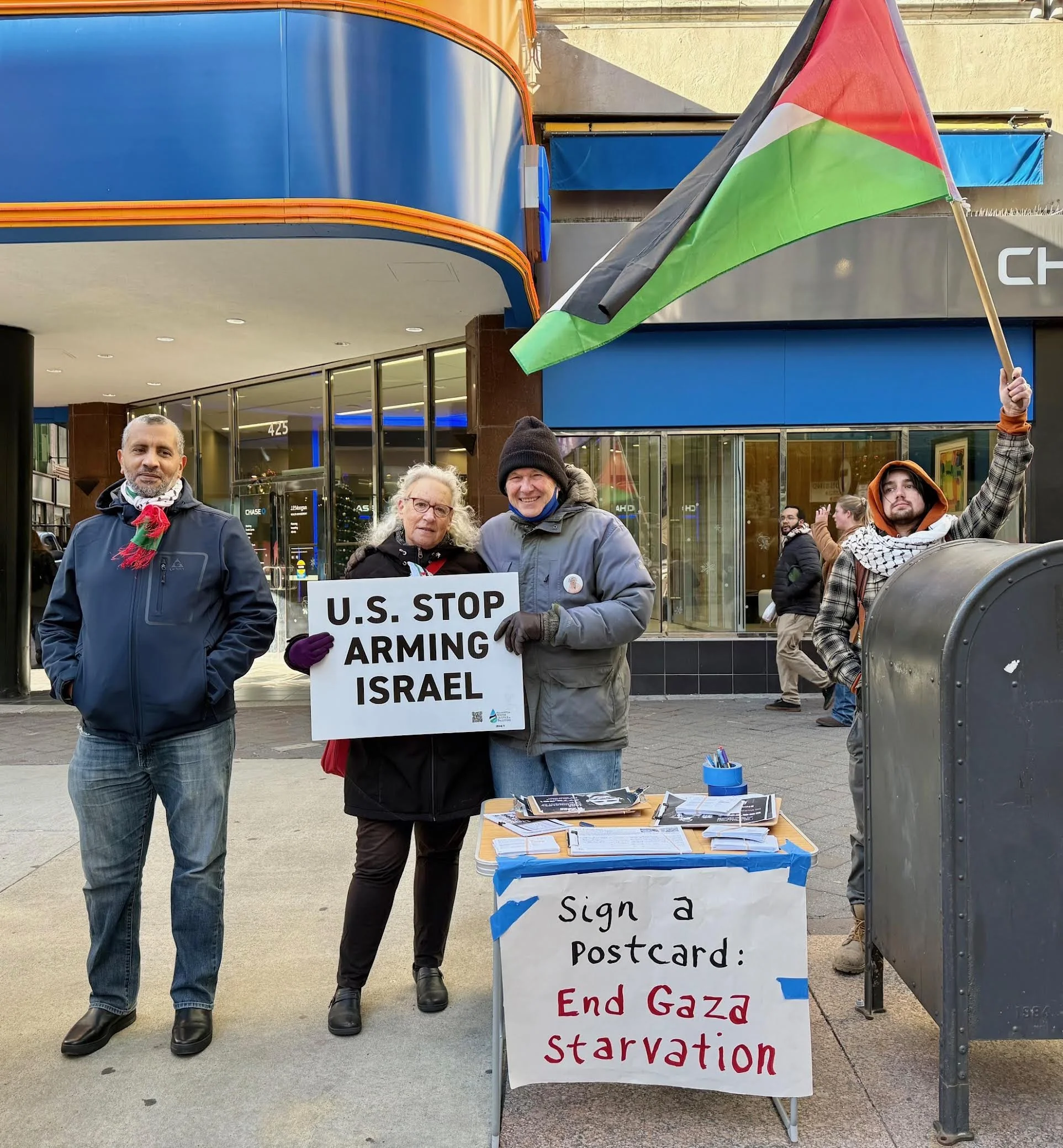
 P.S. November 29th is the International Day of Solidarity with the Palestinian People; here is one photo from our recent annual standout.

Gaza Humanitarian Response | Situation Report No. 40

As of 18:00 on 5 December 2025, unless otherwise noted

This report, issued daily from Monday to Saturday, outlines efforts and progress made by the UN and its partners to scale up humanitarian response across the Gaza Strip under the ceasefire that entered into effect on 10 October 2025. For all situation reports see here.

HIGHLIGHTS

  • Health service delivery in northern Gaza surged after the ceasefire, with the number of active health partners more than doubling, and consultations increasing more than tenfold, from 5,000 to 55,000 as of mid-November.

  • On 4 December, the WASH Cluster distributed 35,607 dignity and 2,208 hygiene kits in the North Gaza governorate, reaching approximately 45,000 people.

  • Three hundred essential cleaning supply kits were distributed to 93 learning spaces in Khan Younis, Deir al Balah and Gaza city to help mitigate the spread of communicable diseases. 

SITUATION OVERVIEW

Reports of airstrikes, shelling and gunfire continued across all governorates, with all incidents recorded east of the “Yellow Line”. On 5 December, OCHA helped the Palestinian Civil Defence coordinate the attempted rescue of an injured person in North Gaza’s Beit Lahiya area. The mission, initially requested at 17:00, could only proceed five hours later, when the Israeli forces approved the deployment, exclusively on foot, of a Civil Defence team to the incident location. Upon arrival, however, the team found the individual had already died. The incident reportedly occurred when a family comprised of a father, mother, and son went to their damaged home in Beit Lahiya to retrieve winter clothes; they were impacted by a shell near the “Yellow Line”, with the father – who was also a Civil Defence worker - succumbing to his injuries. 

The Site Management Cluster (SMC) currently records 942 active displacement sites, hosting nearly 1.5 million people. The vast majority, 783, are makeshift or scattered sites, accommodating more than 1.1 million people. Site Management partners are operational in 356 of these sites, about 38 per cent of the total, undertaking winterization and flood mitigation measures as possible, despite the extremely limited supply of construction materials that entered the Strip over the past two years. This leaves most of the population sheltering in displacement sites without dedicated Site Management support. The Cluster has started collecting data on these sites to assess flooding risks and needs; so far, 170 sites hosting over 191,000 people have been contacted. Of these, 141 reported flooding during recent rainfall, directly affecting 65,745 people. This information is currently being reviewed and will be shared with relevant partners to help inform potential support and targeted interventions.

In Gaza City, the garbage mountain of solid waste at Faras Market has now reached 13 metres with an arrival rate of one truck every three to five minutes. New spontaneous dump sites are also appearing, all of which include medical waste mixing. 

Only half of drinking water samples and 4 per cent of domestic samples meet standards and just 21 per cent of drinking water in health facilities is chlorinated. All partners operating wells, desalination units, or trucking have been requested to test water quality and inform communities. 

According to WASH Cluster surveillance, Acute Respiratory Infections (ARI) and Acute Watery Diarrhea (AWD) remain the most frequently reported conditions, accounting for an average morbidity of 60% and 39%, respectively. A rise in AWD morbidity has been observed among individuals aged ≥5 years, while a decline in ARI cases is noted.

UNITED NATIONS-COORDINATED AID ENTRY*

On 5 and 6 December, all Gaza’s crossings were closed for offloading. 

Collection of humanitarian cargo from the platforms into Gaza, however, proceeded. While no comprehensive information is available yet, at least 401 pallets of menstrual health management kits and 1,058 pallets of dignity kits, diapers, jerrycans and winter clothes were uplifted from Kerem Shalom for onward distribution to people in needed. 

The above data excludes bilateral donations and the commercial sector.  

Overall, out of 14 humanitarian movements submitted for coordination with the Israeli authorities on 5 and 6 December, seven were facilitated, three faced impediments and were only partially accomplished, two were denied outright, and two were cancelled by the organizers. Out of six aid cargo collection missions, four were facilitated by the Israeli forces, one was impeded, and one was cancelled due to lack of humanitarian cargo left for uplifting at Zikim. An attempt to undertake a reconnaissance mission of Salah ad-Deen Road on 5 December was only allowed for the first two kilometers; a new coordination request to cover the remaining section was denied on 6 December.  

HUMANITARIAN RESPONSE

Health

  • Health service delivery in the Gaza city and the North Gaza governorates has increased since the announcement of the ceasefire, with the number of active health partners nearly doubling from 16 to 30, and consultations increasing more than tenfold, from 5,000 before the ceasefire to 55,000 as of mid-November.

  • On 4 December, the Health Cluster conducted a mission to the North Gaza Governorate to assess health service points (HSP) requirements. Initial findings confirm a critical need for a primary health care centre and a field hospital in underserved areas, while the reactivation of the Kamal Adwan and Indonesian hospitals remains uncertain due to repeated mission denials and military operations in the area. The Health Cluster has identified three locations for the establishment of these HSPs and will work with partners to address community needs in the assessed areas.

  • Between 3 and 5 December, WHO delivered 10 anesthesia machines to partner hospitals and supported a new field hospital set up in Gaza city with essential emergency department equipment, including beds, monitors, and emergency trolleys.

  • Between 24 and 30 November, one new case of Guillain-Barré Syndrome (GBS) was reported in Gaza, bringing the total suspected cases registered since 1 June to 142, including 21 deaths. GBS is a rare autoimmune disorder where the body’s immune system attacks its own nerves, causing weakness, pain, and sometimes paralysis. In Gaza, the abnormal surge in cases is driven by overcrowding because of destruction and displacement and the collapse of water and sanitation systems, which increase the risk of infections that can trigger the syndrome.

Water, Sanitation and Hygiene

  • On 4 December, the Cluster distributed 35,607 dignity kits and 2,208 hygiene kits in the North Gaza governorate, reaching about 45,000 people.

  • Cluster partners installed 15 tap stands in the Al Satar area of Khan Younis, began repairs on Al Zarka well in Jabalya, continued water network repairs in Al Yarmouk and Shatia in Gaza city, and signed a new contract to repair two water wells, carry out maintenance and emergency repairs of 15 water networks, and ad-hoc flood mitigation activities. 

  • A 3000Kva electric generator has been installed in Beit Lahia Central water well which now has the capacity to provide 220 cubic meters of water per hour and serve 30,000 people in Beit Lahia city.

  • As part of winterization efforts, cluster partners are cleaning inlet grills at both the Sheikh Radwan stormwater pond and Al-Samer sewage pump station in Gaza city. At Sheikh Radwan, water levels have dropped to 1.4 metres, partially reducing the risk of flooding; operating hours have been decreased to match inflow and maintain a steady water level.

Protection

Child Protection

  • On 4 December, Child Protection (CP) partners distributed 2,000 clothing kits to children in need and supported 100 families of children with protection concerns with essential shelter items to help them cope with current conditions.

  • In the north, partners organized an orientation session for 35 frontline staff to strengthen their skills in child participation ahead of upcoming activities. 

Gender-Based Violence Prevention and Response

  • On 4 December, GBV partners provided psychosocial support to 150 people through individual consultations. In addition, awareness sessions on GBV, sexual exploitation and abuse prevention, sexual violence, and legal rights reached approximately 350 participants across the Strip, while specialized mental health support continued across Women and Girls Safe Spaces (WGSS).

  • On the same day, legal assistance, provided through individual consultations and group sessions, reached more than 60 people across the Strip, covering topics such as marriage, divorce, custody, guardianship, inheritance, and civil documentation.

  • On 5 December, a total of 400 women and girls received dignity kits and menstrual hygiene management (MHM) items through Women and Girls’ Safe Spaces (WGSSs) across the Strip, and an additional 3,000 dignity kits and MHM items were distributed to partners in northern Gaza to continue supporting vulnerable women and girls.

Education

  • On 4 December, partners distributed 300 essential cleaning supply kits to 93 learning spaces in Khan Younis, Deir al Balah, and Gaza city. These aim to promote better hygiene practices within the learning spaces and help reduce the risk of communicable disease outbreaks, particularly critical during the winter season.

  • On the same day, four High-Performance Tents (HPTs), each measuring 48 square meters, were installed in two schools east of Gaza city to expand in-person learning spaces and accommodate increased student enrollment. 


* All figures solely refer to UN and partner assistance dispatched through the UN-coordinated system. They are preliminary and will be reconciled in the course of the ceasefire. Supplies entering through bilateral donations and the commercial sector are not reflected.