U.S. Envoys Refused to Report "Apocalyptic" Conditions in Gaza. Exclusive Photos...
The U.S. embassy in Jerusalem suppressed a February 2024 report on northern Gaza because it “lacked balance.” These photos from the UN fact finding trip are visual evidence of the conditions.
FEB 02, 2026
In February 2024, just over three months into Israel’s war on Gaza, U.S. ambassador to Israel, Jack Lew, and his deputy, Stephanie Hallett, blocked an internal cable intended for wider distribution among senior officials in the Biden administration that warned northern Gaza had turned into an “apocalyptic wasteland,” according to Reuters. Lew and Hallett reportedly blocked the cable, which described the consequences of Israel’s assault in harrowing detail, because they believed it lacked balance.
The cable was drafted by U.S. Agency for International Development staffers and was based on a two-part humanitarian fact-finding mission by a small United Nations team that visited the area on January 31 and February 1, 2024.
I was part of that mission.
Northern Gaza had been under a total siege for over three months when we were eventually allowed to enter in January 2024. We moved through Gaza City, Beit Lahia, Jabaliya, and Beit Hanoun.
What we found was an endless horizon of destruction. People were living under plastic sheeting or in the rubble of buildings. Schools had been destroyed. In parts of Beit Hanoun, the entire area had been depopulated and decimated. There was a deadly shortage of clean drinking water, food and access to healthcare.
Mass starvation had already set in. Everyone we spoke to asked us for food. People gestured to us in the street for something to eat. Israeli authorities continued to deny the entry of any supplies despite our warnings of the deadly conditions.
We found bodies of people that had been killed for getting too close to Israeli checkpoints. Their remains were being eaten by cats and dogs. On a wall that was still standing in someone’s destroyed home we found the word “Revenge” graffitied in Hebrew, with the date of October 7, 2023, written below.
The purpose of a fact finding mission like this one is to report back on the humanitarian situation on the ground. The goal is to accurately reflect reality, not political balance. The images I captured during that trip are raw evidence of the conditions in northern Gaza at that time. Some, depicting bodies that were left to decompose in open air, are too gruesome to show. A selection is being published here for the first time. Many of these scenes had already been captured by Palestinian journalists, but they too had been dismissed as biased.
Almost exactly two years later to the day, the situation has been made far worse. The Israeli assault has destroyed, flattened and emptied northern Gaza even more—the UN estimates that over 81% of all buildings in the Gaza Strip have been destroyed or damaged. Much of the little that is depicted here is now gone.
Go here to see the exclusive photos that show “the reality they suppressed”.
Thwarted tree-planting underscores daily torments for embattled Palestinian hamlet
Villagers in West Bank’s Umm al-Khair say security forces quick to stymie Tu Bishvat coexistence event or new soccer pitch, but take their time when it comes to stopping settler harassment
UMM AL-KHAIR, West Bank – The ramshackle Palestinian hamlet of Umm al-Khair, located in the South Hebron Hills region of the West Bank, is no stranger to hardship and adversity.
Since October, the village has had demolition orders hanging over more than a dozen of its structures. In July, peace activist Awdah Hathaleen, one of the village’s most prominent residents, was shot dead, allegedly by an extremist Jewish settler from the area.
On Monday, the hamlet was once again the scene of strife as the army and police thwarted a planned tree-planting event there organized by Israeli coexistence activists, illustrating what villagers say are ever-growing challenges imposed by their settler neighbors and Israel’s security services that threaten their daily existence beyond the tragedies and large-scale tribulations that usually grab headlines.
These day-to-day difficulties include perpetual harassment and intimidation inside the hardscrabble village, struggles to maintain their agricultural livelihood, and even efforts aimed at stopping them from giving their children a place to play soccer.
“We are upset all the time here,” Khalil Hathaleen, the brother of the slain activist, told The Times of Israel on Monday, complaining of persistent harassment by settlers and security services whenever he takes his sheep and goats out to graze. “They don’t give the kids one minute to be happy. They make life very difficult for everyone.”
The tree-planting activity was organized by Rabbis for Human Rights to mark the Jewish holiday of Tu Bishvat, which celebrates the new year for trees and is a day on which tree-planting ceremonies are traditionally conducted in Israel.
READ THE ENTIRE ARTICLE HERE.
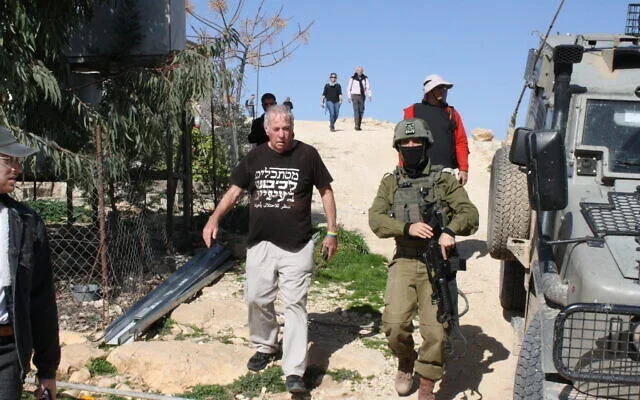
An IDF officer comes to inform coexistence activists that they have to leave the Palestinian hamlet of Umm al-Khair in the West Bank where they went to plant olive trees on February 2, 2026 (Jeremy Sharon/Times of Israel)