BY UNIVERSITY OF CAMBRIDGE
JANUARY 6, 2026
Gaza’s children are losing not just school, but hope, identity, and belief in a future worth reaching.
After more than two years of fighting, many Palestinian children in Gaza are physically exhausted, emotionally traumatized, and unable to take part in everyday activities like learning or playing, according to a new report. The study warns that some children now believe they will be “killed for being Gazans.” Led by the University of Cambridge, the research also presents the first detailed assessment of education in the West Bank and East Jerusalem since October 7, 2023.
Researchers say international funding for education across Palestine is urgently needed, regardless of whether the current ceasefire in Gaza continues. In Gaza, the report finds that ongoing conflict has nearly wiped out children’s access to education and, with it, a key source of identity and stability.
Childhood Disrupted by Hunger and Trauma
Building on a similar study released in 2024, the report documents how war has reshaped nearly every aspect of children’s lives in Gaza. Schools have been destroyed or closed, while violence, hunger, and psychological trauma have eliminated any sense of a normal childhood.
Children described in the study are so depleted that some collapse from exhaustion. Others are told not to play so they can conserve what little energy they have. Before the recent ceasefire, many parents and teachers faced impossible decisions between helping children survive and keeping them in school. Some families were living on as little as a bowl of lentils a day.
Loss of Hope and Faith in the Future
One of the report’s most troubling findings is the erosion of young people’s optimism and trust in global institutions. Witnesses told researchers that children are increasingly angry and losing belief in ideas like peace and human rights. “Students are asking about the reality of those rights. They feel they are killed just for being Gazans,” an international organisation staff member said.
Professor Pauline Rose, Director of the Research for Equitable Access and Learning (REAL) Centre at the University of Cambridge, warned that conditions have sharply worsened. “A year ago we said education was under attack – now children’s lives are on the brink of a complete breakdown,” she said.
Rose added that while Palestinians have shown a strong commitment to education during the war, the growing sense of despair among young people should alarm the international community. “We must do more to support them. We cannot wait.”
A Risk of a Lost Generation
The study was carried out by researchers from the REAL Centre and the Centre for Lebanese Studies, working with the United Nations Relief and Works Agency for Palestinian Refugees (UNRWA). It draws on information from UN agencies, charities, and NGOs, as well as interviews with aid workers, officials, teachers, and students.
The authors warn that Gaza faces a serious risk of a “lost” generation due to the combined effects of disrupted education, physical harm, and psychological trauma.
As of 1 October 2025, the UN Office of Coordination of Humanitarian Affairs (OCHA)reported that 18,069 students and 780 education staff had been killed in Gaza, with 26,391 students and 3,211 teachers injured. Save the Children estimates that during the fighting, 15 children suffered life-altering injuries every day.
Teachers interviewed for the study described widespread despair. Some parents asked, “Why should I care about education for my kids if I know they will die from famine?” Focus groups found that children were “afraid of everything,” while another report cited in the study said many felt “like the living dead.”
Years of Learning Already Lost
Researchers estimate that children in Gaza have already missed the equivalent of five full years of education because of repeated school closures since 2020, first due to COVID-19 and later because of war. Although UNRWA and the Palestinian Ministry of Education introduced temporary and remote learning programs, ongoing violence, damaged buildings, and shortages of basic resources have severely limited their reach.
These estimates account for the added impact of trauma and starvation, drawing on established research showing how both interfere with learning. By October 2025, nearly 13,000 children in Gaza had been treated for acute malnutrition, and 147 of them had died.
If schools remain closed until September 2027, the authors calculate that many teenagers could fall as much as ten years behind their expected level of education.
West Bank and East Jerusalem Also Affected
The situation outside Gaza is also severe. In the West Bank, including East Jerusalem, 891 students and 28 teachers have been killed or injured by settlers or Israeli forces since October 2023, and hundreds more have been arrested, often for reasons the UN Human Rights Office describes as “arbitrary.” Schools in these areas have faced repeated disruptions, temporary closures, or permanent shutdowns. Children there are estimated to have lost at least 2.5 years of schooling.
Across Palestine, teachers described their profession as deeply demoralized and stretched to a breaking point. One international organisation staff member said educators were “working day and night” to provide any form of learning, with many not taking a single day off in two years.
The Cost of Rebuilding Education
The report estimates that restoring education across Palestine would cost about US$1.38 billion. Yusuf Sayed, Professor of Education at the University of Cambridge, said teachers and counselors continue to show sumood (steadfastness) and dedication to protecting Palestinian identity through education, but warned that the needs are overwhelming. Thousands of additional teachers will be required to replace those lost and to support a full recovery. He stressed that investing in educators is essential to rebuilding the system.
With Gaza’s economy nearly at a standstill, education is expected to rely on foreign aid for the foreseeable future. However, the study points to growing “donor fatigue.” Of the US$230.3 million requested by OCHA for education in 2025, only 5.7% had been received by July, amounting to roughly US$9 per child. Full reconstruction is estimated to require about US$1,155 per person.
Dr. Maha Shuayb, Director of the Centre for Lebanese Studies, emphasized that education must not be sidelined. “Education and children’s services cannot be an afterthought. They are a vital source of stability and care,” she said.
Signs of Hope Amid the Crisis
Despite the bleak findings, the report notes some encouraging developments. During the ceasefire in early 2025, schools reopened quickly, and Tawjihi exams for high school graduates resumed. One teacher described the return of exams and classrooms as “a miracle.”
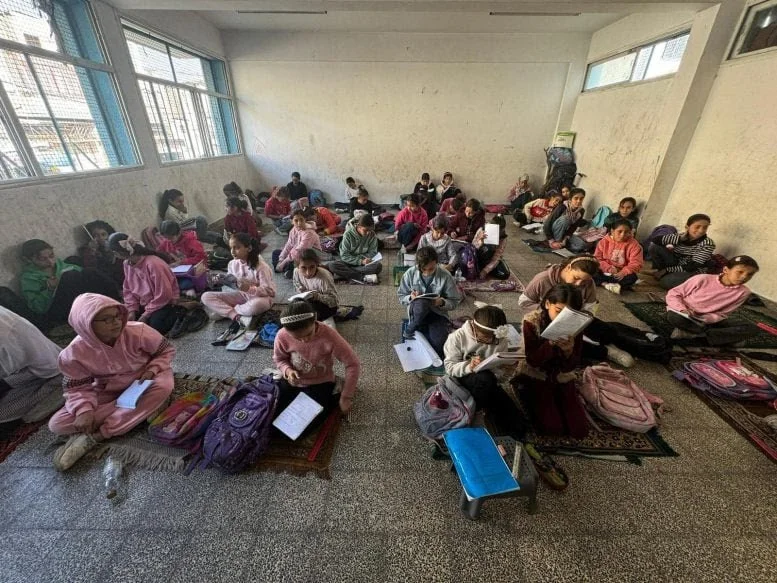
Photograph of students in a UNRWA temporary school in Gaza, 2025. Credit: UNRWA
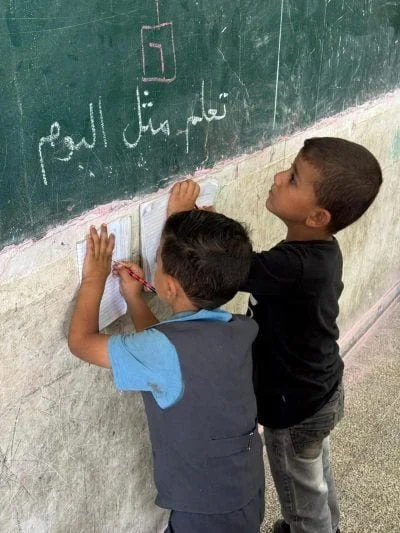
Students in a UNRWA temporary school, Gaza 2025. Credit: UNRWA photo