
Ecocide: what Israel's war has done to Gaza's already precarious water supply...

As War Halts, the Environmental Devastation in Gaza Runs Deep

The war in Gaza has taken a heavy toll on the environment, with water supplies contaminated, raw sewage pouring into the Mediterranean, once-fertile soils ruined, and the land stripped of trees. Experts say the extent of the damage needs to be tallied to help plan for a recovery.

BY FRED PEARCE FEBRUARY 6, 2025

The natural environment took an unprecedented pounding during the war in Gaza. And as the territory’s inhabitants have returned home since the ceasefire, the extent of the environmental devastation is becoming clear, raising crucial questions about how to reconstruct Gaza in the face of severe and potentially irreversible damage to the environment.

The war has knocked out water supplies and disabled sewage treatment facilities, causing raw effluent to flow across the land, polluting the Mediterranean and underground water reserves essential for irrigating crops. More than two-thirds of Gaza’s farmland, including wells and greenhouses, has been damaged or destroyed by bombardment and military earthworks.

Detailed satellite images taken since the ceasefire began on January 19 show 80 percent of Gaza’s trees lost. In addition, vital wetlands, sand dunes, coastal waters, and the only significant river, the Wadi Gaza, have all suffered extensively. The UN Environment Programme warns that the stripping of trees, shrubs, and crops has so badly damaged the soils of the once-fertile, biodiverse, and well-watered territory that it faces long-term desertification.

Read the entire article here.
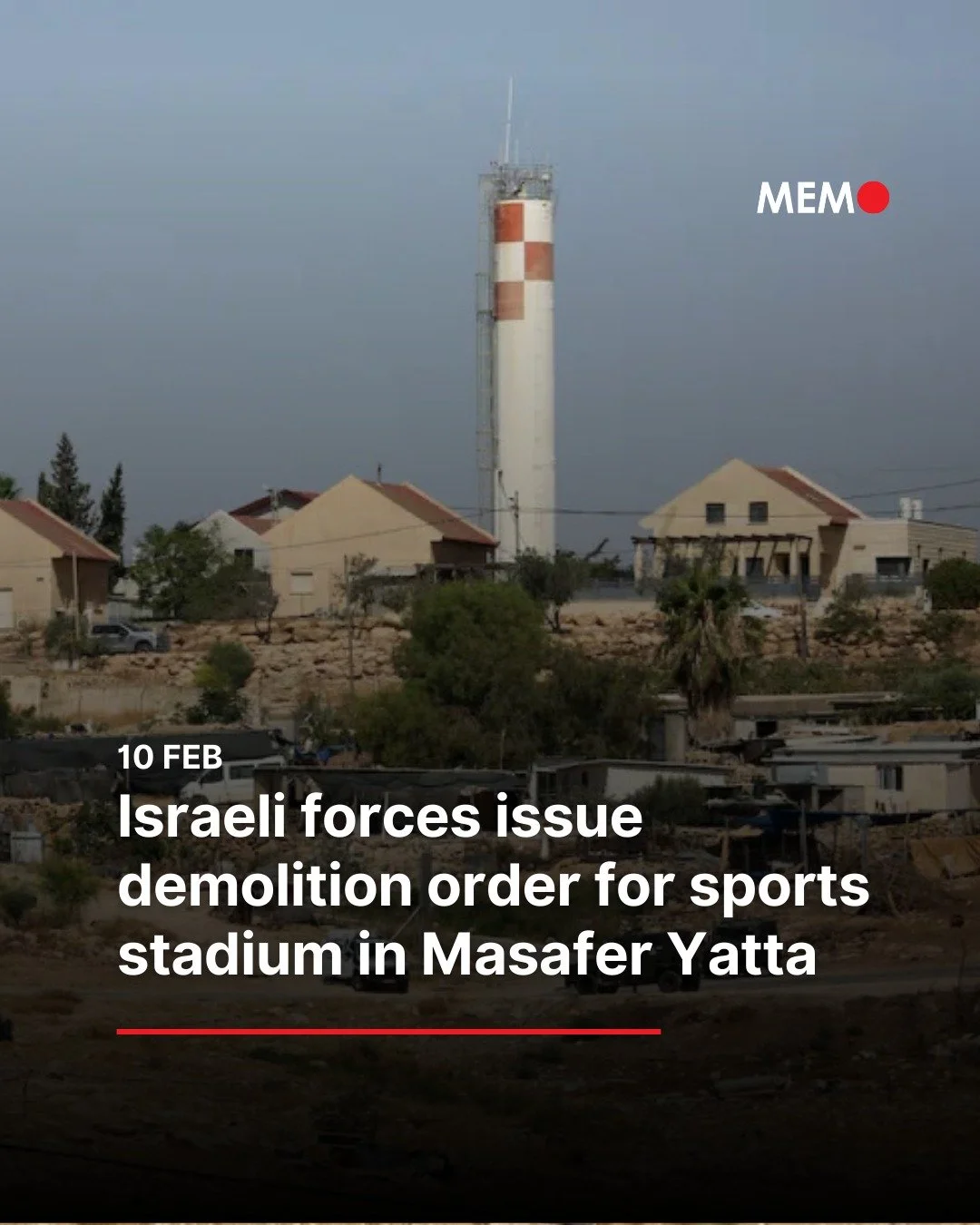
Feb 10. Israeli forces issue demolition order for sports stadium in Masafer Yatta


Middle East Monitor 

Israeli occupation forces have issued a demolition order for the Umm al-Khair stadium in Masafer Yatta, south of Hebron in the occupied West Bank, following what local sources described as a campaign of settler incitement.

According to residents, the order was delivered on Tuesday for the sports field, which serves as a key recreational space for children in the village. The stadium was inaugurated around two years ago with foreign funding as part of projects aimed at supporting communities in Masafer Yatta.

Read: https://www.middleeastmonitor.com/20260211-israeli.../

Israel cancels Jordanian law banning sale of West Bank land to Jews in new decisions

Middle East Monitor 

Feb 8

Israel’s security cabinet on Sunday approved a series of new decisions on the occupied West Bank, proposed by Finance Minister Bezalel Smotrich and Defence Minister Israel Katz. The measures introduce major changes to how land, planning and construction are managed in occupied the territory.

According to an official statement issued after the meeting, the decisions aim to remove long-standing obstacles in order to speed up the development and expansion of settlements, as described by the Israeli government. The package includes cancelling a Jordanian-era law that banned the sale of property in the West Bank to Jews, a move the government said would open the way for land purchases.

Read: https://www.middleeastmonitor.com/20260209-israel.../

PENTAGON MAKES LARGEST KNOWN ARMS PURCHASE FROM ISRAEL — FOR CLUSTER WEAPONS

The no-bid deal for arms internationally banned for high civilian death tolls is the biggest purchase from Israel in available government records.

Dan Glaun

February 6 2026, 5:07 a.m.

THE DEPARTMENT OF DEFENSE has quietly signed a $210 million deal to buy advanced cluster shells from one of Israel’s state-owned arms companies, marking unusually large new commitments to a class of weapons and an Israeli defense establishment both widely condemned for their indiscriminate killing of civilians.

The deal, signed in September and not previously reported, is the department’s largest contract to purchase weapons from an Israeli company in available records, according to an online federal database that covers the last 18 years. In a reversal of the more commonly seendirection for weapons transfers between the countries — in which the U.S. sends its weapons to Israel — the U.S. will pay the Israeli weapons firm Tomer over a period of three years to produce a new 155mm munition. The shells are designed to replace decades-old and often defective cluster shells that left live explosives scattered across Vietnam, Laos, Iraq, and other nations.

The terror of cluster weapons persists long after the guns that fired them have quieted, as civilians return to fields, forests, and settlements laced with bomblets that can explode years later without warning.

Read the entire Intercept article here.