A Song for Palestine--please share widely

We Stand With Palestine. Please share our song with the world. 

Greetings Palestinian Campaign Family!

With the ongoing destruction and genocide in Gaza and the West Bank, we cannot ignore the devastation that has unfolded for almost 80 years and continues to this day.

As an independent music producer working with a small team, I know I am only ONE voice. But history reminds us that it often takes just ONE voice to inspire many.

That is why I am asking for your help!

I hope this song moves you to share it across every network, affiliate, social media platform, podcast, and media outlet willing to listen. I hope it reaches those with the courage to stand up for the rights, dignity, and freedoms of the Palestinian people.

Our goal is to honor and inspire the brave individuals who continue to defend the people of Palestine. One day, their suffering will end. One day, Palestinians will have their own state and the opportunity to rebuild their lives for future generations.

This song is a tribute to their history, their suffering, their resilience and hope for a better tomorrow. As you listen, I hope it compels you to take action by helping share this message with the world.

Let is be our battle cry in ending the genocide in GAZA!

With Kindest Regards,

Dreamlake Media / Dreamlake Films

Apple Music: https://music.apple.com/us/album/one-day-well-rise-a-song-for-palestine-feat-stella-d-single/1873742837

Spotify: https://open.spotify.com/album/30BzUQ5YZxAq7xR510k5bR

YouTube Music: https://youtu.be/73SrFpgiqTQ?si=-NVdUE4B9P4SBEky
Inside a Coordinated, Multi-Village Settler-Soldier Program in the West Bank

“While unusual in scale and severity, this assault on Masafer Yatta is not unique. Even on the night preceding the attack, settlers raided Wadi Al-Rakhim, cutting down approximately 500 olive trees belonging to the Rumi family and spray-painting slogans describing the act as “revenge” for Karm Susya — a settler vineyard planted on land belonging to the Nawajah family. After years of legal proceedings, a court ruling had ordered the vineyard’s removal on the grounds that it had been established illegally.

The role of Israeli soldiers in Tuesday night’s highly coordinated assault was unmistakable. Throughout the evening, they established flying checkpoints, prevented residents from reaching the villages, blocked ambulances, and allowed settlers to carry out attacks and large-scale theft without interference — while arresting Palestinian victims without cause. In at least one instance, soldiers themselves took part in the beatings.”

Read the article here.

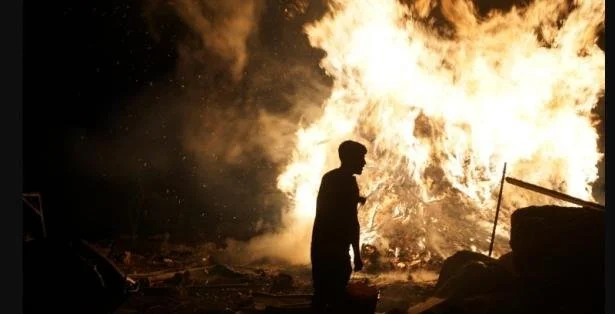
An activist helps extinguish a fire set during a settler acct in Al-Tuban, Masafer Yatta, occupied West Bank, January 27, 2026. | Photo: Roni Amir / +972 Magazine

The Street that Refuses to Die

This piece is part of A Day for Gaza, an initiative in which The Nation has turned over its website exclusively to voices from the Gaza Strip. You can find all of the work in the series here.

an excerpt:

“They want a land without people”

On the sidewalk sat Mohammad Mansour, 74, wrapped in a wool scarf despite the heat.

“Since the Balfour Declaration in 1917,” he began, “we’ve been living this occupation. They want a land without people. This genocide is their way of finishing the project.”

He listed what was destroyed: homes, schools, mosques. “They even turned it into a war on faith,” he said.

Before the war, $30 could fill his pantry. During the genocide, one kilo of onions cost $100. “Now prices go up and down like bombs,” he said.

He spoke of two people he’ll never forget: young Aref Abu Laban, who was killed while helping his mother pick lemons, and his old friend Mohammad al-Saidi, who had dreamed up the Colorful Block project that once made these walls bright. “He believed color could defeat despair,” Mansour said. “Now the walls are gray again, but the dream is still alive in my heart.”

“We live as if the war never stopped.”

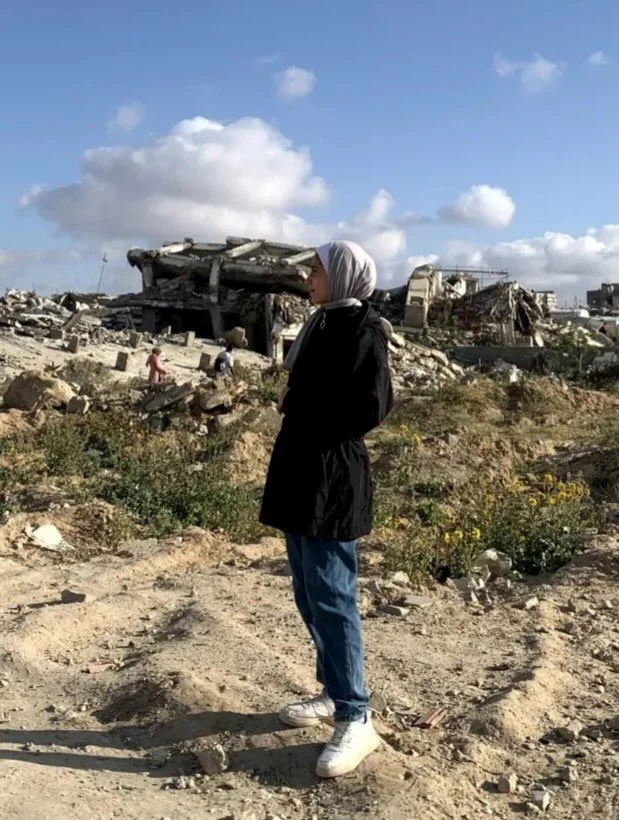
I met Dunya Ashour, 19, when she was taking some photos of the destruction of the New Ajjami Mosque.

“I don’t feel the ceasefire,” she told me. “At night I still wake up to explosions two kilometers away, in the yellow zones. I can smell the gunpowder in the air.”

She lost her favorite teacher, Arij al-Maydana, as well as her grandfather, Jameel. “I carry their loss every day,” she said, “but I tell myself they’re in a better place.”

Dunya Ashour, 19.(Courtesy of Dunya Ashour)