Via Norman Finkelstein. Feb 18



Indian Writer Arundhati Roy Pulls Out of Berlinale Over Wim Wenders’ Comments on Gaza
The Booker Prize-winning author said Wenders' comments, that filmmakers "have to stay out of politics," were "jaw-dropping" and "a way of shutting down a conversation about a crime against humanity even as it unfolds before us in real time."
BY SCOTT ROXBOROUGH
Plus Icon. FEBRUARY 13, 2026 8:56AM
So much for keeping politics out of the Berlinale.
Acclaimed Indian author Arundhati Roy (The God of Small Things) has pulled out of the Berlin Film Festival in response to comments by Berlinale jury president Wim Wenders that “art should not be political.”
The German director made the comments at the jury press conference on Thursday, in response to a question about the ongoing conflict in Gaza and the military support the German government, the festival’s main backer, has given Israel.
“We have to stay out of politics because if we make movies that are dedicatedly political, we enter the field of politics,” Wenders said, arguing that filmmakers should be “the counterweight of politics, we are the opposite of politics. We have to do the work of people, not the work of politicians.”
Roy does not agree.
“To hear them say that art should not be political is jaw-dropping,” said Roy in a statement announcing she would be exiting the Berlinale jury. “It is a way of shutting down a conversation about a crime against humanity even as it unfolds before us in real time – when artists, writers and film makers should be doing everything in their power to stop it.”
She added: “I am shocked and disgusted.”
The Booker Prize-winning author was due to attend Berlin to present Pradip Krishen’s 1989 campus comedy In Which Annie Give It Those Ones, for which Roy wrote the screenplay, as part of the festival’s Classics section.
In the statement, first provided to Indian publicationThe Wire and verified by The Hollywood Reporter, Roy described the situation in Gaza “a genocide of the Palestinian people by the State of Israel. It is supported and funded by the governments of the United States and Germany, as well as several other countries in Europe, which makes them complicit in the crime.”
If artists and filmmakers do not take a political stance on the issue, Roy added “They should know that history will judge them.”
Wenders wasn’t alone in trying to dodge tricky political questions at this year’s Berlinale.
Neil Patrick Harris, in town with Generation title Sunny Dancer, directed by George Jaques and co-starring Bella Ramsey, faced a barrage of questions at the film’s presser on U.S. democracy. Harris also tried to take a neutral stance.
“While I have my own political opinions, I think as a performer, especially in this kind of movie, [I’m] trying to be as inclusive [as possible.]” he said. “I never read this script as a political statement. It was much more about a human growing up and having realizations about themselves, singularly and [about] friendship.”
The Berlinale used to pride itself on being the most political of the big film festivals, a tradition that dates back to its role as an event bridging East and West during the Cold War. But the Israel-Gaza war has disrupted the festival’s image of itself. The Oct. 7, 2023 Hamas terror attacks on southern Israel, which killed 1,200 and resulted in the taking of 251 hostages, and Israeli subsequent military campaign, which killed more than 70,000 in Gaza, has divided opinion across Europe and the globe.
In 2024, there were calls for a boycott of the Berlinale for refusing to publicly denounce of Israel’s military campaign. Several Arab filmmakers said they would not submit films to the festival. That year’s award ceremony was turned into a public debate over Gaza, when Palestinian-Israeli documentaryNo Other Land, which focuses on Israeli settler violence against Palestinians in the West Bank, won the 2024 Berlinale Documentary Award, and Israeli co-director Yuval Abraham used his acceptance speech to accuse his country of apartheid. That sparked a backlash in Germany, with some prominent conservative politicians calling for the Berlinale to be defunded.
Roy’s statement announcing her withdrawal was first given to Indian publication The Wire and verified by The Hollywood Reporter. THR has asked the Berlinale for comment.
Roy’s statement is below:
In Which Annie Gives It Those Ones, a whimsical film that I wrote 38 years ago, was selected to be screened under the Classics section at the Berlinale 2026. There was something sweet and wonderful about this for me.
Although I have been profoundly disturbed by the positions taken by the German government and various German cultural institutions on Palestine, I have always received political solidarity when I have spoken to German audiences about my views on the genocide in Gaza. This is what made it possible for me to think of attending the screening of Annie at the Berlinale.
This morning, like millions of people across the world, I heard the unconscionable statements made by members of the jury of the Berlin film festival when they were asked to comment about the genocide in Gaza. To hear them say that art should not be political is jaw-dropping. It is a way of shutting down a conversation about a crime against humanity even as it unfolds before us in real time – when artists, writers and film makers should be doing everything in their power to stop it.
Let me say this clearly: what has happened in Gaza, what continues to happen, is a genocide of the Palestinian people by the State of Israel. It is supported and funded by the governments of the United States and Germany, as well as several other countries in Europe, which makes them complicit in the crime.
If the greatest film makers and artists of our time cannot stand up and say so, they should know that history will judge them. I am shocked and disgusted.
With deep regret, I must say that I will not be attending the Berlinale.
Arundhati Roy
The Disappearance of Palestine
Feb 17, 2026 by John Ferrer/Foreign Policy in Focus
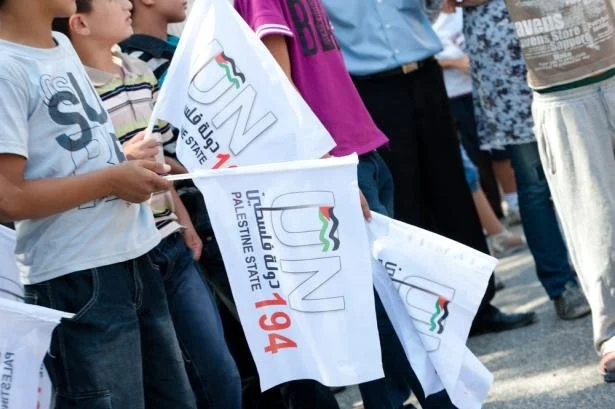
By some measures, the Palestinian bid for statehood has never been stronger.
By the end of last year, at least 157 countries had recognized the state of Palestine, which represents slightly more than 80 percent of the world’s nations. Some of those countries are quite powerful, such as China, India, Indonesia, the UK, France, Australia, and Russia. Palestine is a member of the International Criminal Court, UNESCO, the Group of 77. A Palestinian delegation has competed in every summer Olympics since 1996.
The Palestinian Authority, which functions as the closest thing to an internationally recognized government, has even prepared a draft constitutionthat would, if it passes a referendum, formally transform Palestinian lands into a state.
Read the entire article here.
Shutterstock
Apple buys Israeli ‘pre-speech’ tech firm implicated in Gaza genocide
By ¡Do Not Panic!
FEB 16
Tech giant Apple has quietly paid nearly $2 billion for a “pre-speech” tech company whose employees helped Israel commit genocide in Gaza.
In the second-biggest deal in its history, Apple paid this money for a company that doesn’t have a product, doesn’t have any revenues and whose website is a single page containing 15 words.
The company, Q.ai, is developing sensors which map the imperceptible movements of a human face to determine the words someone is thinking before they’re spoken. They call it “silent speech,” or “pre-speech” — and it appears to be exactly as sinister as it sounds.
Q.ai was founded by Aviad Maizels, Avi Barliya and Yonatan Wexler, all of whom honed their skills by testing technologies of apartheid on Palestinians. Maizels is a former commander of Unit 81, the IDF division which builds Israel’s offensive cyber weapons. Barliya, according to his LinkedIn, was an intelligence officer in the Israeli air force, while Wexler is a former Unit 8200 agent.
Apple’s genocide intake
In a blog post announcing the deal, Tom Hulme, an executive at Google Ventures, one of the company’s early investors, revealed that 30% of Q.ai’s more than 100 staff were called up to participate in the genocide of Gaza.
This admission means dozens of people implicated in genocidal acts who served under the political command of Yoav Gallant, an ICC indicted war criminal, are now Apple employees.
It should be a huge scandal. The biggest company in the US, one of the world’s most recognizable names, has folded into its staff dozens of people who served in a military during the period it committed genocide, according to all of the world’s most acclaimed rights experts.
But every single mainstream article which covered news of the deal, from Reuters to FT, ignored this fact. Mainstream coverage also ignored a number of other extremely cogent elements to the story, including the nature of the deal and the technology itself.
Apple has paid two billion dollars for something that barely appears to exist.
Q.ai’s website consists of just 15 words. To find out exactly what the company does you have to look beyond the press releases to the patents Q.ai and its founders have filed.
And these patents read like plot lines from the bleakest dystopian futures.
Sensing silent speech
One filing details technology capable of “determining an emotional state of an individual based on facial skin micromovements.” The same filing says the technology could be used “to identify a user based on heart-rate and breathing-rate.” Another filing says Q.ai’s software “synthesizes speech in response to words articulated silently by the test subject.”
Q.ai’s technology centers around “silent speech.”
This is the idea that before we vocalize words and move our mouths to emit sounds, our brain has already sent signals to muscles in our throat and face determining what we’re going to say. Q.ai claims to have invented infrared sensors that can pick up these pre-speech micro-movements.
One filing talks about a “sensing device configured to fit an ear of a user, with an optical sensing head which senses light reflected from the face and outputs a signal in response. Processing circuitry processes the signal to generate a speech output.”
Tech bloggers have suggested Apple has bought the company to enable non-verbal control of an iPhone and other devices via its airpod earphones or smart glasses. An annotated diagram included with the patent shows a person wearing glasses and an earpiece integrated with the technology.
Indeed, Apple is no stranger to adopting the technologies of Israeli apartheid, and in fact the company is extremely familiar with Maizels himself.
In 2013, Apple bought Maizels’s first company, PrimeSense, a developer of 3D sensing technology. PrimeSense technology went on to become the foundation for Apple’s Face ID system on its newer iPhone and iPad models.
Nonetheless, two billion dollars for a non-existent technology and a three-year old company, is unprecedented. What isn’t unprecedented, however, is a US tech giant overpaying for an Israeli company.
Overpriced Israeli tech
Last year, Google bought Israeli cybersecurity Wiz for $32 billion, which, at 64 times Wiz’s annual sales, was widely seen as an inflated price and far in excess of the sales-to-valuation ratio for similar companies.
At this price, however, Israel received a huge $5 billion tax windfall. At the time, Zionists crowed it would help the country buy more warplanes and missiles to commit genocide.
The deal for Q.ai, while a lot smaller, will still generate significant tax income for Israel’s struggling economy.
And Israel is critical to Apple.
The company has a large R&D campus in the country, its second-biggest outside the US, into which large numbers of Unit 8200 and Unit 81 graduates are funneled. Apple CEO Tim Cook is a devoted Zionist, has visited Israel on numerous occasions, and in 2018 received an award from Zionist lobby group the ADL for his efforts to censor anti-Israel speech. Apple has made good on that promise over the last two years, sacking staff for expressing pro-Palestine, anti-genocide views. Cook has never spoken about Gaza.
The price for a ghost company with a few patents, then, looks as much about politics as it does about technology.
That’s not to say Q.ai’s technology won’t be commercialized for consumer applications. It probably will be. And if the tech is realized, the implications for privacy and data collection are frightening.
As are the security state and military applications.
A pre-crime future
A few days after the Q.ai deal, the head of neurotechnology at Israel’s directorate of defense research and development, the country’s equivalent to the US’s DARPA program, gave her first-ever interview to Israeli media. In the interview she referenced Q.ai and said the Israeli military is working on similar technology. The US has a DARPA project known as Silent Talk which is also working to develop pre-speech sensing and non-verbal control technologies.
Once the technology is developed, and pre-speech established as a legitimate biological human function, how far behind will pre-crime be?
Given the frenzied efforts we’ve seen to shut down and criminalize criticism of Israel under the guise of antisemitism, one can easily imagine a future of pre-speech sensing technology being rolled out to identify would-be critics of Israel. Or the US. Or Europe. Or imperialism in general.
One can imagine it now: “Based on our silent speech detector we have determined you were going to say something hateful or antisemitic or un-American and are therefore under arrest.”
The most dystopian technologies continue to flow out of Israel. And they continue to flow because Israel is empowered by the US and Europe to maintain a system of apartheid built upon invasive and authoritarian technologies of control.
It is therefore no surprise that the creators of Q.ai are veterans of Israel’s genocidal military security state, or that the largest company in the US sees these technologies as essential to its AI future.
Consider making a donation here to support ¡Do Not Panic!
This Substack is reader-supported. To receive new posts and support my work, consider becoming a free or paid subscriber.