How settler outposts are seizing new regions of the West Bank

By Oren Ziv and Ariel Caine March 24, 2026

In partnership with LOCAL CALL

In May 2023, the Palestinian Bedouin community of Ein Samia, located east of Ramallah, fled their village. Facing mounting pressure and harassment from nearby Israeli settlers, who enjoyed significant military support, dozens of families dismantled their homes and left. It was one of the first instances in which an entire Palestinian community in the West Bank had been completely uprooted since 1967 — and it was a harbinger of what was to follow.

leven of those families relocated a short distance away to Al-Khalail, a rural area on the outskirts of the village of Al-Mughayyir. The site lies in Area B of the occupied territory — the zone, under the Oslo Accords, where the Palestinian Authority (PA) has jurisdiction over civil affairs but must coordinate security with Israel. It offers Palestinians more autonomy than Area C, which is under full Israeli control and has been the site of almost all settlement expansion, but less than Area A, which is under full PA control. By moving from Area C into Area B, the displaced residents of Ein Samia thought they would find relative safety.

In Al-Khalail, the families rebuilt their lives. They erected tin houses and animal pens, installed solar panels and water tanks, and resumed herding their animals. 

“We are refugees from the Naqab,” explained 85-year-old Muhammad Ka’abneh, referring to the desert in southern Israel. “We moved several times until, in the 1980s, the army ordered us to move to Ein Samia. We lived there until the settlers and the army expelled us three years ago. We came here [to Al-Khalail] because we knew it was Area B and that it was safe.”

For a time, residents said, the area was quiet. Then in 2024, on the hill facing their encampment, a group of settlers established a new herding outpost called Shlisha Farm. (Outposts are mini-settlements established without prior state authorization that serve as strategic beachheads for settlers to expand into the West Bank.)

The settlers began grazing their flocks on land surrounding the community, damaging olive trees and crops, entering the encampment, and threatening families. They did this with the backing of the military. “They just make a phone call, and the army comes,” Ka’abneh said of the settlers. “The soldiers protect them.”

Read the rest of the article via +972 here.
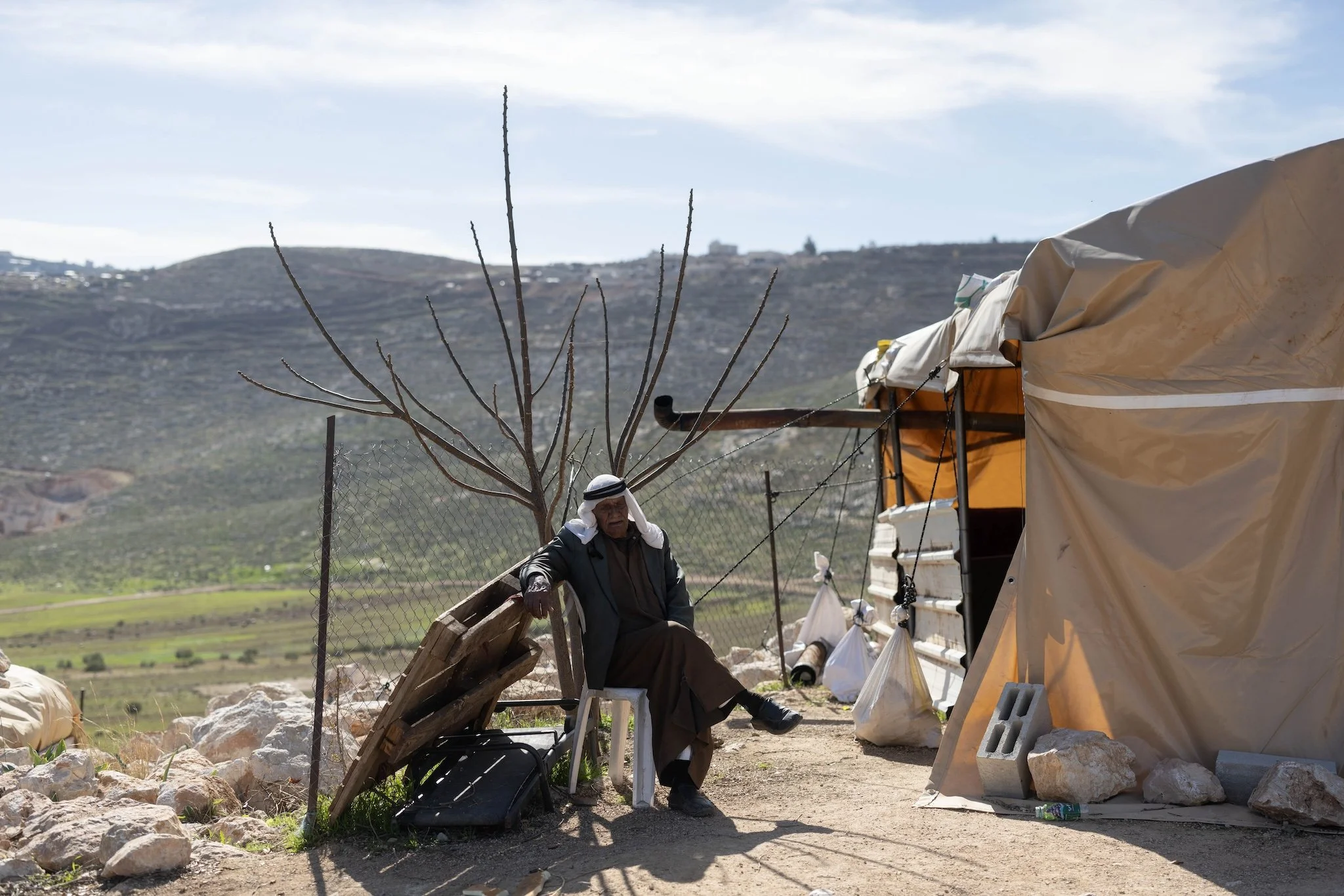
85-year-old Muhammad Ka’abneh at his house in Al-Khalail, near the village of Al-Mughayyir in the West Bank, February 2026. (Oren Ziv)
HAARETZ EDITORIAL: "A Palestinian Family Is Gunned Down and No One Will Be Questioned" - from 3/23

As indicated by today's HAARETZ lead editorial, transmitted below, some people in Israel have, exceptionally, been made to feel uncomfortable by a particular slaughter of innocent Palestinian civilians, one which inevitably recalls the slaughter of Hind Rajab and her family in Gaza but which has occurred this time in the West Bank.

Of course, unexceptionally, there will be no adverse consequences -- or even, in this case, any inconvenience of being questioned -- for the family's murderers.

As the editorial concludes: "The killing of Arabs, any killing of any Arab, is not a crime and doesn't merit an investigation.... Palestinian lives -- innocent adults, children, people with disabilities -- are cheap, their blood may be spilled with impunity. Did you kill without justification? Nothing bad will happen to you."

This "incident", as well as, to cite a non-exhaustive list of examples, Israel's current full-scale wars against Iran and Lebanon and periodic bombings of Syria, the repeated Israeli assaults on the people of Gaza culminating in the current and continuing Gaza genocide and the U.S. government's prior wars for Israel against Israel's perceived enemies Iraq, Libya, Syria and Iran, are all illustrative of a fundamental reality: An injustice as monumental as the transformation of Palestine into Israel, necessarily requiring the dispossession and dispersal of the great majority of the indigenous population and the oppression of the survivors to encourage them to leave, can only be sustained by perpetual violence.


A Palestinian family Is Gunned Down and No One Will Be Questioned

March 23, 2026

Nine days after the killing of members of the Bani Odeh family in the town of Tamum, none of the Border Police officers who took part in the heavy gunfire at the vehicle -- carrying four young children, one of them blind, and their parents -- have been summoned for questioning.

Sources familiar with the investigation said that the Justice Ministry department that probes allegations of police misconduct decided not to question the officers because the evidence supports their claim that they fired "out of fear for their lives."

It's unbelievable. An undercover unit hides behind a wall at night, a car whose passengers are unaware of the policemen emerges -- witnesses say the car was driving slowly, its windows open, so that it was easy to see who was inside -- and the Border Policemen shower it with bullets.

The officers did not call on the car to stop, did not fire into the air or at the vehicle's tires; rather, they immediately began shooting dozens of bullets at innocent passengers. Waad Othman Bani Odeh, her husband Ali Khaled Bani Odeh and their sons Othman, 7, and Mohammed, 5, died at the scene. Khaled, 11, and Mustafa, 8, survived. Khaled told Haaretz later that the officers beat him after they killed his parents and his two youngest brothers.

Such a serious incident must be investigated. The decision to blindly accept the Border Policemen's version of events without even questioning them marks another stage in the swift deterioration of the rule of law in Israel. It's also hard to understand the dubious excuse given by the Justice Ministry department: If the officers, the Palestinian eyewitneses and the two surviving children were not interviewed, then how do they know that the officers' version is correct? Based on what evidence?

In the past, Border Policemen were brought in for questioning immediately after such incidents occurred to prevent them from coordinating their stories and obstructing the investigation. Most of the cases were buried in the file drawers of the Justice Ministry unit without any legal action being taken.

This time, however, the agency responsible for investigating alleged police misconduct decided not to investigate at all. Perhaps its investigators know there's no point in probing the pointless killing of a Palestinian family because no one will do anything with the investigative material. In the background, there is also the chilling effect on the investigative entities in the wake of the Sde Teiman affair.

The gravity of these issues cannot be overstated. The "spirit of the commander" of National Security Minister Itamar Ben-Gvir has also taken control of the Justice Ministry department:
The killing of Arabs, any killing of any Arab, is not a crime and doesn't merit an investigation.

The conclusion that Border Policemen are drawing is clear: Palestinian lives -- innocent adults, children, people with disabilities -- are cheap, their blood may be spilled with impunity. Did you kill without justification? Nothing bad will happen to you; you won't be troubled even with a questioning to determine the motives and circumstances of your despicable crime.

The above article is Haaretz's lead editorial, as published in the Hebrew and English newspapers in Israel.

An ISRAELI court says...

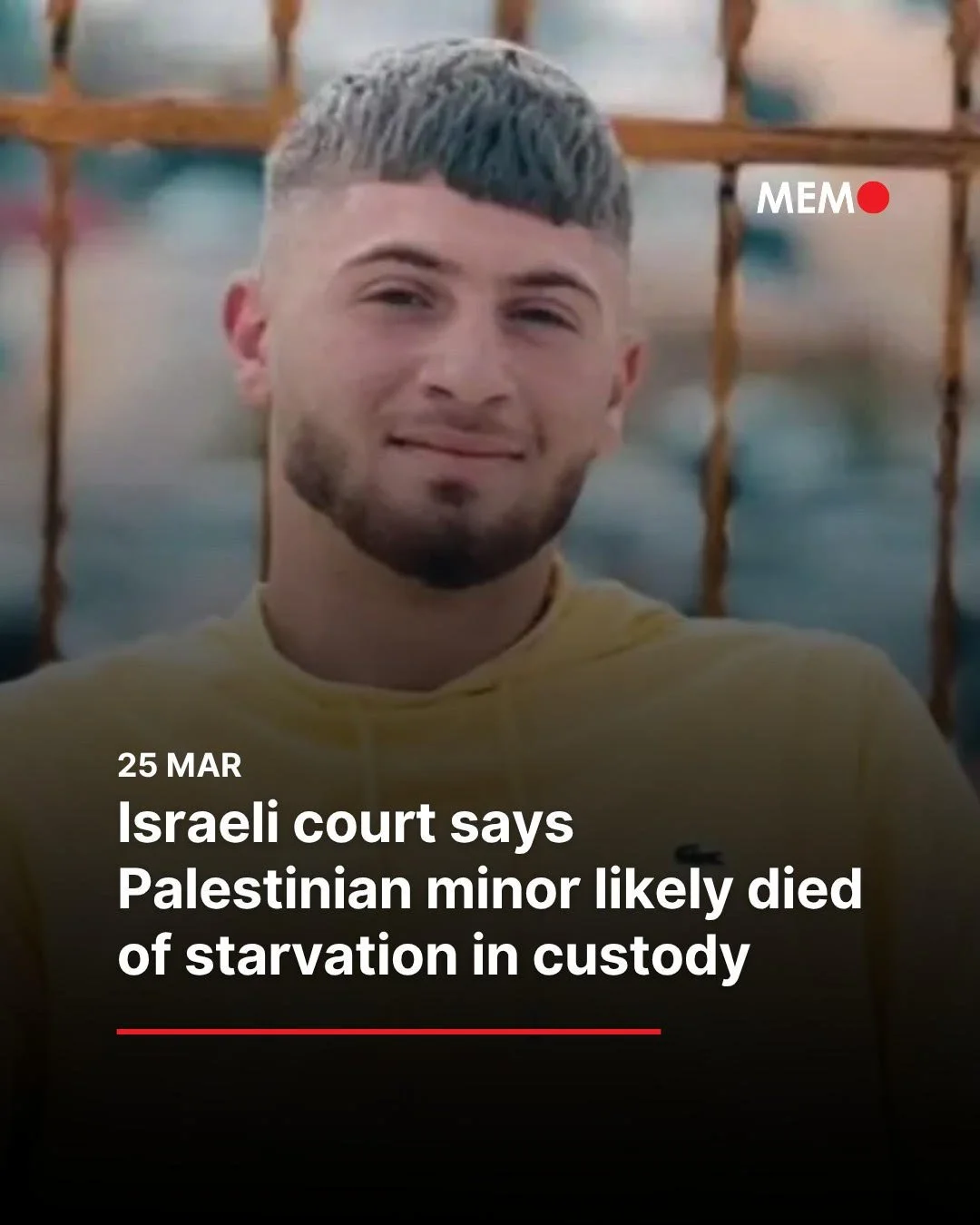
An Israeli court has concluded that a Palestinian minor who died in custody most likely succumbed to starvation, despite the formal closure of the investigation into his death.

According to details reported by the Hebrew newspaper Haaretz, Judge Ehud Kaplan ruled that Walid Khaled Abdullah Ahmed, a 17-year-old from Silwad, suffered from severe malnutrition while held in Megiddo prison, and that starvation was the most likely cause of death.

Read: https://www.middleeastmonitor.com/20260325-israeli-court.../

In What World is the Okay??

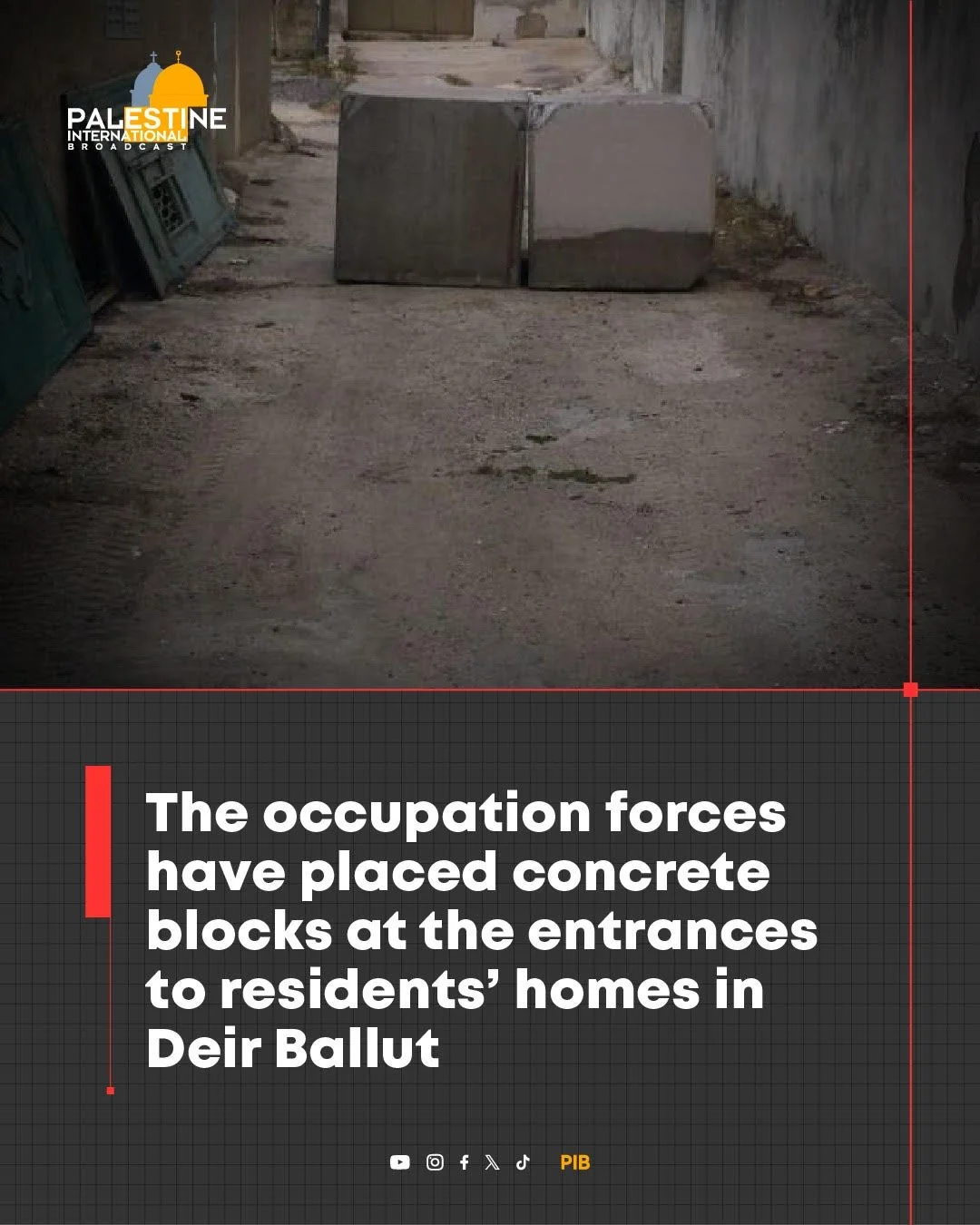
Yesterday, the occupation forces placed concrete blocks at the entrances to a number of residents’ homes in the town of Deir Ballut, west of the Salfit Governorate.

Local sources reported that the occupation forces proceeded to block the entrances to residents’ homes in the area near the town’s main entrance by placing concrete blocks at the entrances to their main homes.

These measures are part of a campaign to harass residents and impose additional restrictions on their movement.