This week, Palestine lost one of its greatest scholars, Professor Walid Ahmad Samih Khalidi, who passed away peacefully in Cambridge, MA, after having celebrated his 100th birthday the previous year surrounded by family. His passing was received less with shock than with amazement at his intellectual contribution over most of his century, a legacy to which he continued to add his final meticulous touches even in his last days.
His reputation as the historian of the Nakba, established through his studies, books, and historical collections, is well known in Palestine and throughout the Arab world, as well as among researchers worldwide. But these towering scholarly achievements are less known globally, and remain to be fully recognized, especially since, from the outset, they went against the prevailing Israeli narrative around 1948 and ever since.
The historian of the Nakba
Khalidi’s earliest scholarly work uncovered the Zionist movement’s “Plan Dalet,” which he called the “master plan” to expel the Palestinian people en masse — well before the revisionist school of Israeli historians gradually revealed what Walid Khalidi had shown the world in the 1950s. His singular academic achievements since the 1970s include landmark volumes documenting the Nakba, such as From Haven to Conquest, Before Their Diaspora, and All That Remains, which provide an encyclopedic Palestinian narrative of our history, essential elements of any library on Palestine.
As the tributes to Walid Khalidi poured in over the past days from presidents and kings, from political, intellectual, and community leaders, and from his peers, his academic and scholarly biography has been prominently featured. These include not only his own publications, but no less significantly, the establishment of the Institute for Palestine Studies (IPS), the premier Palestinian scientific research center. The IPS, today operating in Palestine, Lebanon, and the U.S., is enjoying its sixth decade of world-class research on Palestine in the “all-Palestine” historical and political tradition pioneered by Khalidi, who led the Institute for over 40 years. So not only will he be remembered as a great historian, but he was also a master institution-builder and manager, drawing on his well-honed understanding of the needs of the moment.
Perhaps what is less known about this very special Oxford-educated Palestinian gentleman, with the pedigree of an aristocratic Jerusalemite family, was his deep, less visible political activism. Over three periods of his life, he engaged in different roles in Palestinian politics, and remained very much in tune with the politics of each era and with his own ability to play a role. His biography was formative in that regard, having witnessed the buildup to the Nakba and its aftermath, and having received an upbringing that combined education, patriotism, and courtesy all in one package. His father, Ahmad Samih, was a liberal educator; his grandfather an Ottoman and Mandate-era judge who established a family manuscript Library in 1900; and his uncle was the last elected mayor of Jerusalem and a critical ally of the Palestinian national leadership of his era. Another of his uncles, Ismail (my father), was a UN diplomat.
The man on whom nothing was lost
But what I would like to shed more light on, for those who know of his place in Palestinian history and those who may not, is based more on my own personal interactions with him over the past few years, as well as on some widely known milestones in his political history. Those I refer to in passing, as the definitive version of that story will hopefully be published soon, as Walid has spent the best part of the past decade writing his own memoirs. They promise to be something special in recording the history of the Palestinian national movement since 1948.
READ THE WHOLE MONDOWEISS ARTICLE HERE.
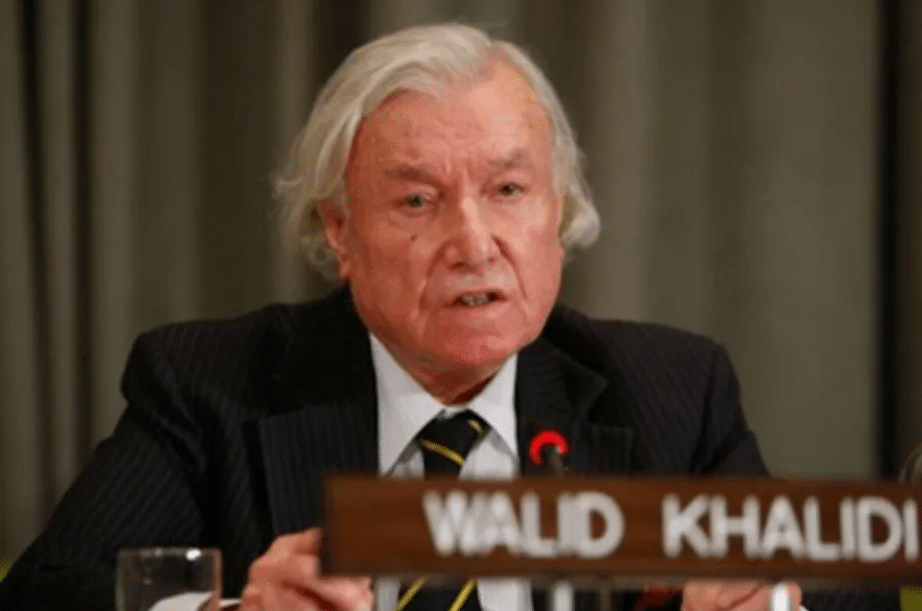
WALID KHALIDI SPEAKING AT THE UN GENERAL ASSEMBLY, NOVEMBER 30, 2009. (PHOTO: SOCIAL MEDIA)