
By Oren Ziv and Ariel Caine March 24, 2026
In partnership with LOCAL CALL
In May 2023, the Palestinian Bedouin community of Ein Samia, located east of Ramallah, fled their village. Facing mounting pressure and harassment from nearby Israeli settlers, who enjoyed significant military support, dozens of families dismantled their homes and left. It was one of the first instances in which an entire Palestinian community in the West Bank had been completely uprooted since 1967 — and it was a harbinger of what was to follow.
leven of those families relocated a short distance away to Al-Khalail, a rural area on the outskirts of the village of Al-Mughayyir. The site lies in Area B of the occupied territory — the zone, under the Oslo Accords, where the Palestinian Authority (PA) has jurisdiction over civil affairs but must coordinate security with Israel. It offers Palestinians more autonomy than Area C, which is under full Israeli control and has been the site of almost all settlement expansion, but less than Area A, which is under full PA control. By moving from Area C into Area B, the displaced residents of Ein Samia thought they would find relative safety.
In Al-Khalail, the families rebuilt their lives. They erected tin houses and animal pens, installed solar panels and water tanks, and resumed herding their animals.
“We are refugees from the Naqab,” explained 85-year-old Muhammad Ka’abneh, referring to the desert in southern Israel. “We moved several times until, in the 1980s, the army ordered us to move to Ein Samia. We lived there until the settlers and the army expelled us three years ago. We came here [to Al-Khalail] because we knew it was Area B and that it was safe.”
For a time, residents said, the area was quiet. Then in 2024, on the hill facing their encampment, a group of settlers established a new herding outpost called Shlisha Farm. (Outposts are mini-settlements established without prior state authorization that serve as strategic beachheads for settlers to expand into the West Bank.)
The settlers began grazing their flocks on land surrounding the community, damaging olive trees and crops, entering the encampment, and threatening families. They did this with the backing of the military. “They just make a phone call, and the army comes,” Ka’abneh said of the settlers. “The soldiers protect them.”
Read the rest of the article via +972 here.
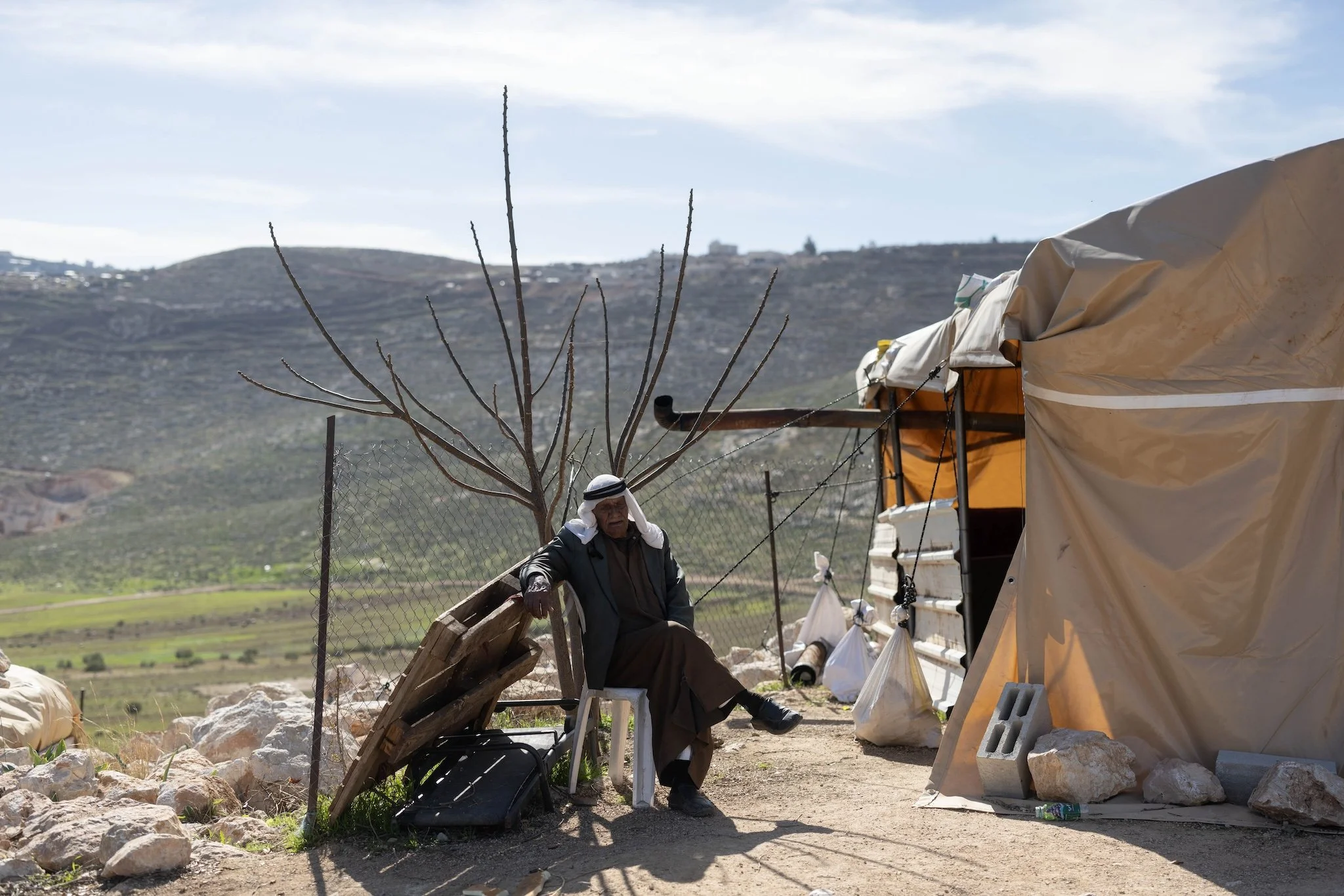
85-year-old Muhammad Ka’abneh at his house in Al-Khalail, near the village of Al-Mughayyir in the West Bank, February 2026. (Oren Ziv)