What on earth just happened? Trump, Iran, and the unlikely ceasefire - Trita Parsi

Trita Parsi
Apr 08, 2026
 

Yesterday began with Donald Trump issuing genocidal threats against Iran on social media and ended—just ten hours later—with the announcement of a 14-day ceasefire, on Iran’s terms. Even by the volatile standards of Trump’s presidency, the whiplash is extraordinary. What, then, have the two sides actually agreed to—and what might it mean?

In a subsequent post, Trump asserted that Iran had agreed to keep the Strait of Hormuz open during the two-week pause in hostilities. Negotiations, he added, will proceed over that period on the basis of Iran’s 10-point plan, which he described as a “workable” foundation for talks.

Those 10 points are:

1. The US must fundamentally commit to guaranteeing non-aggression.

2. Continuation of Iran’s control over the Strait of Hormuz.

3. Acceptance that Iran can enrich uranium for its nuclear program

4. Removal of all primary sanctions on Iran.

5. Removal of all secondary sanctions against foreign entities that do business with Iranian institutions.

6. End of all United Nations Security Council resolutions targeting Iran.

7. End of all International Atomic Energy Agency resolutions on Iran’s nuclear program.

8. Compensation payment to Iran for war damage.

9. Withdrawal of US combat forces from the region.

10. Cease-fire on all fronts, including Israel’s conflict with Hezbollah in Lebanon.

The United States has not, of course, signed on to all ten points. But the mere fact that Iran’s framework will anchor the negotiations amounts to a significant diplomatic victory for Tehran. More striking still, according to the Associated Press, Iran will retain control of the Strait during the ceasefire and continue—alongside Oman—to collect transit fees from passing vessels. In effect, Washington appears to have conceded that reopening the waterway comes with tacit recognition of Iran’s authority over it.

The geopolitical consequences could be profound. As Mohammad Eslami and Zeynab Malakouti note in Responsible Statecraft, Tehran is likely to leverage this position to rebuild economic ties with Asian and European partners—countries that once traded extensively with Iran but were driven out of its market over the past 15 years by U.S. sanctions.

Iran’s calculus is not driven solely by solidarity with Palestinians and Lebanese. It is also strategic. Continued Israeli bombardment risks reigniting direct confrontation between Israel and Iran—a cycle that has already flared twice since October 7. From Tehran’s perspective, a durable halt to its conflict with Israel is inseparable from ending Israel’s wars in Gaza and Lebanon. This is not an aspirational add-on; it is a prerequisite.

The forthcoming talks in Islamabad between Washington and Tehran may yet falter. But the terrain has shifted. Trump’s failed use of force has blunted the credibility of American military threats, introducing a new dynamic into U.S.-Iran diplomacy.

Washington can still rattle its saber. But after a failed war, such threats ring hollow. The United States is no longer in a position to dictate terms; any agreement will have to rest on genuine compromise. That, in turn, demands real diplomacy—patience, discipline, and a tolerance for ambiguity—qualities not typically associated with Trump. It may also require the participation of other major powers, particularly China, to help anchor the process and reduce the risk of a relapse into conflict.

Above all, the ceasefire’s durability will hinge on whether Trump can restrain Israel from undermining the diplomatic track. On this point, there should be no illusions. Senior Israeli officials have already denounced the agreement as the greatest “political disaster” in the country’s history—a signal, if any were needed, of how fragile this moment may prove to be.

Even if the talks collapse—and even if Israel resumes its bombardment of Iran—it does not necessarily follow that the United States will return to war. There is little reason to believe a second round would produce a different outcome, or that it would not once again leave Iran in a position to hold the global economy hostage. In that sense, Tehran has, at least for now, restored a measure of deterrence.

One final point bears emphasis: this elective war was not only a strategic blunder. Rather than precipitating regime change, it has likely granted Iran’s theocracy a renewed lease on life—much as Saddam Hussein did in 1980, when his invasion enabled Ayatollah Khomeini to consolidate power at home.

The magnitude of this miscalculation may well puzzle historians for decades to come.
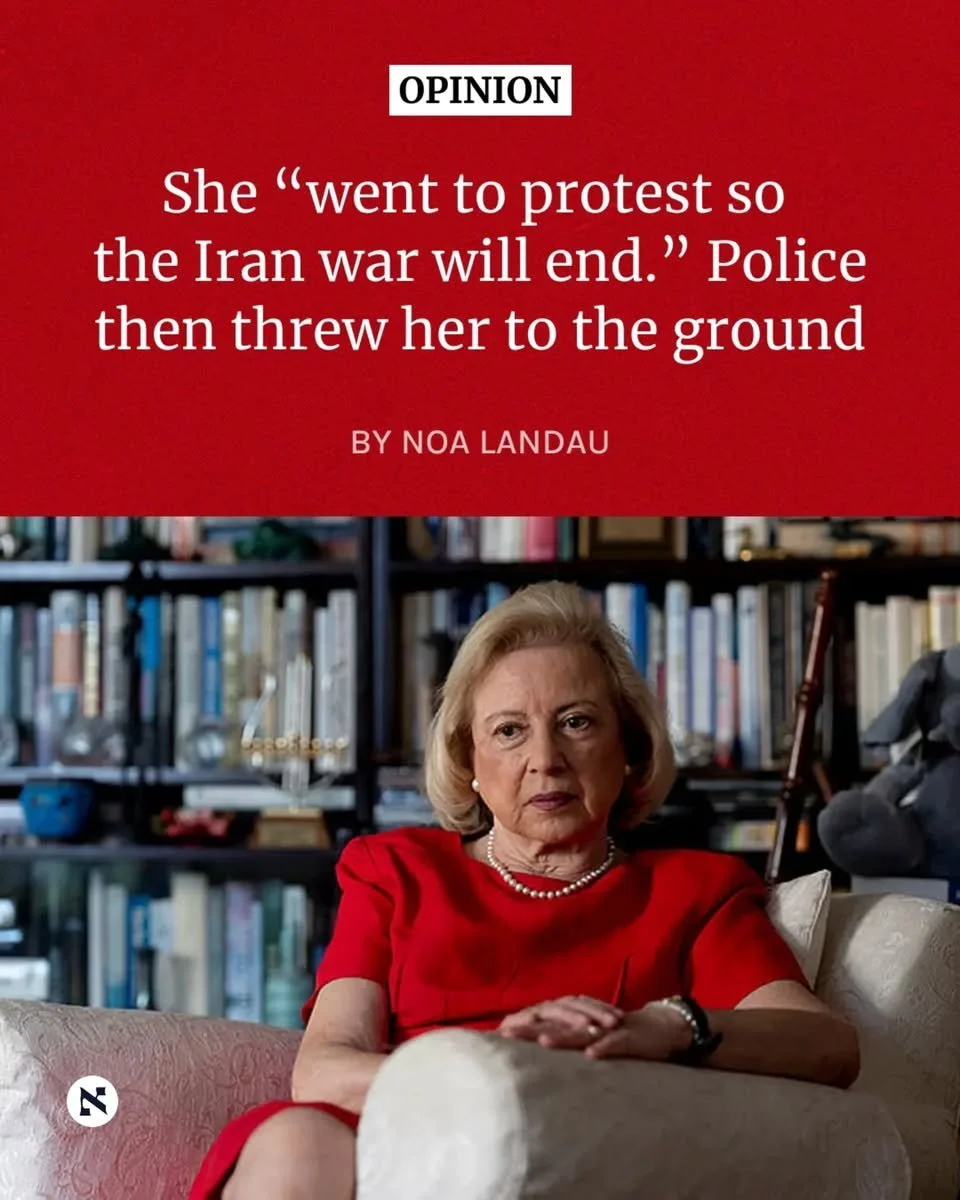
An enraging story via Haaretz. April 7, '26

Haaretz.com 

Credit: Itai Ron; Daniel Tchetchik. Design: Anastasia Shub | נועה שוב

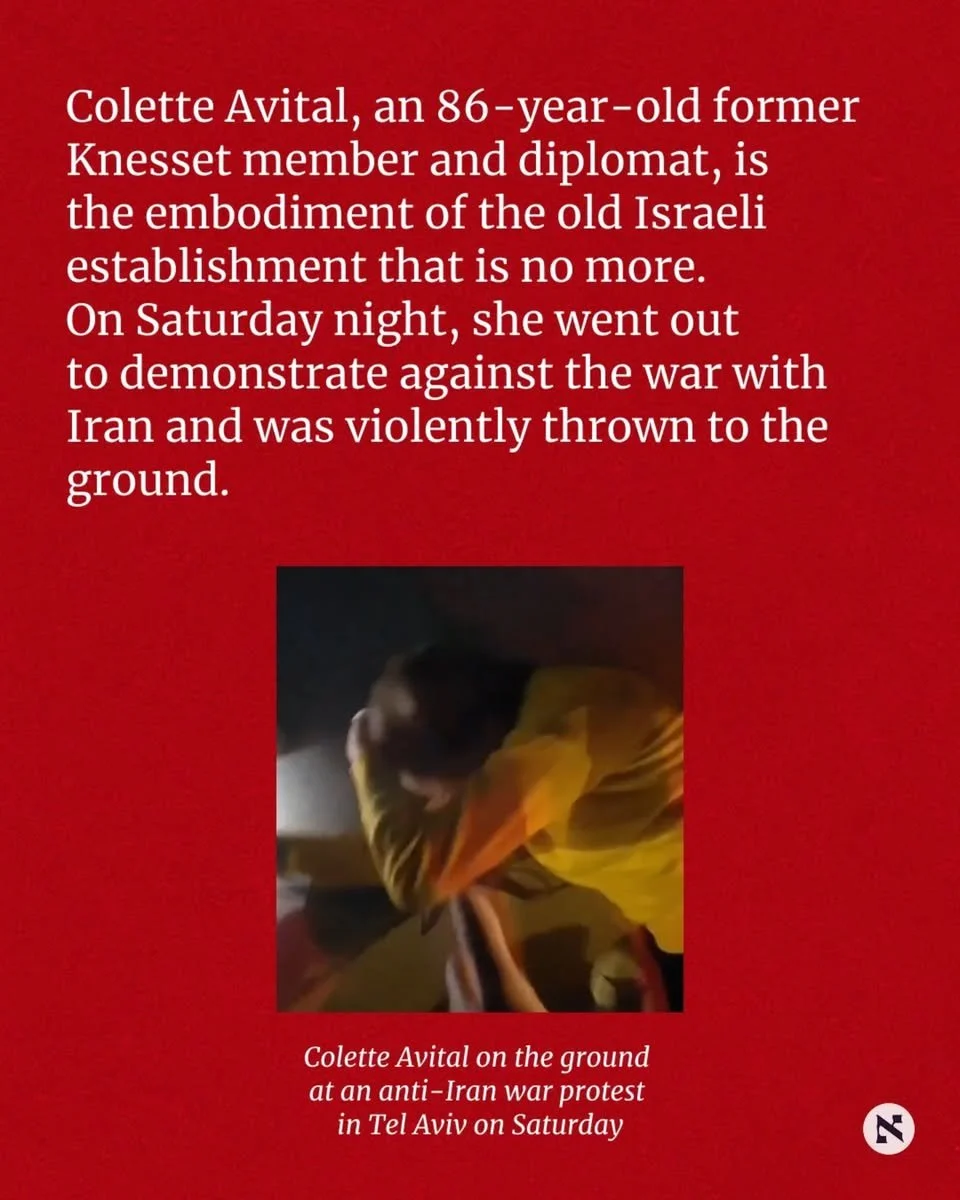
When Colette Avital, an octogenarian former Knesset member and Holocaust survivor, was thrown to the ground by police at a peace protest in Tel Aviv, the true purpose of Netanyahu's government came to light: to destroy Israel's founding democratic principles, one at a time | Noa Landau.

What an Incalculable Loss

Defense for Children International - Palestine has ceased operations. After 35 years of defending Palestinian children’s rights, we are not able to overcome operational challenges resulting from Israel’s targeted criminalization of Palestinian human rights organizations.

Palestinian children are living through genocide, apartheid, military occupation, and the rapid expansion of illegal Israeli settlements. They are imprisoned in Israel’s torture dungeons, buried under the rubble, and adapting to lifelong disabilities. They deserve protection and the fulfillment of all their human rights.

For decades, DCIP has worked relentlessly to protect Palestinian children against all odds. Now, we look to others to take up the charge and fight for the future that Palestinian children deserve.

All recurring donations have been cancelled. Once DCIP dissolves, any unspent funds will be transferred to another independent Palestinian organization with a child-centered mandate.

Onward,

Khaled Quzmar

General Director

A New Low for the ADL?

The ADL’s Mamdani Tracking Program Targets Muslim City Officials

The group’s lunge into local politics looks like an anti-Muslim blacklist.

Josh Nathan-Kazis for Jewish Currents

April 1, 2026.

THE ANTI-DEFAMATION LEAGUE HAS NEVER BEEN A MAJOR PLAYER in local New York politics. But before 9:00 am on the morning after New Yorkers elected Zohran Mamdani mayor late last year, the group announced plans to dedicate significant resources to “monitor” the incoming administration, providing “early-warning research” that ADL said would “protect Jewish residents.”

Nearly five months later, the centerpiece of the ADL’s anti-Mamdani campaign, a website it calls the Mamdani Monitor, is a veritable blacklist of Muslim Mamdani appointees. The ADL has so far posted 30 intelligence-style dossiers on senior Mamdani administration officials, and on members of now-disbanded administration transition committees, each labeled with a rating: “concerning,” “positive,” or “no relevant record.” Among the 22 Mamdani appointees the organization has deemed “concerning,” more than half are Muslim or have roots in the Middle East or South Asia, according to an analysis by Jewish Currents. Jewish Currents could only identify two senior-level Muslim Mamdani appointees who the ADL has not profiled, and only one who was profiled and not labeled “concerning.”

Meanwhile, the organization has awarded a “positive” rating to just one administration official: Jessica Tisch, the billionaire police commissioner, whose immediate and extended family are stalwarts of the city’s Jewish establishment.

The ADL has meddled in New York politics in the past, leading the charge in 2010 against an effort to build a new mosque on Manhattan’s Park Place, which its national director at the time, Abraham Foxman, deemed too close to the site of the September 11th attacks. For the most part, though, it’s left New York politics to other establishment groups. Now, its new emphasis on political work in New York looks to progressive and liberal activists like an anti-Muslim crusade. “They are subjecting any Muslim employees, or prospective Muslim employees, to extra scrutiny because of their faith in an attempt to sideline the Muslim community, and especially to smear Muslim Americans who have been critical of the Israeli government,” says Edward Ahmed Mitchell, national deputy director of the Council on American-Islamic Relations, a Muslim civil rights group. (The Mamdani Monitor site flags three appointees’ links to CAIR.)

The mayor’s office declined to comment, but an operative close to the mayor called the Mamdani Monitor site “a clearly Islamophobic blacklist.” The ADL, for its part, did not respond to a list of questions about its Mamdani tracking operation.

The lengthy dossiers the ADL has posted on the Mamdani appointees it’s deemed “concerning” rely heavily on guilt by association, harping on tenuous or implied links to individuals or groups the ADL dislikes.

Take the ADL dossier on Bitta Mostofi, a special advisor to the first deputy mayor with an extensive resume in public service, who the ADL tagged as “concerning” in part because she “has been associated” with the prominent Palestinian American activist Linda Sarsour. ADL’s evidence for that association is that Mostofi “accepted an award” from Sarsour in 2019, appeared with her on a panel about immigrants in New York in 2017, and spoke at the same protest as her in 2020. “They’re pointing out who in the Mamdani administration is pro-Palestine,” says Sarsour, who is mentioned in six of the dossiers on the ADL site. “That’s what that list is.”

Mostofi and other administration officials didn’t respond to a request for comment submitted through the mayor’s press office.

The dossiers also paint even incidental links to progressive Jewish groups as potentially disqualifying. ADL’s dossier on Faiza Ali, the commissioner of the Mayor’s Office on Immigrant Affairs, says Ali was “trained by” the progressive Jewish group Bend the Arc, which it says called for a ceasefire in Gaza. Bend the Arc’s CEO, Jamie Beran, told Jewish Currents, “I think that the Mamdani Monitor is an incendiary and bigoted response that is not in the true interest of American Jews.”

The dossier on Phylisa Wisdom, the progressive Jewish activist appointed in February to lead the Mayor’s Office to Combat Antisemitism, attempts to make even more attenuated connections. It says Wisdom is “concerning” in part because New York Jewish Agenda, the liberal Jewish group Wisdom formerly ran, works with the leftist Jewish groups Jews for Racial and Economic Justice and IfNotNow, which in turn, the ADL alleges, “work directly” with unnamed groups that “are known to harass Jews.”

Other Mamdani Monitor dossiers imply that mainstream stances taken in defense of Muslim civil rights are radical or extreme. The ADL dossier on Ali says that she organized a petition against the police department’s use of an anti-Muslim film called The Third Jihad as a training tool in 2012, implying that her opposition to the use of the film in police training is among the reasons for tagging her as “concerning.” But at the time of Ali’s petition, the disclosure that police trainees were shown The Third Jihad was a major scandal in New York politics, and the subject of a front-page exposé in The New York Times. Even the mayor, Michael Bloomberg, acknowledged that it had been “terrible judgement” to show the film to police recruits.

Some of the material cited in the dossiers is notably old: It calls Mamdani’s chief counsel, the CUNY law professor Ramzi Kassem, “concerning” based in part on views expressed in articles he published in a student newspaper in the late 1990s. The ADL also cites Kassem’s legal work for two Guantanamo detainees. (The organization did not respond to questions about whether it believes Guantanamo detainees deserve legal representation, or whether attorneys should be judged based on the allegations made against their clients.)

For all the thousands of words the ADL has published on Mamdani appointees on its monitor site, its impact has been slight. The group claims credit for one resignation: Cat Almonte Da Costa, appointed as the mayor’s director of appointments in mid-December, resigned shortly after the ADL unearthed 15-year-old social media posts that appeared to be generally demeaning towards Jews.

What the site has successfully done, however, is position the ADL as an enemy of City Hall, as other Jewish groups are looking to build relationships with the administration. “I just don’t think it’s smart,” says Nancy Kaufman, chair of New York Jewish Agenda’s board and former CEO of the National Council of Jewish Women. “This is our mayor for four years, and we want to work with him. That’s our attitude.”