HeART of Gaza

The traveling exhibition HeART OF GAZA features drawings created by Palestinian children in Gaza, aged 3 to 17 years, during the ongoing conflict. Created in cooperation with Féile Butler from Sligo, Ireland, it is based on a project founded by Mohammed Timraz, a Gaza-based art therapy researcher at the University of Parma and the owner of Grey Café in Deir al-Balah, Gaza, which was destroyed by Israeli bombing in 2024.  

Timraz embarked on this project with a clear goal: to allow children in the Gaza Strip to express their feelings and communicate their experiences through drawing and art amid the catastrophic humanitarian conditions that have been imposed by the Zionist entity. With these activities, he intended to help transform pain and suffering into a humanitarian art space that fosters creativity and encourages the free expression of trauma and complex emotions through an authentic visual language. Since 2024, the project has organized art workshops for children in the so-called Artists’ Tent in the city of Deir al-Balah and in other art spaces located in various areas of the Gaza Strip. Over time, it expanded to include more than 17 art spaces, and it has involved over 2,000 children who find in art a way to express what they sometimes cannot express with words. 

READ THE ARTICLE HERE & CONSIDER SUBSCRIBING
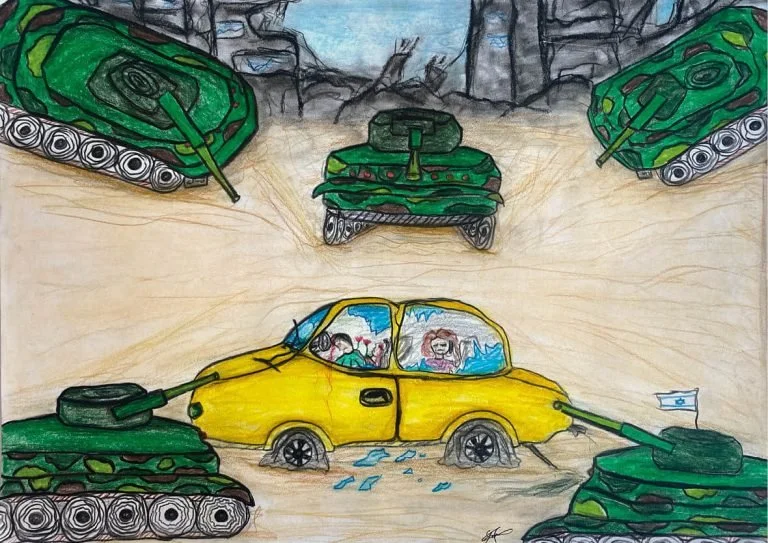
Hind by Qamar Timraz (age 17) and Misk Timraz (age 15).
Shipments from US carrying 6,500 tons of military gear arrived in Israel in past day

via the Times of Israel


‘Two cargo ships and several planes carrying 6,500 tons of military equipment from the United States, including thousands of munitions and light armored utility vehicles, arrived in Israel in the past day, the Defense Ministry announces. The ministry says that since the start of the war with Iran on February 28, more than 115,600 tons of military equipment have arrived in Israel on 403 flights and 10 ships.’

Read the article here.

Why Israel is so interested in Lebanon's water resources...

Water, Power, and Geopolitics: Zionist Israeli Ambitions and the Hydro-politics of Southern Lebanon

Lebanon’s rivers are more than lifelines; they lie at the heart of a long-standing struggle shaped by external ambition.

VANESSA BEELEY

MAY 01, 2026

What distinguishes the Wazzani River is not merely its hydrological contribution, but its geopolitical positioning. Over a stretch of roughly four kilometres, the river delineates a sensitive boundary zone between Lebanese territory and the Zionist Israeli-occupied Syrian Golan Heights, particularly around the village of Ghajar. This dual function, as both a vital water source and a de facto boundary marker, places the river at the heart of regional tensions, where issues of sovereignty, resource allocation, and security converge due to constant Zionist aggressions on Lebanon.

Meanwhile, the Hasbani River originates from the northwestern slopes of Jabal al-Sheikh, descending through southern Lebanon as one of the principal resources feeding the upper Jordan River Basin. Flowing for approximately 24 to 40 kilometres within Lebanese territory, it represents a critical transboundary watercourse whose significance extends well beyond its geographical modesty. Hydrologically, the Hasbani integrates contributions from several springs, most notably the Wazzani, forming a steady flow that plays a vital role in sustaining downstream systems. Its position at the intersection of Lebanese, Syrian, and Palestinian hydrological networks situates it firmly within one of the most politically sensitive water basins in the Middle East.

READ THE ARTICLE HERE.