Week in Review. 5/31/26 by Alice Rothchild
Here is one part of this excellent summary:
Zochrot program “Envisioning Return Amid Genocide”
a conversation with Angela Davis and Rashid Khalidi
Two points of note:
1. The support for Palestinian Liberation is at an all-time high around the world, but steps must be taken to take advantage of this moment.
2. These folks are making concrete and possibly practical proposals to push the conversation of return and de-colonization further along. Such a conversation intersects with a discussion of the BDS Movement.
Watch this excellent webinar here.
Read the entire “Week in Review” here. You can sign up to have these weekly summaries show up in your email.
Rats, raw sewage, skin diseases: Israel’s siege is ravaging Gaza’s displaced
As Israel continues to restrict aid, Gaza’s shattered health system is struggling to treat and contain illnesses spreading through overcrowded tent camps.
By Ahmed Dremly and Ibtisam Mahdi May 29, 2026
Eman Abu Jame had counted her family among the lucky ones. Israel bombed their home in the southern Gaza Strip at the beginning of the war, forcing them to move from one shelter to another. But throughout the first two years of the genocide, neither she, her husband, nor her children suffered any serious health problems.
That all changed in October 2025, when they took refuge in a crowded tent camp in Khan Younis.
By the time they arrived, the lack of hygiene, spread of insects, and severe overcrowding had turned the camp into a breeding ground for disease. Two months later, Abu Jame’s 8-year-old son, Mousa, and her 47-year-old husband, Abdul Majeed, began showing symptoms: Their bodies started to swell, accompanied by severe diarrhea and high fevers.
Due to the difficult economic conditions and skyrocketing prices of meat, fish, and other protein-rich foods, their protein levels dropped rapidly, worsening their ability to retain fluids.
“We were completely unable to buy food and water,” Abu Jame told +972 Magazine. Everything was so expensive back then, and we simply did not have the money. My husband couldn’t afford anything — even bread was unavailable.”
Doctors struggled to diagnose both father and son. At first, they suspected a gluten allergy, but tests ruled it out. Travelling abroad for treatment was also impossible due to the closure of crossings. The only effective treatment was medical albumin, a protein solution that helped stabilize their condition.
“When [Mousa] took the medication, he would get better,” Abu Jame explained. “But whenever he missed it, his body would start swelling up all over again.”
Yet the treatment was extremely difficult to acquire. Since October 7, 2023, Israel has heavily restricted the entry of medicines and blocked international NGOs from delivering medical supplies to the Strip. Even after the announcement of a ceasefire last October, Israel continued to block aid; as of this month, according to Gaza’s Ministry of Health, 47 percent of essential medicines, 59 percent of medical supplies, and 87 percent of laboratory testing materials are out of stock.
As the medication ran out, Mousa’s body swelled further with fluid, and he died in January. Three months later, Abdul Majeed also succumbed to the same mysterious illness that doctors had failed to diagnose.
While the disease remained unidentified, it was clearly linked to conditions in the camp — potentially transmitted by a rodent bite or an ectoparasitic infestation. In just the first four months of 2026, according to the UN, there have been over 70,000 cases of similar infestations across Gaza, where parasites live on or under the skin and become a vector for disease. More than 80 percent of displacement sites report visible pests alongside rampant skin infections like scabies, lice, and bedbugs, while Save the Children recently noted that two in three children in Gaza live in displacement sites plagued by these risks.
READ THE ENTIRE ARTICLE HERE.
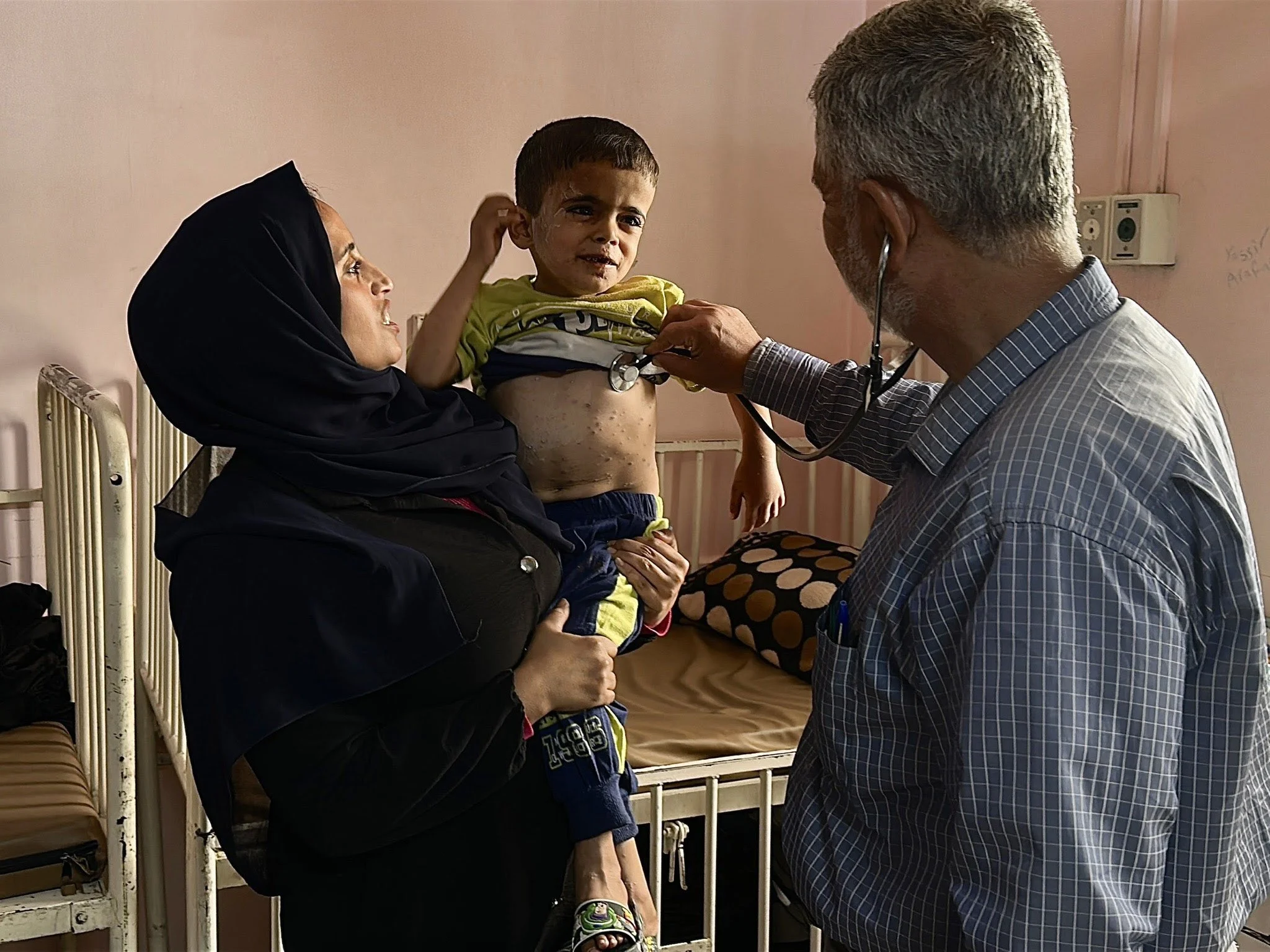
Palestinian child suffering from skin infections and severe malnutrition receives treatment at Al-Nasser Hospital, Khan Younis, southern Gaza Strip, May 12, 2026. (Doaa Albaz/Activestills)
Not just the US: India to Brazil, 51 nations armed Israel amid Gaza war | Investigation News | Al Jazeera
By Caolán Magee. Published On 23 May 202623 May 2026
On a cold day in early January 2024, protesters gathered outside the International Court of Justice (ICJ) in The Hague to denounce Israel’s genocidal war on Gaza, then nearly 100 days old.
More than 3,000km (1,864 miles) away, some Palestinians in Gaza followed the proceedings, livestreamed on YouTube, but most were trying to survive Israel’s relentless bombardment.
In nearly eight decades of the Convention on the Prevention and Punishment of the Crime of Genocide, only a handful of cases had ever reached the court. That day, South Africa was asking the world’s highest court to consider whether Israel’s assault on Gaza constituted a genocide - the destruction, in whole or in part, of an ethnic, racial, religious or national group.
Inside the courtroom, Irish lawyer Blinne Ni Ghralaigh, who was representing South Africa, began to speak.
“The international community continues to fail the Palestinian people,” she told the judges, despite Israeli officials’ “dehumanising, genocidal rhetoric” matched by the military actions in Gaza.
“This is the first genocide in history, where its victims are broadcasting their own destruction in real time, in the desperate, so far vain, hope that the world might do something,” she said.
An average of 247 Palestinians were being killed every day, Ni Ghralaigh told the court; 48 mothers, two every hour; more than 117 children daily, five each hour.
She referred to the new acronym used among doctors and aid workers that had emerged from the devastation: WCNSF - wounded child, no surviving family. By that point, more than 7,000 Palestinians had been killed.
“These facts,” Ni Ghralaigh said, “could not present a clearer or more compelling case” for genocide.
On January 26, 2024, the ICJ ruled that there was a plausible risk of genocide in Gaza and ordered provisional measures. Crucially, it reminded all states party to the Genocide Convention, of which there are 153, of their obligations: to act to prevent genocide.
But over the next 22 months, the killing continued. By the time a ceasefire was reached in October 2025, more than 70,000 people had been killed, with some 171,000 injured.
Throughout that period, the weapons to Israel kept flowing.
Weapons exports
A months-long Al Jazeera investigation has found that military-related goods originating from at least 51 countries and self-governing territories continued entering Israel after the ICJ’s warning of a plausible risk of genocide in Gaza.
Based primarily on an analysis of Israeli Tax Authority (ITA) import data between 2022 and 2025, and supported by customs records and freedom of information requests, the investigation traced military supply chains linked to countries across Europe, Asia, North America and South America. All named countries are signatories to the Genocide Convention.
In some cases, the military-related goods originated from countries that had formally imposed arms embargoes on Israel or had partially suspended arms supplies to the country.
In fact, according to the ITA data, arms imports increased after the ICJ ruling, with the largest share falling under the category of munitions.
The five largest countries of origin for military-related goods entering Israel - the United States, India, Romania, Taiwan and the Czech Republic - all recorded increased shipments during the war.
While many countries included in this investigation do not share statistics on arms exports to Israel, the ITA data shows that 2,603 consignments of military-related goods - including imports labelled as goods related to ammunition, explosive munitions, weapons parts and armoured vehicle components - entered Israel between October 2023 and October 2025.
In total, the imports were valued at 3.22 billion shekels ($885.6m), with 91 percent of that value recorded after the ICJ’s ruling, according to the ITA data.
By comparison, in the 20 months before October 2023, military-related imports to Israel totalled 1.41 billion shekels ($388.1m). The data suggests Israel increased its dependence on foreign weapons supplies to help sustain its military offensive in Gaza.
Even after the latest ceasefire took effect on October 10, 2025, the flow of weapons did not stop. In the final two months of 2025, Israel received an additional 324.9 million shekels ($89.4m) in military-related imports, according to the ITA data.
Read the article here.