Water Fact--June 21, 2026
Water is life, and there is little of it in Gaza
Palestinians in the devastated Gaza Strip who survived the winter floods sweeping through tented encampments that caused babies to die of hypothermia must now endure the blistering heat of summer without sufficient water to sustain health and life itself.
According to the UN, 7.5 liters of water per person per day is the absolute baseline for survival, while 15 – 20 liters per person is the recommended amount for drinking, washing and hygiene. In Gaza, the Coastal Municipal Water Utility (CMWU) aided by the International Committee of the Red Cross is struggling to make 6 liters per day per person available for much of the population.
Since 2016, the ‘Water Facts’ produced by the Alliance for Water Justice in Palestine have documented the severe water crisis facing the Gaza Strip. That crisis has now turned deadly. The CMWU reports that given the destruction of desalination plants and pipelines, and Israel’s refusal to allow the entry of materials to fix the smashed infrastructure as well as the fuel needed to run water storage and distribution networks, Gaza only has 40% of the amount of clean water that had been produced before October 2023. Many Palestinians are forced to rely on water from damaged and polluted wells and other contaminated sources.
In its report for June 12, 2026, OCHA states that over 70% of Gaza’s population relies on trucked water, but Israel’s restrictions and funding shortfalls “are putting this supply at risk.” Four humanitarian agencies are now phasing out their trucking operations “leaving over 330,000 people across approximately 250 sites at risk of losing their primary drinking source.”
The acute water shortage, open sewage flowing among he tents and the refusal of Israel to permit the entry of machinery necessary to clear Gaza’s mountains of garbage and rubble have led to an escalation of water-borne diseases such as gastroenteritis and severe diarrhoea, causing dangerous dehydration. A collapsing health care system that lacks basic medications, intravenous fluids, laboratory supplies and even sufficient clean water for handwashing is not able to cope with the urgent physical needs.
In the words of one Gaza resident, “We are not afraid only of bombs or starvation. We are now afraid of the food we eat and the water we drink.”
This is a HUGE win...
Gaza: Israel’s shelter restrictions force nearly a million people to endure summer heat in tents
via the Norwegian Refugee Council (June 18, 2026
As Gaza enters the sweltering summer months, Israel’s destruction of homes and restrictions on shelter materials have trapped displaced families in Gaza in dangerously hot tents and makeshift shelters, warns the Shelter Cluster in Palestine.
Across Gaza, around 170,000 households, equivalent to nearly one million people, live in tents. Another 5,000 households sleep outdoors, while 52,000 households live in overcrowded shelters. This month, 850,000 people still lack emergency shelter items such as plastic sheeting, plywood, and rope. These figures point to a shelter crisis driven not by weather, but by destruction, displacement, and blocked relief.
Summer heat will only sharpen the risks families face, with daytime temperatures reaching 34.5C in the warmest month and the number of hot days with temperature recording 35C or higher expected to increase.
“Gaza’s families are not facing a natural disaster. They are being forced to endure deadly heat in emergency shelters that were never designed to withstand prolonged displacement or high temperatures. Simple measures such as shading, ventilation and basic shelter improvements can significantly reduce risks and improve living conditions, but this is currently not available inside of Gaza and deliberately not being allowed to enter,” said Jehan Salim, Shelter Cluster Coordinator.
Without these supplies, preventable risks will deepen. Children, older people and those with chronic illnesses face higher risks of heat stress, dehydration, respiratory distress, and disease. Women and girls face greater danger in overcrowded sites where poor lighting, lack of privacy and unsafe sanitation deepen fear and exposure.
“It is an outrage that families in Gaza, after months of displacement and loss, now face summer heat in makeshift tents because Israel continues to restrict shelter materials,” said Jan Egeland, Norwegian Refugee Council (NRC) Secretary General. “The Shelter Cluster and its partners have the expertise and capacity to help Palestinians secure safer and more dignified shelter. But skills cannot replace materials. Israel must allow shelter supplies into Gaza now so our partners can help families protect themselves from heat, exposure and further harm.”
Israel’s military operations have destroyed and damaged 76.6 per cent of Gaza’s housing stock, displaced families again and again, and left entire communities with no safe place to go.
Families need proper tents and basic shelter materials, including tarpaulins, shade nets, plastic sheeting and basic repair supplies. These materials will not rebuild Gaza, but they can make the difference between a tent that traps heat, smoke, dust and disease, and a shelter that gives a family shade, airflow, privacy and a measure of protection.
“I could not bear to be inside the tent from 8am until 7pm, because as soon as the sun rises, ants, flies, and insects begin to spread inside, and the heat starts to soar,” said a 44-year-old husband and father of three from Deir al-Balah. “My wife and children ended up with burns on their faces.”
The Shelter Cluster calls for rapid, predictable and sustained entry of shelter materials through all available crossings, alongside urgent donor support for summer-specific household items such as bedding, clothing, solar fans, lighting and safe storage. This includes substantial quantities of tents, sealing-off kits, emergency shelter materials, and other critical shelter supplies that remain outside Gaza despite being approved for entry. These delays continue to limit the ability of humanitarian actors to improve shelter conditions and respond to urgent needs at scale.
“This summer does not have to strip away more lives and dignity,” said Salim. “The solutions are known, the response capacity exists, and partners are ready to act. What is needed now is sustained entry of shelter materials to help families protect themselves from heat, exposure and further harm.”
Notes to editors
Photos from Gaza can be downloaded for free use here.
The Norwegian Refugee Council leads the Shelter Cluster in Palestine, which coordinates humanitarian shelter actors responding to emergency shelter needs in Gaza and the West Bank.
The Shelter Cluster identifies Gaza’s main summer shelter risks as heat stress, dehydration, overcrowding, poor ventilation, shelter deterioration, pest infestation, dust exposure, fire hazards, WASH-related health risks and reduced dignity.
The Shelter Cluster, citing Site Management Cluster data, reports that 170,000 households live in tents, 58,000 households rely on emergency shelter kits or distributed items, 30,000 households live in shelters built from locally sourced materials, 5,000 households sleep outdoors and 52,000 households live in overcrowded shelters.
The “nearly one million people” figure applies the Shelter Cluster’s average household-size assumption of 5.8 people to the 170,000 households living in tents, giving an indicative scale of around 986,000 people.
Average daytime temperatures in Palestine reach 34.5C in the warmest month, according to the Red Cross Red Crescent Climate Centre, which warns that hot days above 35C could rise sharply in the decades ahead.
According to the UN, around 1.7 million people lived across roughly 1,600 displacement sites by late May, with 88 per cent in makeshift sites. According to the UN, 850,000 people needed emergency shelter items by early June.
The Gaza Strip Rapid Damage and Needs Assessment, prepared by the UN, EU and World Bank, found that 76.6 per cent of Gaza’s housing units, 371,888 out of 485,361, had been destroyed or damaged as of October 2025.
According to the UN, shelter and essential-item stocks approached depletion by 5 June. Access constraints also tightened during the reporting period, with Zikim closed since 24 May, Kerem Shalom serving as the only crossing for approved cargo as of 4 June, and only 49 private-sector truckloads carrying shelter materials between 25 and 31 May.
For more information or to arrange an interview, please contact:
Norwegian Refugee Council's global media hotline: media@nrc.no,
+47 905 623 29
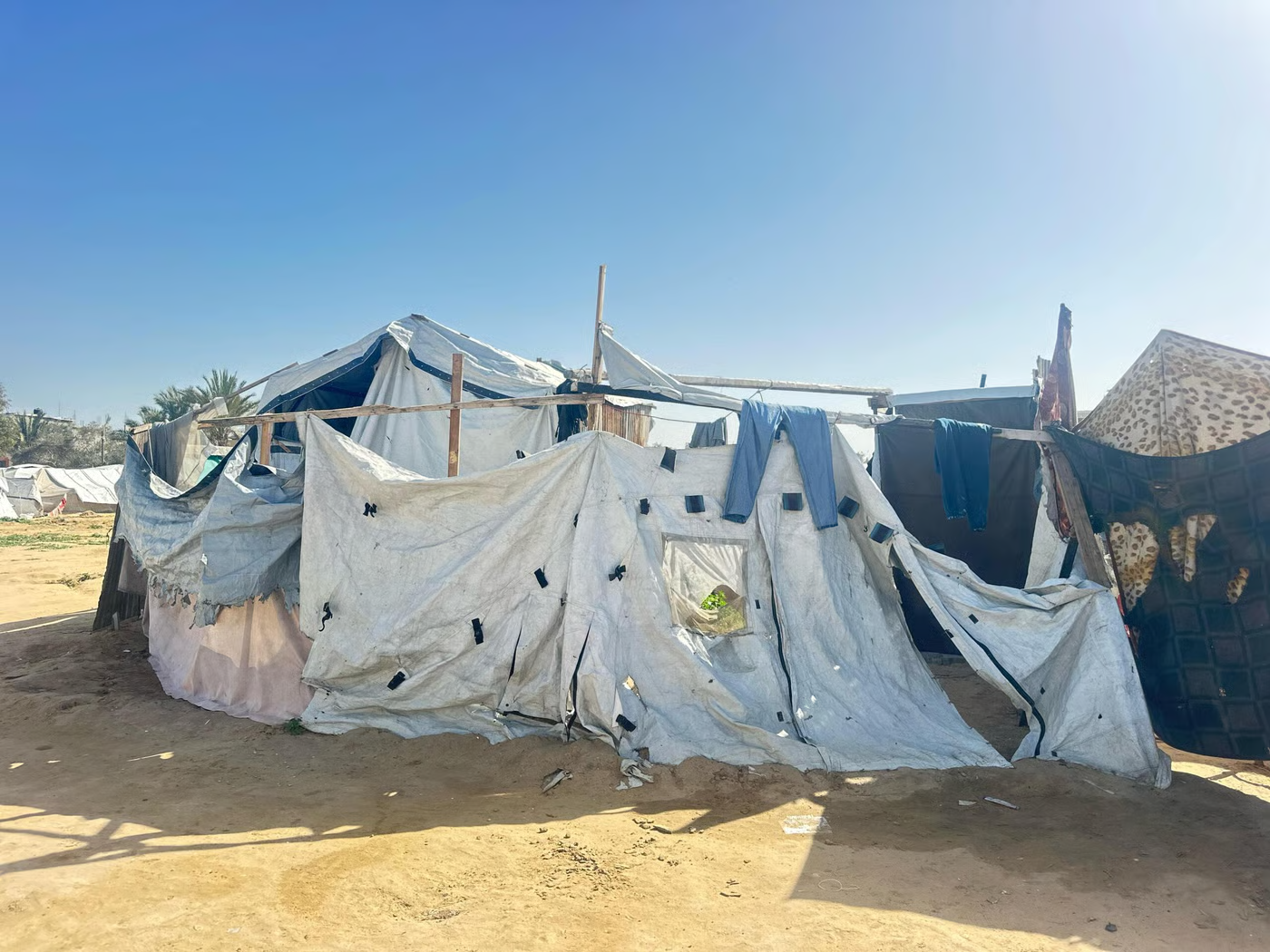
Displaced Palestinians staying in flimsy tents amid rising temperatures in Gaza. Photo: Zyad Abu Mariam/NRC