THE PALESTINE CONNECTION
JUN 17, 2026 By Izzy at Adalah Justice Project
We’re all familiar with the same destructive story that repeats every year. Congress sends billions of taxpayer dollars in military funding overseas to Israel, politicians cheer and applaud an “ironclad alliance,” and American weapons companies collect the profits as Israel expands its regime of colonization and genocide.
But buried inside the latest National Defense Authorization Act (NDAA) bill is a provision that points to something much more disturbing and insidious than “military aid”—a policy shift that could transform the U.S.-Israel relationship for decades to come.
The NDAA is a must-pass defense bill considered each year by Congress. The proposed bill for fiscal year 2027 includes an enormous $1.5 trillion defense budget that would dramatically expand state militarization, surveillance, and corporate war profiteering. The bill is currently making its way through the House and Senate.
Earlier this month, both the House and Senate Armed Services Committees voted to approve a new dangerous measure within their respective versions of the NDAA. The measure lays out a policy aiming to deepen integration between U.S. and Israeli military technology, artificial intelligence systems, cybersecurity programs, surveillance infrastructure, intelligence operations, and weapons development. Supporters frame the provision as cooperation and innovation. In reality, it represents a toxic merging of America’s technology industry and Israel’s security state—with devastating consequences.
The timing is not accidental.
The current U.S.-Israel Memorandum of Understanding, the ten-year agreement guaranteeing $38 billion in military aid through 2028, is approaching its expiration date.
In the face of Israel’s ongoing genocide in Gaza, our movements have accelerated the fight to challenge military funding, expose the realities of apartheid and occupation, and make U.S. support for Israel increasingly costly politically—and we’ve been making significant gains.
To date, 75 Members of the House of Representatives have signed on to the Block the Bombs Act, critical legislation that would stop the Trump administration from sending weapons to Israel to use in its genocide in Gaza. In April, 40 Senators voted in favor of Joint Resolutions of Disapproval (JRDs) to block the sale of nearly $500 million in 1,000-pound bombs and Caterpillar D9 bulldozers that have been used by Israel to murder Palestinians and destroy infrastructure. These numbers were unthinkable just a year ago.
This historic shift in Congress is a result of overwhelming public pressure. Younger generations are far more skeptical of unconditional support for Israel than previous generations. Tech workers have begun organizing against military contracts. Communities have started challenging Big Tech and surveillance infrastructure.
The growing popular and political opposition to the U.S.-Israel military alliance makes it clear: The tides have turned, and there is no going back.
Now the Israeli government, lobby, and its allies have been forced to pivot strategies. Josh Paul, a former State Department official who resigned in the wake of the genocide in Gaza, argues the new measure in the NDAA represents an effort to transform the U.S.-Israel relationship beyond traditional aid packages and toward long-term defense industrial integration.
Military aid can be cut. Contracts can be renewed. But the proposal of this deadly merger is designed to create something much more durable: institutional lock-in. Once governments, defense contractors, cloud providers, AI companies, and weapons manufacturers become financially and technologically dependent on one another, they develop a shared interest in preserving the relationship. What begins as a policy becomes infrastructure that is far harder to dismantle.
The proposed NDAA Measure also reflects a relationship between Silicon Valley and Israel that has been growing behind the scenes for years. The surveillance firms that developed and refined their technology through Israel’s occupation of Palestine are selling those same products to ICE, DHS, police departments, and local governments. The same billionaire investors funding Israeli defense technology are investing in AI companies, surveillance startups, technologies used to monitor and track people, and data infrastructure across the United States. As both Israel and the U.S. bet their economic futures on the success of the Big Tech industry that undergirds state military infrastructure, this convergence is becoming all the more important and profitable.
The expanding entanglement of U.S. and Israeli military tech industries paints a clear picture: Palestine is not a side story in conversations about the global rise of AI, surveillance, and technology-driven warfare—it’s a central character, and the fight for freedom for Palestinians is inextricably linked to the fight against these repressive technologies and destructive tech corporations globally.
The new measure in the NDAA promises to take the toxic U.S.-Israel military alliance to a whole new level. But it’s already facing significant bipartisan opposition—further evidence of our movement’s undeniable strength. The next step for the NDAA is a House floor vote, and Representatives Ro Khanna and Thomas Massie have already introduced an amendment to have the disastrous military merger stripped from the bill.
To understand where we’re headed and how to shape the fight ahead, we must first break down how we got here.
“Battle-tested” Israeli technology
For years, investors, defense contractors, technology companies, and politicians have been laying the groundwork for this exact type of integration.
One of the most influential figures was billionaire hedge fund manager Paul Singer, who helped champion the Startup Nation project and co-founded Startup Nation Central in 2013. The premise was simple: Israel would be marketed not only as a military ally, but as a global center for cybersecurity, software development, venture capital, and technological innovation.
Why has Israel become so attractive to Silicon Valley, venture capital firms, defense contractors, and the Pentagon?
It’s not simply because Israel produces talented engineers. Many countries do that.
Israel offers something far rarer: an environment where surveillance systems, biometric technologies, AI tools, predictive analytics, drones, and military technologies can be deployed, tested, and refined in a real-world human laboratory. With no accountability, regard for ethics, law, or human life, these tests have been allowed to be taken to their most extreme—genocide.
Behind the language of innovation lies a human reality that is often absent from conversations about Israel’s technology sector.
For decades, Palestinians living under occupation have been subjected to some of the most sophisticated systems of surveillance and control in the world. Facial recognition networks, biometric databases, predictive policing programs, drone surveillance, AI-assisted targeting systems, and digital monitoring technologies have all been developed and deployed within that context.
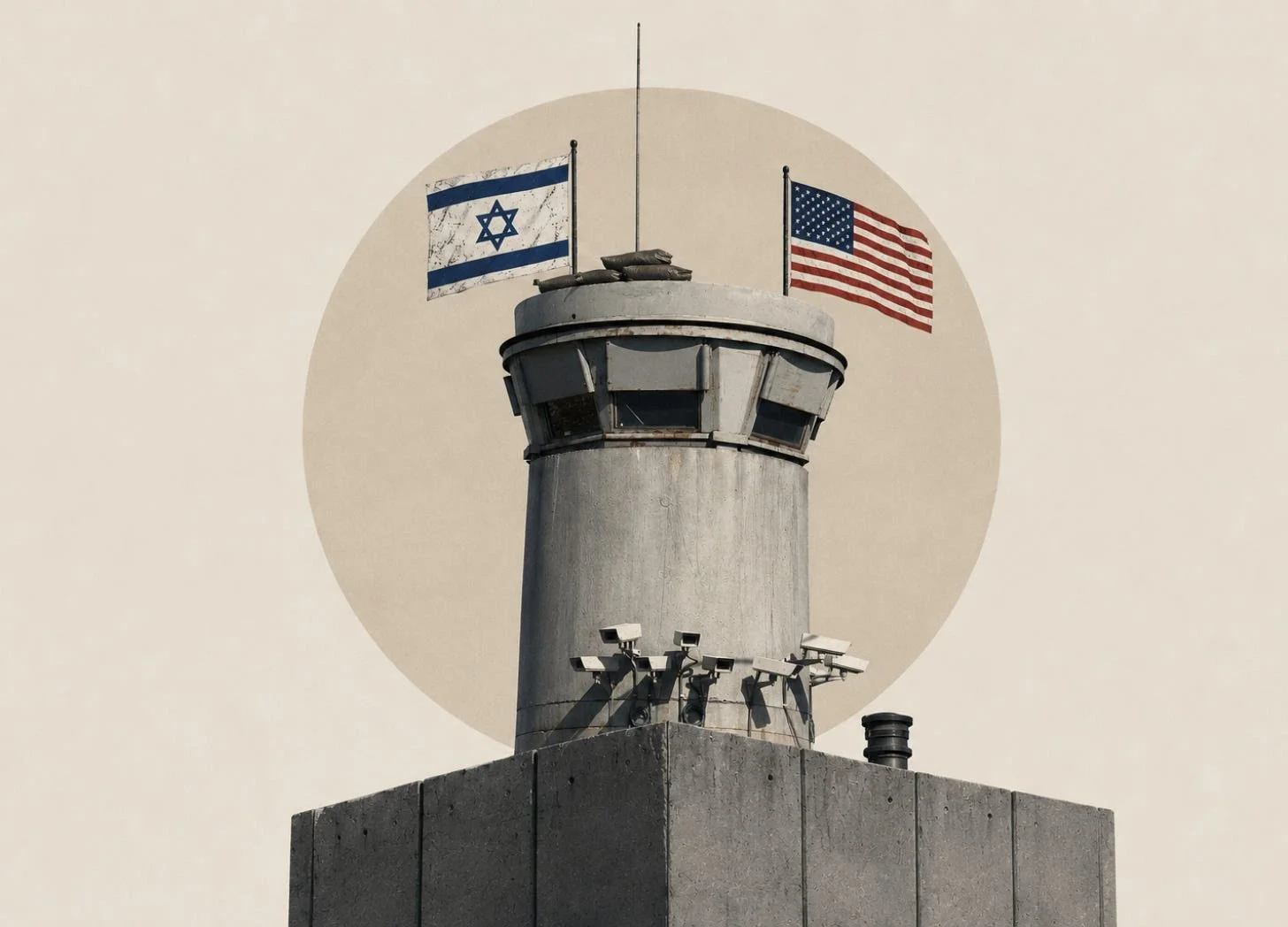
For Palestinians, these technologies are not futuristic concepts discussed in conference rooms or investor presentations. They are daily realities through checkpoints, military raids, surveillance towers, biometric databases, predator drones, and a network of systems that determine who is monitored, restricted, detained, and killed.
That reality is inseparable from Israel’s rise as a global security and AI hub.
Israel does not merely sell technology. It sells technology that it argues has been tested and proven under real-world conditions. “Battle-tested” has become one of the most valuable marketing labels in the country’s defense and technology sectors.
The conditions that have subjected Palestinians to generations of a violent, high-tech occupation have also created a pipeline for the same technologies to be exported around the world.
In many ways, Palestinians have borne the cost of an industry that now generates billions in investment, acquisitions, government contracts, and military partnerships.
Profiting from the “Palestine Lab”
This pattern appears repeatedly. Technologies deployed against Palestinians are marketed as proven. Investment flows toward the companies behind them. Those companies receive contracts from governments and law enforcement agencies. The technologies are then integrated into policing, border enforcement, and surveillance systems elsewhere.
For example, Eric Trump recently invested in a major $1.5 billion deal involving Israeli drone manufacturer Xtend, which manufactures drones that have reportedly been used by the Israeli military in Gaza while the company simultaneously pursues contracts with the U.S. Department of Defense.
Federal agencies like ICE and DHS hold contracts with Paragon, an Israeli spyware company, as well as Cobwebs Technologies, an Israeli surveillance firm acquired by PenLink, a major provider of investigative and intelligence software to U.S. law enforcement agencies. The deal created yet another pathway through which surveillance technologies developed within Israel’s security ecosystem became tools used by police, immigration authorities, and federal investigators in the United States.
U.S. companies are also cashing in. After October 7, U.S.-based drone manufacturer Skydio sent hundreds of drones to Israel. The genocide in Gaza became a sinister testing laboratory for its drone technologies.
Today, Skydio has contracts with dozens of police departments, sheriff’s offices, emergency response agencies, and public institutions throughout the United States. In New Orleans, local organizers and civil liberties advocates led by groups like Eye on Surveillance have spent more than a year fighting the expansion of police biometric and drone surveillance technologies.
Unit 8200 and the export of surveillance “expertise”
Often described as Israel’s equivalent to the U.S. National Security Agency (NSA), Unit 8200 functions as far more than an intelligence agency. It operates as a talent pipeline connecting military intelligence to the private technology sector.
Young Israelis develop expertise in cyber operations, surveillance, artificial intelligence, data collection, and targeting systems through military service. Many then move into the private sector, launch startups, attract venture capital, and eventually sell their companies to major technology firms. Others become executives, investors, advisors, and board members.
The result is a system in which military intelligence expertise becomes private industry, private industry becomes national security infrastructure, and national security infrastructure becomes a corporate cash cow.
Today, Unit 8200 alumni via the “8200 Alumni Association“ can be found throughout Big Tech companies, cybersecurity firms, venture capital funds, and AI startups.
Apple’s recent acquisition of Israeli AI company Q.ai serves as one of many examples. Through the transaction technology and leadership connected to Israel’s military-tech ecosystem, including individuals tied to Unit 8200, were incorporated into one of the most powerful corporations in the world. And they brought their experience from upholding the occupation of Palestine with them.
The walls between the Pentagon, Silicon Valley, Wall Street, and the surveillance industry are getting thinner by the day. What once looked like separate institutions increasingly functions as a single ecosystem.
The Big Tech-Israel alliance
Today, nearly every major technology company maintains a substantial presence in Israel and holds contracts with the Israeli government and military, including Google, Amazon, Microsoft, Apple, Nvidia, Intel, Meta, Oracle, and Cisco.
In 2021, Google and Amazon signed Project Nimbus, a $1.2 billion cloud and AI contract with the Israeli government. Leaked documents later revealed unusual provisions that reportedly limited the companies’ ability to suspend services and provided extraordinary protections for Israeli access to cloud infrastructure.
Microsoft employees spent years organizing around the company’s relationships with Israeli military and government entities. Their efforts ultimately forced the company to commission independent reviews examining how its technology is used in conflict settings.
Cisco also deepened its relationships with Israeli institutions during the genocide in Gaza, highlighting how major technology companies increasingly function as cogs within a broader security machine, rather than neutral service providers.
Nvidia has gone even further. The company is building a massive AI campus in Israel capable of housing more than 10,000 employees. CEO Jensen Huang has referred to Israel as Nvidia’s “second home,” underscoring how central the country has become to the company’s long-term AI strategy.
These are not isolated business decisions. They are evidence of a growing integration between Silicon Valley’s Big Tech oligarchs and Israel’s technology sectors.
A global turn towards weaponized AI
In December 2025, Israel joined the U.S.-led Pax Silica initiative alongside Japan, South Korea, Australia, the UAE, Singapore, the Netherlands, and the United Kingdom. The initiative focuses on securing AI supply chains, semiconductors, critical minerals, energy resources, manufacturing capacity, logistics networks, and data center infrastructure.
Pax Silica shifts the conversation away from traditional military hardware and toward control over the infrastructure that powers artificial intelligence. The competition is no longer only about weapons systems. It is increasingly about chips, cloud infrastructure, energy systems, and supply chains.
This is the terrain on which geopolitical power is increasingly exercised.
The U.S. military is also making changes internally in response to these global shifts.
The Pentagon has entered into contracts with companies including OpenAI, Google, Microsoft, Nvidia, Oracle, Anduril, Amazon Web Services, and SpaceX as part of a broader effort to integrate artificial intelligence into military planning, logistics, intelligence analysis, surveillance, and battlefield operations.
At the same time, senior technology executives at these companies are increasingly moving into military advisory structures and defense programs. Today, the wall that once separated Silicon Valley from the national security state is effectively nonexistent.
Resisting tech-powered state violence
Increasingly, the same repressive technologies that have infiltrated Palestinians’ lives are finding their way into immigration enforcement systems, police departments, schools, workplaces, and national security agencies far beyond Israel’s military apparatus.
But one of the biggest mistakes we can make is assuming this militarized tech take-over is inevitable. As Palestinians have shown us time and again, no form of oppressive system is invincible.
Workers at Microsoft forced independent reviews of the company’s contracts with the Israeli military and brought about the termination of Microsoft’s services to Unit 8200––the first known instance of Big Tech cutting a contract with the Israeli military due to human rights concerns . Google and Amazon workers built international campaigns challenging Project Nimbus, such as the No Tech for Apartheid campaign. Communities across the country have pushed back against Flock Safety surveillance systems, challenged police technology contracts, and organized against the construction of energy-intensive AI data centers. In city after city, ordinary people have demonstrated that public pressure can disrupt projects that once appeared unstoppable.
These fights are ongoing. But they demonstrate that this ecosystem is vulnerable.
Shutting down the plan to shift the U.S.-Israel military alliance into a more insidious partnership is about more than stopping a single policy. It is about interrupting the construction of a military-tech ecosystem that links Silicon Valley, Wall Street, the Pentagon, and Israel’s security establishment through shared contracts, shared infrastructure, and shared financial interests.
It’s also one piece of a much larger fight against the tech oligarchy’s dystopian plans to transform our communities into surveillance prisons, prevent us from organizing and challenging state power, and siphon our community resources to ensure their oppressive systems have what they need to expand.
As we move forward, the struggle will require deeper alliances between workers fighting the tech oligarchy, Palestine organizers, civil liberties advocates, labor unions, climate justice movements, abolitionists, immigrant rights activists, and anti-surveillance activists. Together, our communities must come to terms with the fact that the struggle against data centers and the spread of mass AI-powered surveillance will never be won as long as the U.S.-Israel alliance remains intact. The fight to dismantle Israeli apartheid and settler colonialism will also never succeed unless the destructive U.S.-Israel AI and military tech industries are eradicated.
Palestine is not separate from this fight—it is one of its frontlines, and in many cases, ground zero for resistance to the newest technologies of domination and control.
The fight for Palestinian freedom is inseparable from the fight against data centers, mass surveillance, militarized policing, detention and deportation, and the destructive power of Big Tech.
The proposals to transform the U.S.-Israel alliance like those outlined in the NDAA haven’t emerged because our movements have failed. They have emerged precisely because our movements are winning. The cracks in their system are already showing. The question is whether we’ll be able to take our collective organizing to the level required break them wide open.