
June 25, 2026 at 8:52 am. Opinion by Hossam Shaker
People can be consciously aware of atrocities without experiencing the moral outrage those horrors warrant. This emotional detachment is particularly pronounced when atrocities target “those who are different,” occur in seemingly “remote” lands, or repeat so frequently that they dissolve into a familiar, predictable monotony. Psychological frameworks explain this affective insularity through cognitive biases like the “just-world fallacy,” which blocks empathy in otherwise deserving cases to protect one’s own psychological comfort. Alternatively, it manifests as victim-blaming to rationalize aligning with the oppressor, or as compliance with propaganda narratives designed to dehumanize victims and render them unworthy of concern.
The rendering of atrocities into something ordinary through repetitive exposure systematically erodes the human capacity for a fittingly shocked response. This was vividly demonstrated as Israeli forces systematically targeted hospitals across the Gaza Strip one after another, until such strikes became routine footnotes in daily news cycles. A similar desensitization occurred regarding the targeted attacks on United Nations facilities. Once an initial war crime is permitted to pass, its predictable repetition fosters a form of emotional conditioning among the public—even alongside the abstract knowledge that a grave violation is occurring. The global public has grown accustomed to watching high-rise residential blocks collapse in seconds under Israeli bombardment. Consequently, this recurring crime no longer registers as an anomaly, so long as it remains confined to Gaza. This shift can be measured by comparing the fierce global condemnation that followed the May 15, 2021, destruction of Gaza City’s 11-story al-Jalaa Tower with the relative apathy with which the systematic destruction of Gaza’s remaining residential high-rises through a series of Israeli airstrikes was met in September 2025. Breaking free from this paralyzing sense of desensitisation is a profound challenge if our world is to avoid acclimatizing to atrocities in the twenty-first century.
Another critical dilemma is that our perception of the gravity of such brutality can be disrupted when they are executed through modern, highly sophisticated tools.
Read the whole opinion piece in the Middle East Monitor here.
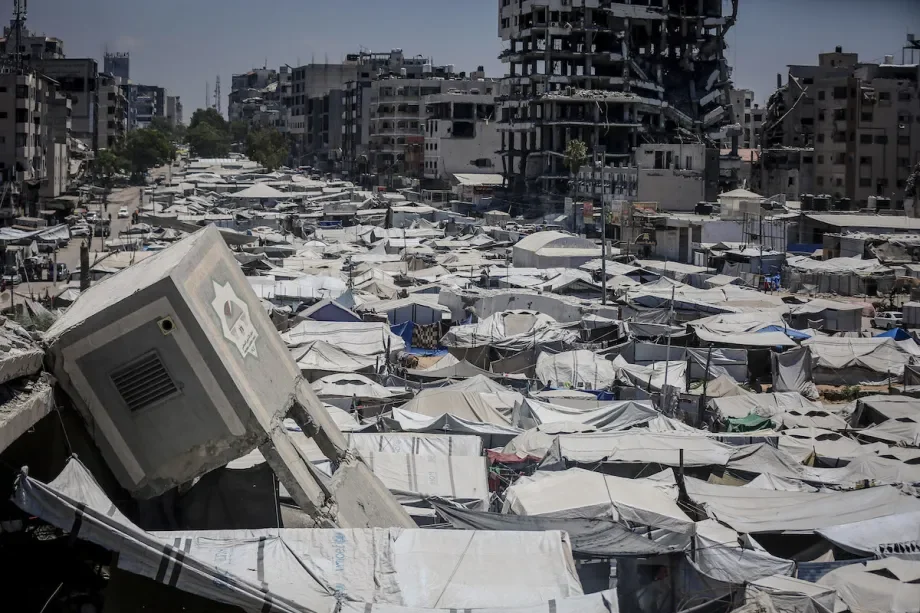
A view of makeshift tent camp as civilians trying to survive face major difficulties in accessing basic needs such as food, clean water, and healthcare in severely overcrowded tent camps amid a severe humanitarian crisis caused by the conflict, in Gaza City, Gaza, Palestine, on June 19, 2026. [Saeed M. M. T. Jaras – Anadolu Agency]