via NewsCord
(NOTE: Paragraphs added to make reading on line easier.)
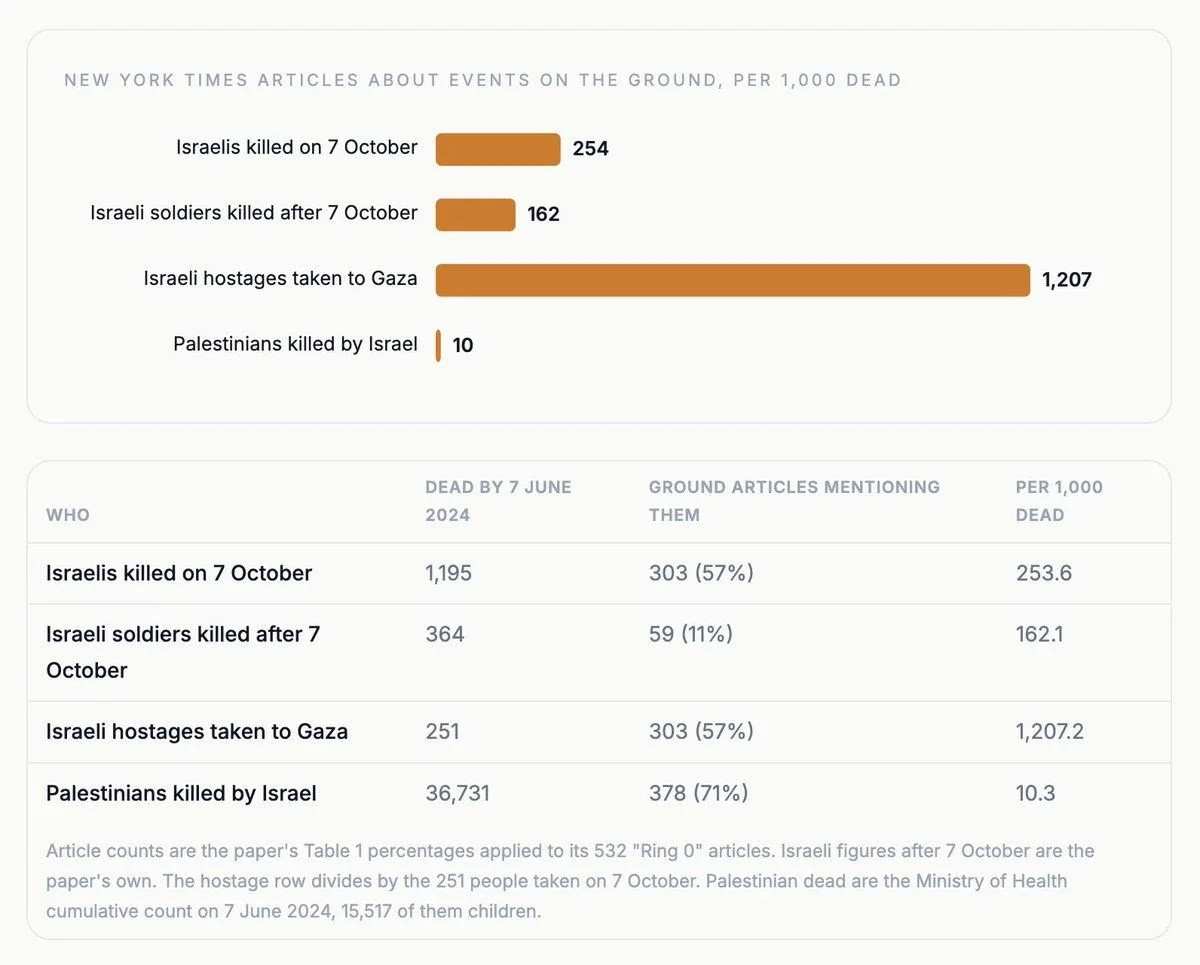
Exclusive: Yale study attempting to 'prove' anti-Israeli bias at NYT does the opposite and reveals that an Israeli killed on 7 October got 25 times the coverage of a Palestinian killed by Israel. The Yale study was written by Edieal Pinker and subsequently pushed by Israeli propaganda outfits like HonestReporting, Israel National News and by the Jerusalem Post and the Times of Israel.
The NYT's coverage of Israeli deaths is wildly disproportionate to its coverage of Palestinian deaths. The study just never did the one very relevant sum that reveals it, which raises a serious question about how Yale let its name go on this. The study's headline "revelation" is that the NYT mentions Palestinian deaths more often than Israeli deaths and Israeli captives. What it never did is work that out per 1,000 dead, or any other normalisation. It is simple. The more people are killed, the more coverage there is. The question is whether it is proportionate. So divide the study's own numbers by the death tolls: in the study's own window, 7 October 2023 to 7 June 2024, Israel had killed 36,731 Palestinians on the Gaza health ministry's count. That count, by the way, is a floor: the Lancet puts the true figure 41 per cent higher. The toll today is past 73,000 and scholars say the real number is far above that. The result, from the study's own tables: an Israeli killed on 7 October got 25 times the coverage of a Palestinian killed by Israel. An Israeli soldier killed in Gaza got 16 times.
One Israeli hostage got more articles than a thousand dead Palestinians. Now, who wrote it? Pinker is a professor of operations research. He is an Israeli citizen who made aliyah in 1989, enlisted in the IDF and, in his own words, was "on the streets of Gaza" the following year, then patrolled southern Lebanon. He told the Times of Israel he did this study because American readers "were not getting a clear understanding of how Israelis were experiencing the war". The journal printed: "No potential conflict of interest was reported." Any outlet that ran this study without doing that sum (per 1,000 / any statistical normalisation procedure) has told you everything you need to know about itself. Full breakdown of the 'study' available on our site under the Editorials section.