By Romana Rubeo
Romana Rubeo traces nearly a century of Palestinian women’s resistance, restoring organizers, fighters, prisoners, journalists and caregivers to their central place in national history.
In October 1929, hundreds of Palestinian women gathered in Jerusalem. They came from Jaffa and Haifa, Nablus and Akka, Ramallah, Jenin, Safad and elsewhere, at a moment of deep political transformation. Their meeting, held on October 26, became known as the first Palestine Arab Women’s Congress.
The participants assembled to discuss Palestine. The issue had acquired particular urgency. In 1917, the Balfour Declaration had committed Britain to supporting the establishment in Palestine of a “national home for the Jewish people,” while making no comparable recognition of the Palestinian Arab population’s political or national rights. Additionally, under the British Mandate, Zionist immigration increased significantly, accompanied by land purchases and the growth of institutions intended to support the development of a Jewish national project in Palestine.
In its resolutions, the Women’s Congress rejected the Balfour Declaration, opposed Zionist immigration, and demanded the establishment of a representative national government. The Palestinian women later presented these demands to the British High Commissioner and organized a motorcade through Jerusalem, stopping at foreign consulates to deliver their political message.
Among them were Tarab Abd al-Hadi, who hosted preparatory meetings for the congress in her Jerusalem home; Matiel Mogannam, who would later publish ‘The Arab Woman and the Palestine Problem’ in 1937; and Zulaykha al-Shihabi, whose political activism would continue through the revolt of the 1930s and long after the Nakba and the creation of Israel atop the ruins of historic Palestine in 1948.
Women’s charitable, educational and social organizations had already become increasingly politicized during the early years of British colonial rule. However, in 1929 Palestinian women collectively asserted themselves as political subjects within the developing national movement.
For much of the twentieth century, and continuing into the twenty-first, representations of Palestinian women in Western political and media discourse have frequently resorted to a limited set of archetypes. In the best-case scenario, the Palestinian woman is the hapless victim: the refugee mother, the grieving widow, the woman fleeing destruction. In another register, she becomes the “oppressed Arab woman,” constrained by religion, tradition and patriarchal society, waiting to be emancipated. At certain historical moments, another image has interrupted these representations: the woman with the gun, who has immediately been labeled as ‘terrorist’.
Truth is, passivity was never the historical condition from which Palestinian women had to emerge. It was, rather, a condition repeatedly imposed upon them in representations that struggled to recognize forms of political agency that did not conform to predetermined understandings of Arab women.
As expressed by Jane Hardy and Katie Coles in their essay, Palestinian women’s resistance: from the Great Revolt to the First Intifada (1936 to 1993):
“Orientalist thinking, a current in some ‘feminist’ movements from imperialist countries, has portrayed Palestinian women as lacking agency and being ‘the silent victims of the religious, patriarchal and cultural oppression, as lacking control over self and body’ and in need of rescue. Yet, despite this rhetoric depicting Palestinian women as passive bystanders, with their role in resistance invisible or marginalised, they have consistently been activists in Palestine’s history of struggle, often at the forefront.”
Indeed, Palestinian women organized politically even before the Nakba. They participated in the Great Revolt of 1936–39. Some fought actively, while others transported weapons, intelligence, money, and medicine, helped conceal rebels, and treated the wounded.
In 1948, during the violent expulsion of Palestinian inhabitants from historic Palestine, women participated in the defense of their communities in 1948. After the Nakba, they rebuilt political organizations in exile. They joined clandestine cells and guerrilla organizations, experienced imprisonment and interrogation, organized prisoners, produced revolutionary literature and helped construct the mass institutions that sustained the First Intifada. They participated in popular resistance against the occupation in the West Bank and in the Great March of Return in Gaza. They documented Israeli violence and maintained social and political networks through siege, displacement and war.
This article aims to restore Palestinian women to a political history from which they have too often been analytically separated.
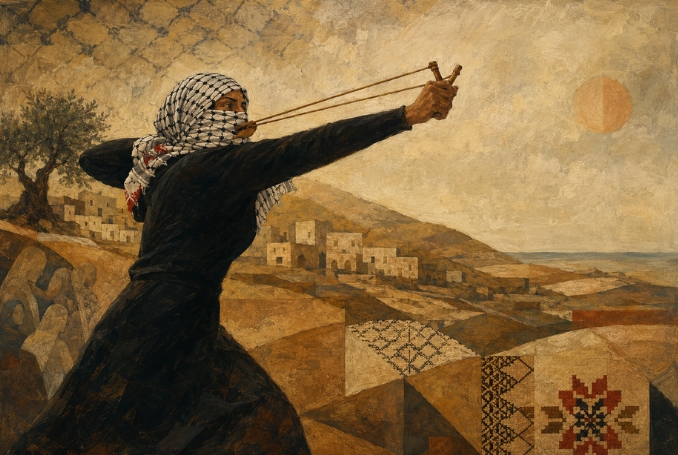
Romana Rubeo traces nearly a century of Palestinian women’s resistance, restoring them to their central place in national history. (Illustration: Palestine Chronicle)