VIA The New York Times
By Reid J. Epstein
Aug. 5, 2026
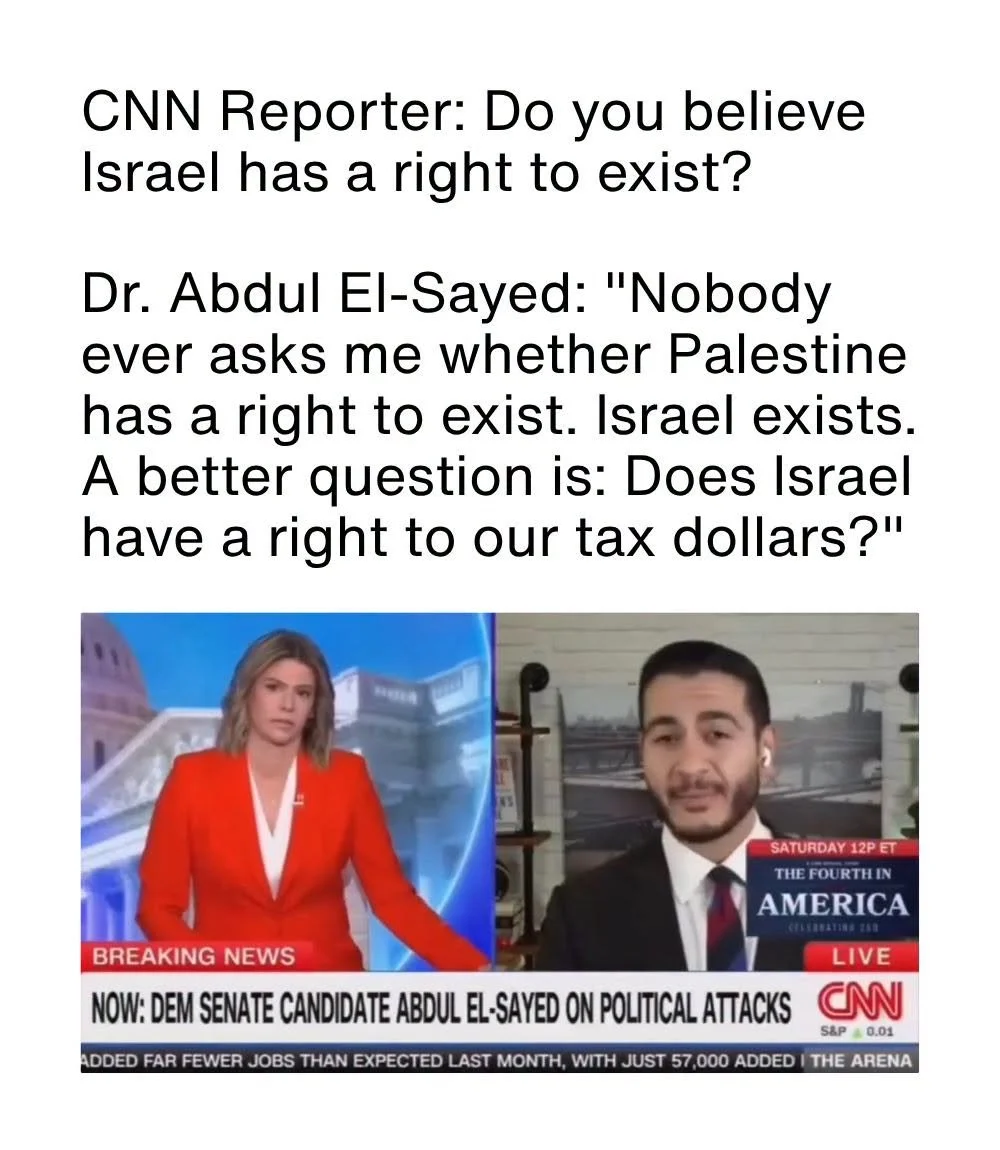
Dr. Abdul El-Sayed narrowly won the Democratic primary race for Senate in Michigan on Tuesday, according to The Associated Press, giving progressives a victory that signaled liberal voters’ anti-establishment mood and shifting sentiment against Israel.
Dr. El-Sayed, 41, a former public health official, narrowly defeated Representative Haley Stevens, a four-term moderate, in a hostile race that was dominated by the politics of Israel and the role of big money in American elections.
He fiercely criticized Israel’s actions in Gaza and promised to pull back American military support, while she vowed to continue sending U.S. military aid to Israel without conditions.
While most Michigan political observers expected in the campaign’s final days that Dr. El-Sayed would prevail, and polls showed him leading by a significant amount, the close margin between him and Ms. Stevens pointed to the tough general-election battle to come for Democrats.
Dr. El-Sayed overcame more than $60 million in super PAC spending on behalf of Ms. Stevens, including at least $30 million tied to the American Israel Public Affairs Committee, the nation’s most influential pro-Israel group. Another $30 million came from so-called dark-money groups whose donors remain hidden.
But even as he was vastly outspent on advertising, Dr. El-Sayed turned Ms. Stevens’s financial advantage into a liability, casting his bid as a grass-roots campaign up against the well-funded establishment. “The money against the many,” as he put it in stump speeches.
His primary victory delivers another shock to a Democratic Party in which left-wing challengers across the country have ousted longtime incumbents or beaten rivals supported by party leaders in Washington.
Dr. El-Sayed was backed by leading progressives, including Senator Bernie Sanders of Vermont and Representative Alexandria Ocasio-Cortez of New York, who went to Michigan to campaign for him. Ms. Stevens was supported by Senator Chuck Schumer of New York, the minority leader, as well as Gov. Gretchen Whitmer of Michigan and other prominent state Democrats.
In the general election, Dr. El-Sayed will face former Representative Mike Rogers, a Republican, in a race widely seen as crucial for control of the Senate. Mr. Rogers was a moderate Republican during his seven House terms, but like many others in his party, he has become an acolyte of President Trump. Mr. Rogers narrowly lost a 2024 Senate bid to Elissa Slotkin, even as Mr. Trump carried the state on his way back to the White House.
Democratic leaders worried — and Ms. Stevens argued — that Dr. El-Sayed could be the weaker candidate in the general election. He is a notably left-wing candidate in a battleground state, with his calls for abolishing Immigration and Customs Enforcement and ushering in universal health care.
“We’ve got to do one thing, and that’s go beat Mike Rogers,” Ms. Stevens said in an interview last month. “We’ve got to be eyes on the prize, and that’s winning in November.”
The Michigan-born son of Egyptian immigrants, Dr. El-Sayed made no secret of his ambitions of progressive leadership within the Democratic Party. He said that he hoped to recalibrate the party’s politics on Israel and wanted to make opposition to funding its military a litmus test for Democrats running for president in 2028.
Defanging AIPAC, he argued, was crucial: “I want AIPAC to cease to be a force in Democratic primaries,” he said in an interview last month. “The best way to do that is to defeat them in a state like Michigan.”
He made much of his campaign pitch a rebuke of both the group and corporate politics. At his events, attendees chanted his slogan along with him: “Money out of politics, money in your pocket, Medicare for all.”
It was no accident that Israel emerged as a fault line in a major Democratic primary in Michigan. The state, which has large numbers of Muslim and Jewish voters, delivered a rebuke to President Joseph R. Biden Jr. in 2024, when 13 percent of Democratic primary voters voted for “uncommitted” in protest of his policy on Israel amid its war with Gaza.
Dr. El-Sayed’s base was seen as the state’s Arab and Muslim voters, as well as younger and more liberal Democrats. Ms. Stevens had pushed to win over the state’s Black voters, whom AIPAC had targeted with a flood of advertisements featuring a clip of former President Barack Obama praising Ms. Stevens during her first run for Congress in 2018.
The contest, which until early July also included Mallory McMorrow, a state senator who sought a middle ground between Ms. Stevens and Dr. El-Sayed, became quite nasty in its final weeks.
So many of Dr. El-Sayed’s supporters mocked Ms. Stevens’s mannerisms and Michigan accent that he urged them to stop making fun of her “for things that have nothing to do with her policies or politics.” In the final days before the primary, Ms. Stevens lashed out at Dr. El-Sayed, posting on social media, “Everyone in America understands you want to blame all of your problems on Jewish Americans.”
Now, Dr. El-Sayed will face the task of uniting Michigan Democrats for the general election.
——————
Via the Other 98%: