Israel recently damaged Lebanon’s vital Qaraoun Dam, raising fears of a structural failure. Experts say the attack reflects Israel’s long-standing ambition to control Lebanon’s water — and mirrors the water apartheid it imposes on Palestinians.
BY FADIA JOMAA JUNE 29, 2026 via Mondoweiss
Before he could make sense of what happened, Ali Oday Yassin felt the ground beneath him tremble.
Yassin owns a roadside rest stop next to Qaraoun Dam, a cornerstone of Lebanon’s water and energy infrastructure. On May 26, Israeli airstrikes hit targets perilously close to the dam, tearing apart adjacent access roads and scattering debris into Lake Qaraoun. Shrapnel hit Yassin’s property, which sits just 200 meters from the dam.
“It was a brutal moment. The ground shook under our feet, then the place filled with dust and smoke,” said Yassin, who recalled scrambling to check if everyone was safe.
Then, a disturbing question lingered: “We asked ourselves why Israel would target the dam?” said Yassin.
Built in 1959, the dam impounds Lake Qaraoun, Lebanon’s largest water reservoir. It feeds four hydroelectric power plants and irrigates about 30 percent of the country’s farmland. The dam is central to the Litani River system, the backbone of Lebanon’s water security from the Bekaa valley to the south.
The latest Israeli strikes, said Sami Alawieh, Director General of the National Litani River Authority, constitute a national threat. “The area struck is not a peripheral road or an ordinary access route,” he said. “It is part of the engineering system connected to the dam’s protection and stability, specifically the road adjacent to the embankments and rocks forming the protective layer of the dam’s rear slope.”
As Lebanon grapples with the fallout from climate change, declining precipitation, and growing demand on its water supplies, the dam is vital. “We do not treat Qaraoun Dam as a local installation,” he said. “Any threat to it is a threat to public safety and to Lebanon’s water and economic security.”
The Litani River has been central to Israeli military strategy since fighting with Hezbollah erupted in October 2023. Defense Minister Israel Katz has said Israeli forces will hold a “security zone” extending up to the river until Hezbollah is “removed,” and the IDF now occupies roughly a fifth of Lebanese territory, with units in some places pushing north of the Litani itself. Israeli airstrikes have systematically destroyed bridges and roads along the river, effectively severing the south from the rest of the country.
Today, as Israeli leaders insist they will not pull troops back despite the U.S.-Iran agreement, the targeting of Qaraoun Dam adds another potentially disastrous layer to a campaign that has steadily turned the river into a frontier.
Israel’s century-long colonial plan for the Litani River
Israel’s ambitions around controlling the Litani River are not new.
As far back as 1919, the World Zionist Organization presented a map to the Paris Peace Conference that included the Litani River within the borders of a future Jewish state. By 1947, Ben-Gurion was openly asserting that the Litani should form Israel’s northern border.
Over the following decades, Israel returned to the river repeatedly: in 1978, during Operation Litani, Israeli forces invaded Lebanon up to the river; in 1982, Israel captured extensive areas up to the Litani, including Lake Qaraoun itself, launching an 18-year occupation of southern Lebanon; and during the 2006 war, Israeli ground forces advanced to the banks of the river in the final hours before the ceasefire. The 2026 strike on Qaraoun fits squarely within this pattern.
In a report published just days before the May strike by the Carnegie Middle East Center, nonresident scholar Camille Ammoun described Lake Qaraoun as sitting at the center of one of the most fertile areas of the Levant, “a reversed L-shaped basin vital to Lebanon’s agricultural and water systems.”
The dam has been battered by overlapping crises, the report pointed out. In the summer of 2025, Lebanon experienced its most severe drought on record, pushing Lake Qaraoun to its lowest water inflow since the dam’s construction. Pollution from untreated wastewater and agricultural runoff has rendered large parts of the lake unsafe even for irrigation. Israeli strikes, in other words, are landing on a water system already weakened by drought and contamination — intensifying existing pressures.
The May strikes were not the first time Israel attacked the area. On April 4, the vicinity of the lake was struck several times. Villages including Sohmor, Yohmor, and Mashghara were bombed by Israeli aircraft, and a drone struck a car 400 meters from the dam itself. Israeli bombardment in 2024 disrupted agriculture by restricting access to land, damaging crops, displacing farmers, and breaking supply chains.
The 2026 war, Ammoun warned, will likely produce similar – if not worse – fallout. With the geographic spread of the war widening, the dam and its surrounding area are more exposed. A prolonged displacement crisis likely means people returning to damaged homes, disrupted services, and polluted land.
An entire region in danger
So far, technical assessments have not found structural damage to the dam from the Israeli strikes.
But the danger, Alawieh said, is that repeated hits on auxiliary structures, embankments, and operational and monitoring systems can accumulate, make it more likely that the dam could fail in the future.
“Any small malfunction, if not monitored in time, can become a major danger,” said Alawieh. “We are talking about the largest water installation in Lebanon. One that stores tens of millions of cubic meters of water.”
If the dam were to fail, the outcome would be catastrophic: a sudden flood wave extending from western Bekaa southward. It could inundate villages and towns in the lower basin, and put residents, infrastructure, roads, bridges, and agricultural and electrical installations at risk.
Next to the dam is the village of Qaraoun. Before the war, it was a popular local tourist destination: cafés, parks, and waterfront spaces typically draw a rush of visitors, particularly in the summer.
This year, the scene is quite different. After the May strikes around Qaraoun, the Litani River Authority declared the area a closed military zone, and the cafés shuttered. In place of tourists, the village is now hosting roughly 5,000 Lebanese displaced from neighboring towns who are sheltering in overcrowded schools near the dam, according to municipal records. They are among the over one million Lebanese displaced by Israel’s scorched earth military campaign to create a buffer zone south of the Litani river.
That makes the dam’s exposure to attacks even more dangerous.“Any damage to the dam or the infrastructure would directly affect water, electricity, and people’s lives,” said Shadia al-Aqdi, a hairdresser who runs her salon in the village. “The fear hit first, then panic and confusion — the strike came without any warning.”
Rabih Chebli, a member of the Qaraoun municipal council, told Mondoweiss that displaced families remain unable to return to their homes, as they’re weary of renewed strikes.
“The strikes caused damage to some of the dam’s associated structures and cut the road at several points,” he said.
Water as an instrument of control
Israel’s strikes around Qaraoun Dam draw parallels to its tactics in occupied Palestine, where control over water resources has long been a tool of settler colonialism.
Amr Wawi, a governance consultant from Palestine, sees the strikes near Qaraoun not as a coincidence, but as a key part of Israel’s plans to control southern Lebanon.
“Targeting infrastructure serves both the goal of weakening steadfastness and creating conditions that push toward displacement and the emptying of areas, especially southern Lebanon and the Litani basin, by striking vital resources, water above all,” said Wawi.
The strikes in Lebanon, like those in Gaza, are part of a systematic policy.
“In Gaza, wells, water networks, and storage tanks were directly targeted as part of a clear strategy to strike the foundations of life,” he said. “In Lebanon, targeting vital installations, including dams, aims to make life in surrounding areas more difficult and to strike the capacity for steadfastness.”
Threatening Lebanon’s most important water source creates a similar dynamic, said Wawi: it can be used as a political tool, creating conditions of extreme vulnerability. That gives Israel leverage, allowing it to negotiate from a position of strength and reduce its opponents demands.
Still, some distinctions remain between the case of Palestine and Lebanon.
“In Palestine, there is a policy of direct control and the feeding of settlements at the expense of Palestinian residents, with the goal of entrenching dependency, draining the concept of statehood of its sovereign content,” he said. “In Lebanon, the dominant approach is destructive, targeting critical infrastructure to weaken the capacity for steadfastness rather than seeking direct control, though historical ambitions exist.”
Back on the road along the dam, Yassin surveys a landscape that has gone quiet.
“The timing compounded the damage,” he said. “Summer had been counted on to compensate for the losses of the ongoing war, a season built on the tourism that clusters around the lake, where restaurants and parks draw both local families and visitors from abroad.”
For Yassin, the latest strikes mark a major escalation. “In the 2024 war, a drone strike near the property damaged my car and caused partial damage to the rest stop,” he said. “This time it was a full on airstrike.”
“Today our breath and our livelihood have been cut off,” he said.
This article is published in collaboration with Egab.
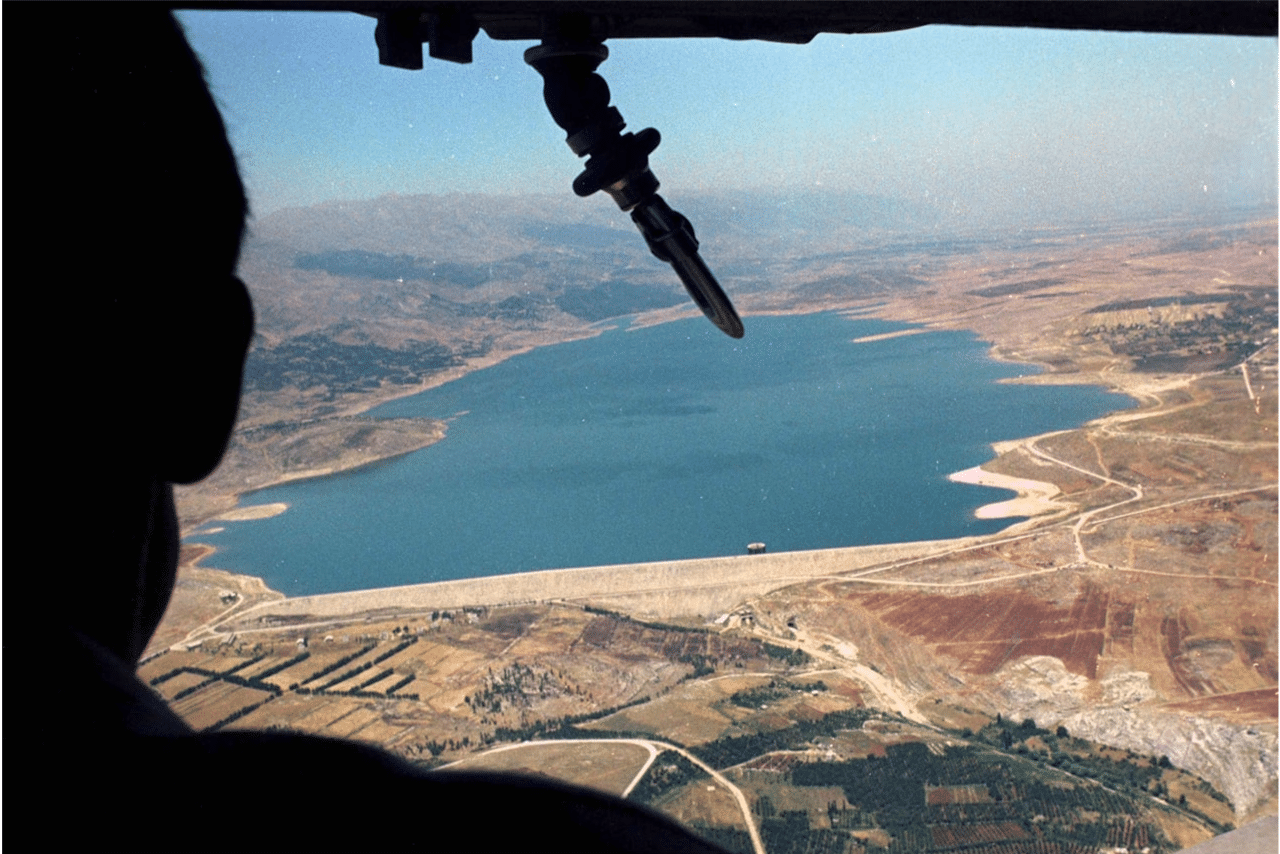
AN ISRAELI MILITARY HELICOPTER FLYING OVER LEBANON’S LAKE QARAOUN DURING THE 1982 WAR. (PHOTO: IDF SPOKESPERSON’S UNIT, CC BY-SA 3.0)