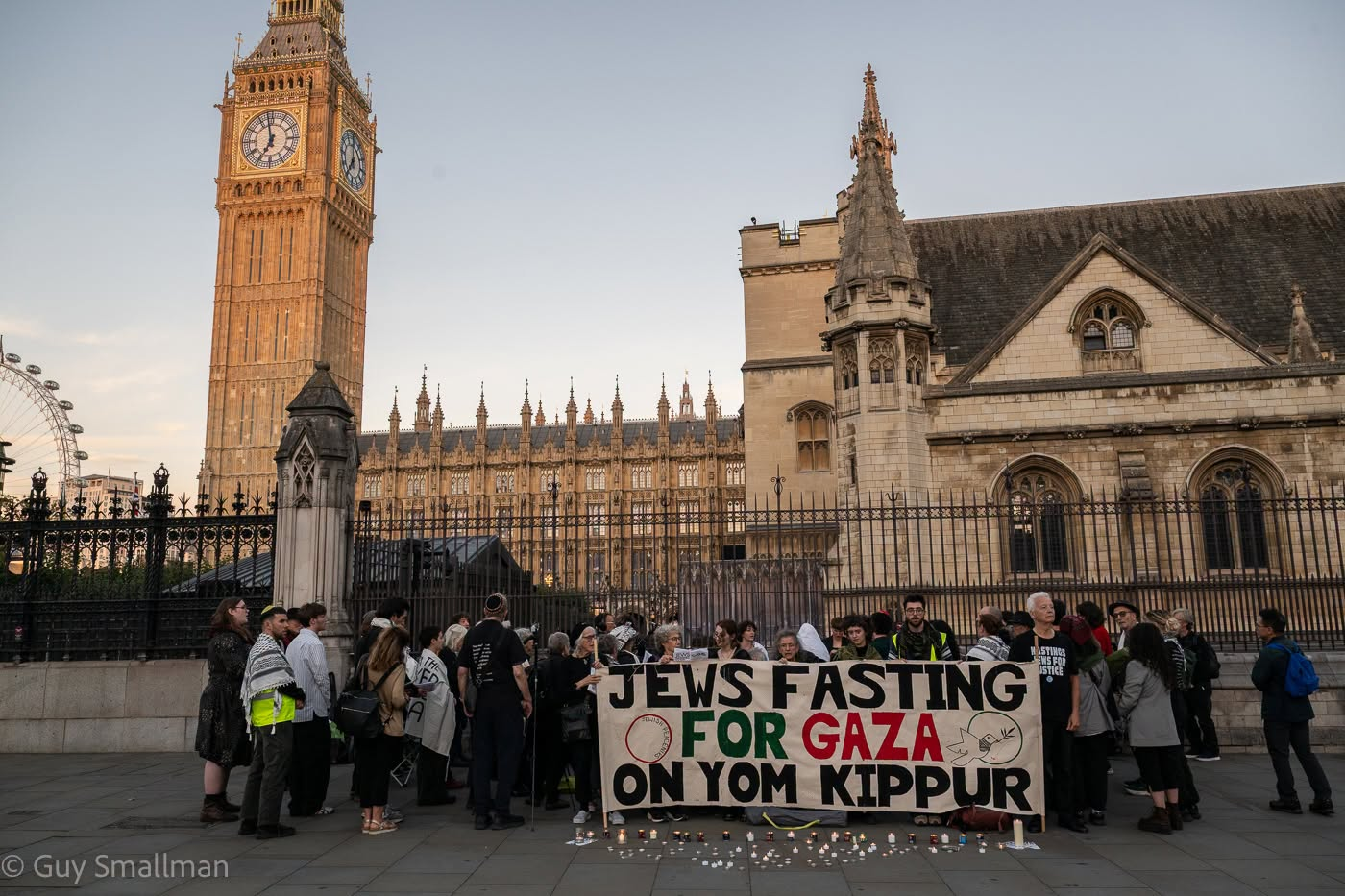
Yom Kippur outside UK Parliament
Gaza Health Ministry says WHO to stop diesel supplies to over 20 hospitals. 9/14/26
via the Middle East Monitor
Gaza Health Ministry Director-General Munir al-Bursh said Monday that the World Health Organization (WHO) has decided to stop supplying diesel to more than 20 hospitals and health centers in the besieged coastal enclave due to a funding shortfall, Anadolu reports.
“In light of the severe shortage of fuel and oils, and the failure to deliver the minimum needed to operate hospitals and health centers in the Gaza Strip, the WHO announced the suspension of diesel supplies to more than 20 hospitals and health centers, starting Sept. 19, due to a lack of funding,” Bursh said in a statement.
There was no immediate comment from the WHO on the decision cited by Gaza’s Health Ministry, although the organization has warned in recent months of declining funding for its activities and programs.
“The limited quantities of fuel reaching the enclave barely keep health facilities alive,” Bursh said.
“The halt in supplies does not only mean generators going dark, but the shutdown of operating rooms and intensive care units, the disruption of ventilators and oxygen stations, and threats to the lives of children in incubators, dialysis patients, the wounded and those with chronic diseases,” he added.
He said that the crisis would also paralyze ambulances and cold chains for medicines and vaccines.
“The fuel crisis is pushing hospitals toward complete shutdown and leaving patients facing preventable death,” Bursh said, describing the cutting of fuel from hospitals as “silent killing of patients in their beds.”
He called on the WHO, donors and the international community to assume their urgent responsibilities, ensure continued supplies of fuel and oils in sufficient quantities, and guarantee their safe and sustainable delivery to all health facilities.
READ: UN chief denies plans to transfer Gaza education system to UNESCO
Power generators stop working
The announcement coincides with a shortage of oil and spare parts for power generators operating in Gaza’s hospitals, which caused several of them to stop working, according to a Health Ministry statement Sunday.
“The past few days have seen several generators stop working due to the lack of oils, spare parts and sufficient fuel quantities,” the ministry said.
It added that the shortage of generator oil in Gaza hospitals is worsening the difficulty of keeping them running to meet daily electricity needs.
Power generators are the main source of electricity for hospitals to operate vital departments and medical equipment amid a complete power outage across Gaza for the third consecutive year since the start of Israel’s genocidal war in October 2023.
The generators also stop working because of fuel shortages, amid Israel’s closure of the Kerem Shalom crossing between Gaza and Israel since October 2023 and the Israeli army’s occupation and control of the Rafah crossing between Gaza and Egypt since May 2024.
Since then, the two crossings have been opened only on a limited basis for the passage of dozens of patients, wounded people and returnees to Gaza, as well as the entry of limited humanitarian, relief and medical aid.
The Gaza government media office has repeatedly said Israel is evading its obligations under the ceasefire agreement in force since Oct. 10, 2025, including allowing the agreed quantities of aid and fuel needed for vital sectors to enter the enclave.
Since the start of Israel’s genocidal war on Gaza on Oct. 8, 2023, more than 73,000 Palestinians have been killed and over 174,000 injured, while around 90% of the enclave’s infrastructure has been destroyed.
READ: Gaza hospital generators stop operating amid shortages of fuel, oil: Health Ministry

Premature babies struggle to survive in difficult conditions due to limited fuel supplies and a shortage of medical supplies at the neonatal unit of Al-Hulwa Hospital in Gaza City, Gaza on March 5, 2026. [Khames Alrefi – Anadolu Agency]
Exclusive: Yale study attempting to 'prove' anti-Israeli bias at NYT does the opposite and reveals that an Israeli killed on 7 October got 25 times the coverage of a Palestinian killed by Israel.…
via NewsCord
(NOTE: Paragraphs added to make reading on line easier.)
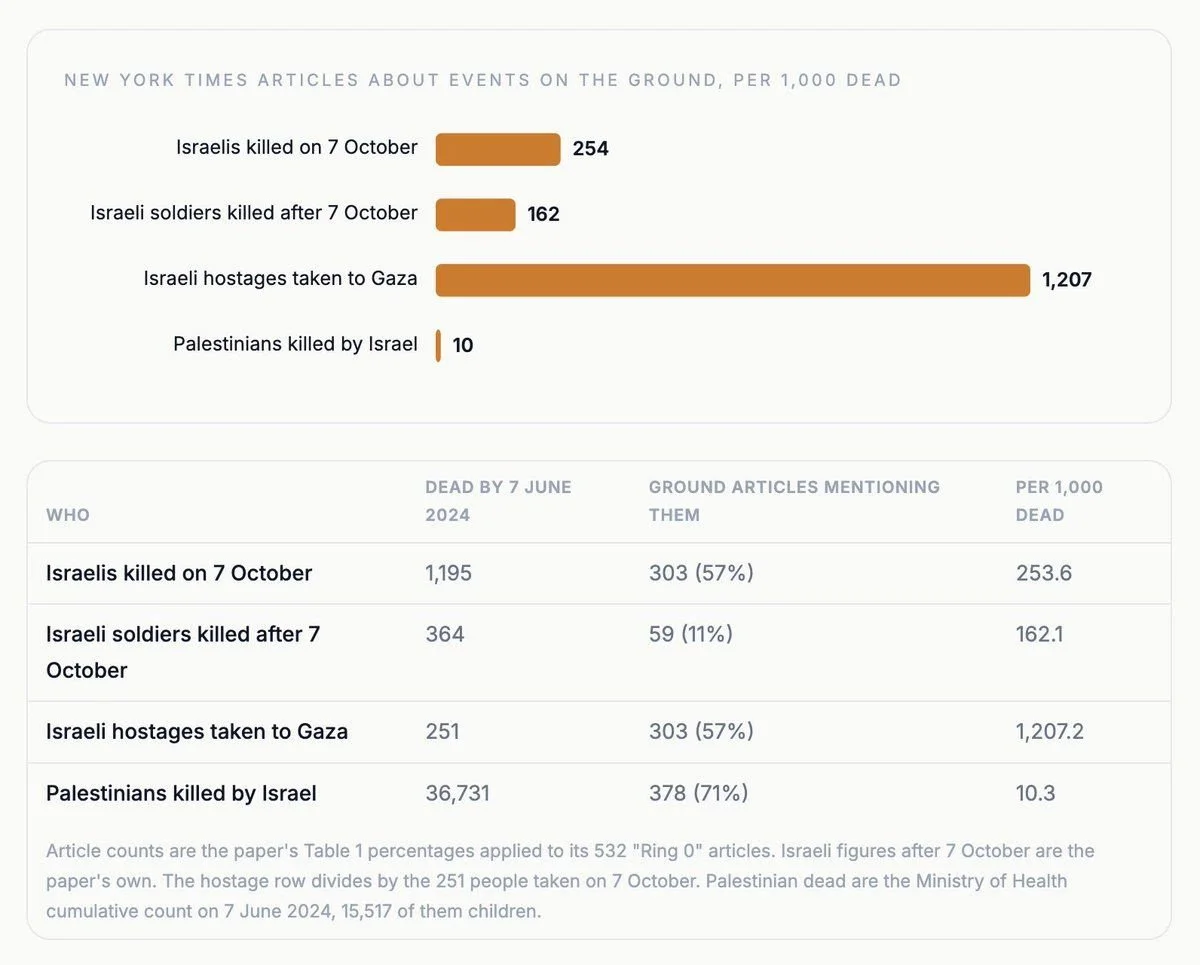
Exclusive: Yale study attempting to 'prove' anti-Israeli bias at NYT does the opposite and reveals that an Israeli killed on 7 October got 25 times the coverage of a Palestinian killed by Israel. The Yale study was written by Edieal Pinker and subsequently pushed by Israeli propaganda outfits like HonestReporting, Israel National News and by the Jerusalem Post and the Times of Israel.
The NYT's coverage of Israeli deaths is wildly disproportionate to its coverage of Palestinian deaths. The study just never did the one very relevant sum that reveals it, which raises a serious question about how Yale let its name go on this. The study's headline "revelation" is that the NYT mentions Palestinian deaths more often than Israeli deaths and Israeli captives. What it never did is work that out per 1,000 dead, or any other normalisation. It is simple. The more people are killed, the more coverage there is. The question is whether it is proportionate. So divide the study's own numbers by the death tolls: in the study's own window, 7 October 2023 to 7 June 2024, Israel had killed 36,731 Palestinians on the Gaza health ministry's count. That count, by the way, is a floor: the Lancet puts the true figure 41 per cent higher. The toll today is past 73,000 and scholars say the real number is far above that. The result, from the study's own tables: an Israeli killed on 7 October got 25 times the coverage of a Palestinian killed by Israel. An Israeli soldier killed in Gaza got 16 times.
One Israeli hostage got more articles than a thousand dead Palestinians. Now, who wrote it? Pinker is a professor of operations research. He is an Israeli citizen who made aliyah in 1989, enlisted in the IDF and, in his own words, was "on the streets of Gaza" the following year, then patrolled southern Lebanon. He told the Times of Israel he did this study because American readers "were not getting a clear understanding of how Israelis were experiencing the war". The journal printed: "No potential conflict of interest was reported." Any outlet that ran this study without doing that sum (per 1,000 / any statistical normalisation procedure) has told you everything you need to know about itself. Full breakdown of the 'study' available on our site under the Editorials section.