
via Free Palestine
What's the point of getting arrested?
By Linda Sarsour
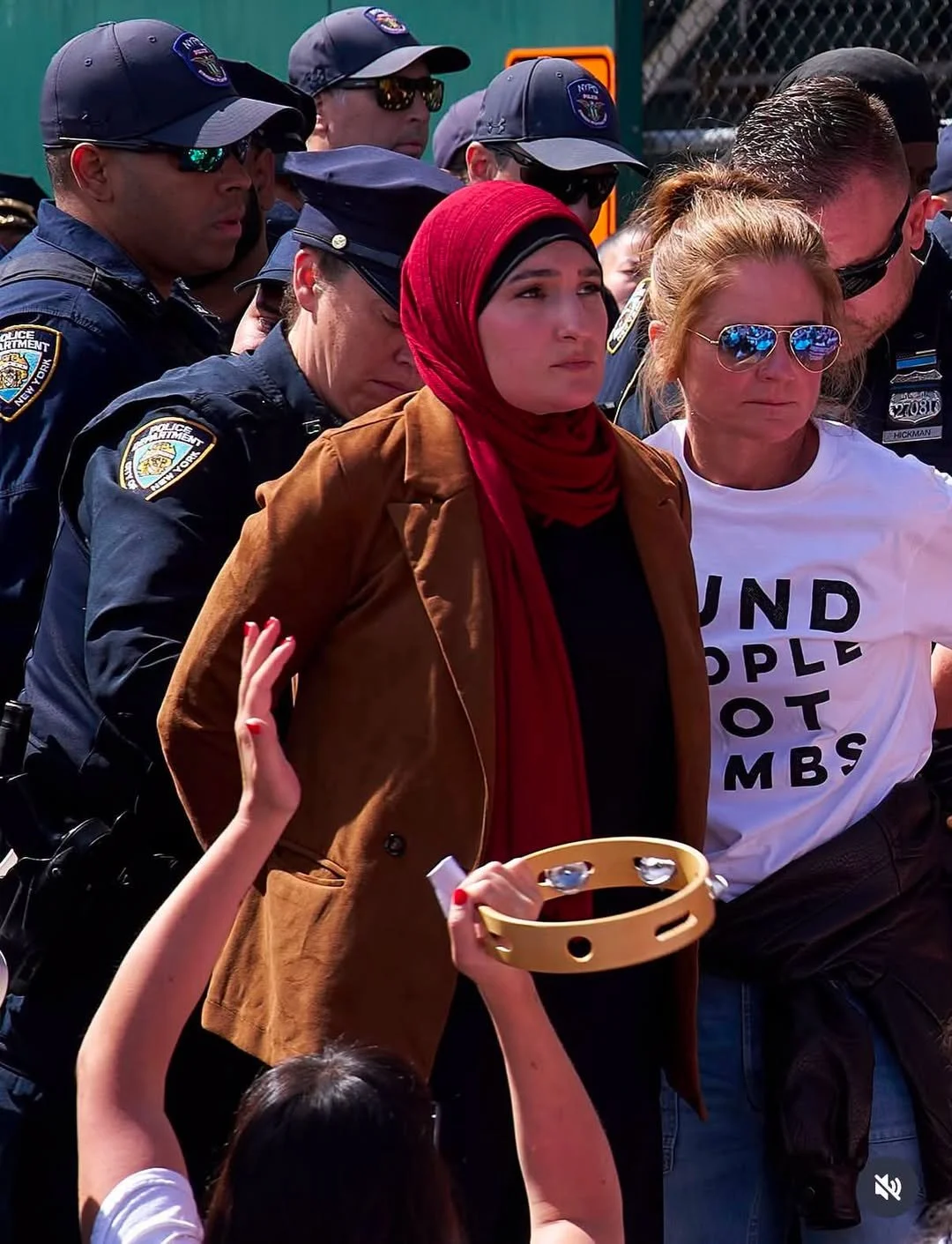
What’s the point of getting arrested? Why the spectacles? Why celebrities? What’s even the point of all this. It seems performative.
I’d like to take this as an educational opportunity. Civil disobedience is for SPECTACLE. The drama is the point. It’s a way to take an issue, something that is newsworthy that mainstream media is ignoring and put it back in the spotlight. It forces media and the internet to TALK ABOUT IT. It’s no small feat to get 100 people to risk arrest for something they believe in. In order to get arrested we need to decide not to comply with orders from police to vacate a property or to stop obstructing traffic, etc.
So yesterday - a war criminal with an ICC warrant addressed the United Nations. Almost EVERY headline included that people were OUTRAGED and against Netanyahu in our country. The stories redirected people to remember there is STILL an ongoing genocide. It was another opportunity to center Gaza, Palestine, Lebanon and the war on Iran.
Why celebrities? They have PLATFORMS. They also have different niche media who follow them. Entertainment media like Hollywood Reporter wouldn’t usually cover protest or Palestine BUT if for example, Susan Sarandon and Hannah Einbinder are there - they will report and that’s a whole other audience that will be exposed to why we are getting arrested and not just the who. The same goes for elected officials.
Trust me, getting arrested isn’t fun. There’s always risks involved. We can’t guarantee what the charges will be. If you’ve been arrested multiple times in a given period, it can be more of a risk. We don’t just get a ticket. We have a court date (or at least I do ). To me, I never think about risk because there is NOTHING I wouldn’t do for my people to remind them I love them and I am still fighting for them - and nothing I risk is even close to what they have sacrificed and endured.
Does my mom hate it - yes. But I don’t tell her until after it’s done.
Free Palestine
Night. A poem by an Alliance member
• Father
she curls on this bed between us every night since she entered the world,
and dreams, muscles twitching and little jerks. the road my sleep takes to
escape is armed, too, with checkpoints. drifting off, I see us from a tower’s
height, ants trapped in the shadow of the shoe. she winds into herself on the
bed tight as a fiddlehead. bombs seal shut her eyes, but my hands, her
mother’s hands, no hands are big enough to cover her ears. once I told her
to press her ear to mine to hear my love for her drumming and she still does,
soft cheek to bristle cheek, little face big face framed in thick dark curls
• Child
is it hot will it rise will it turn on its side, it, it, what is this thing on Mommy
Daddy’s bed where I wriggle into their arms when I wake up, the ceiling’s a
hole, grandma’s room upstairs gone, roof of cousin’s room the sky. they say
bomb but a bomb blows itself to pieces when it blows to pieces and covers
the street with toys clothes books everything, a bomb breaks, I mean breaks
everything into pieces. what is this thing sizzling on the bed. last week we
ran calling, we called, we ran, to cousins under the pile of walls, big cousin
baby cousin, oh cousin, and right now someone’s clamped my arm, pulling
me from the room, from what’s on the bed, longer than the bed, huge with
hate for who I am
• Woman
my sister calls our fragments “bomb sleep” that flees through flames, over
spilled nails and crushed glass. burning, cutting its feet, breaking its bone
arches. bomb sleep she says is a lover who leaps from your arms, slams the
bedroom door on the way out. bomb sleep she says is our mother’s
surgeon’s hand pressed on her heart’s geyser when the electricity was cut,
the generator in the prison of the blockade. was sleep ever not bomb
fragments, I ask. ever the overnight guest who cleaned up after herself,
plumped the cushions, wiped the teacup’s ring off the table before you
reached for the dishtowel. tidied the place up. looked out for us. had our
backs. rearranged her schedule to stay the extra day. no, my sister says,
never
Denise Bergman
Published in pangyrus
—————
Denise Bergman on the origin of the poem:
Before Israel’s October 2023 assault on Gaza and escalation of genocide of Palestinians, I saw a news photo of an enormous bomb on a bed in an apartment in Gaza. (Now, with nearly all of Gaza’s population of 2.1 million displaced and 75,000+ people dead, that image of limited devastation is old history.)
I often use the persona poem to grapple with what is beyond my experience or understanding. Here, inside the horror of endless nights that bring threat not relief, vulnerability not protection, the three voices are unified in their fear and helplessness.
Bill Rand on flickr.com, licensed under CC 2.0.
‘This is where I live now, the back of a truck’: a day in the life of a grandmother in Gaza
From The Guardian
by Seham Tantest in Gaza and Tess McClure. Sept. 23
As the war in Gaza approaches its fourth year, this week, the Guardian follows five ordinary Palestinians as they go about their lives. Each will tell the story of their day, revealing the terrible toll of the ongoing conflict.
The flat-bed truck is open to the hot summer air, its metal frame covered on two sides by draped tarpaulins, the rear by a pegged-up bedsheet. On the tin floor lies a squab mattress and pillow with a yellow frilled cover.
Mansoura Ibrahim Mohammed Abdel Dayem balances a thin cushion at the truck bed’s metal edge to protect her knees as she crawls in and out. She lowers her foot to the plastic chair below, then drops to the ground, staggering slightly as she gets her balance. Mansoura is 76 years old. The truck is her home now. All around her, her family live in tents, the fabric ripped and fraying.
This is a day in the life of a grandmother living in Gaza.
Daybreak
Last night, I stayed awake until 2am. I barely sleep during the night because of the mosquitoes and the heat. I fall asleep for a short while, I wake up early in the morning, pray to God, and wait to hear the call to dawn prayer. When I wake up, I call for my grandson to bring over the white plastic chair that I need to climb in and out of the truck.
This is where I live now: in the back of a pickup truck. This truck, we brought it with us when we were fleeing for our lives from Beit Lahia [a city in northern Gaza]. Its owners had abandoned it, so we took it with us, displaced from place to place – until we ended up here. When we finally arrived, there was no space for me anywhere else – the tents that we have are small, torn and overcrowded, they fall down on the children – so I was forced to live in the truck. I sleep in it to escape the sand, dirt and insects. That is the story of the truck.
After I wake up, I fold up the mattress and prop it with the pillows against the wall, then use a cloth to sweep the dirt and sand from the tarpaulin floor. I sit with my grandson, and we try to make the tiny gas stove work, to boil water for coffee. It’s an old stove – inherited from my own grandfather – and it’s hard to get it to light, as there isn’t enough gas, but eventually we get a flame. I boil water in a small pot and brew coffee for my sons and I – a few spoonfuls for each person. The coffee is filled with the taste of paraffin.