UN theatrics at odds with on ground reality: Israel threatened with sanctions
When Netanyahu on Sept. 23 flew to the US for the eighth time during Trump’s second term, the two leaders did not have a personal get together. Instead, they transformed the UN General Assembly into a stage for their propaganda and electioneering theatrics.
The US president only mentioned Israel once and Netanyahu not at all in his Sept. 23 ‘fake news’-strewn accolade to his own personal leadership and US strength. The following day, after 77 delegations from the Global South walked out of the hall as he took the podium, Netanyahu delivered a lie-studded campaign speech in which he celebrated the heroism of “the most moral army in the world, the IDF” which has for three years “been valiantly fighting a seven-front war.” Holding up a beeper to remind the audience of Israel’s mass pager attack on Hezbollah, he declared that Israel and America “acted together not only to protect ourselves, but to save civilization.”
Unusually, Netanyahu only praised Trump once, stating that he “boldly confronted an enormous danger to America, Israel and the world.” After denouncing all the international attention paid to “settler violence” which he maintained was the work of “a handful of juvenile delinquents” costing only “two or three” casualties a year, the Israeli president turned to Gaza, declaring that “accusing Israel of genocide is the greatest lie of the century…Israel didn’t commit genocide. Israel prevented genocide. And that’s exactly what Mr. Mamdani’s Hamas buddies would have done to us had we not stopped them. They would have killed every last one of us.” Accusing the New York mayor and his wife of antisemitism and of making New York City dangerous for Jews, Netanyahu also slammed Qatar and Turkey, the leaders of Western European countries who “have chosen to succumb to the antisemitic mobs” and the several hundred people who were protesting his presence outside the UN.
In what must be a first for the General Assembly, two world leaders included in their remarks threats to commit genocide. “Do I annihilate the Islamic Republic and do it quickly, never giving them a chance to kill and destroy people and countries again?” Trump pondered from the podium. “Do I drive them into hell with no chance of survival”? Netanyahu, who is struggling to surmount accusations that he failed to pass on to Israel’s security chiefs the message about an impending Hamas attack that he reportedly received from the UAE president just days before October 7, 2023, ended his speech with a Biblical verse intended to buttress his electoral support. It alluded to the need to fully eradicate Israel’s enemy the Amalekites and was, in the words of Jonathan Ofir, “a dog whistle for genocide.”
The Board of Peace stirs into life
The Board of Peace under Trump’s lifelong chairmanship has seemed all but defunct, as Israel continued its lethal attacks on Gaza and steadily moved its deadly ‘yellow line’ westward to put two thirds of Gaza’s territory off limits to Palestinians. But at a UN side meeting held on Sept. 23, Board of Peace executive member Tony Blair said that the Board had held a year of “intense preparation” to rebuild the new Gaza after it was mandated to do so the previous year by Security Council Resolution 2083 which, Blair claimed, was “a remarkable achievement” that had “ended the formal conflict.” He made no mention of the fact that over 1,440 people in Gaza have been killed by Israeli forces since the Oct. 11, 2025 so-called ‘ceasefire.’
The audience heard reassuring words from the Board’s High Representative Nickolay Mladenov as well as Gen. Jasper Jeffers, the head of the ‘International Stabilization Force,’ who is slated to lead the demilitarization effort, and Dr. Ali Shaath, chair of the 12-member National Committee for the Administration of Gaza (NCAC). Dr. Shaath talked about the 71 different programs being planned by NCAC’s Palestinian ‘technocrats,’ but never mentioned the fact that Israel had still not permitted them to enter Gaza. There were several references by speakers to the hundreds of miles of tunnels that had to be detected and destroyed, but no acknowledgement that it was Israel – not Hamas – which had refused to go along with the Board’s demilitarization roadmap. In what was essentially a fundraising appeal to donors, various presenters spoke of the need to raise $71.4 billion (they said they had $18 billion in pledges and $280 million in hand), with an immediate need for $2.45 billion to clean up the Strip and decommission weapons over the next six months.
The session, which you can watch in its entirety here, was brought to a close by Trump’s son-in-law Jared Kushner, who thanked Trump for his “great leadership” and said the last year was “the hardest I’ve worked on a project in my life.” He commended the great cooperation between the Board and the UN which, he said, had led to more “efficiency” in getting aid to people directly. Shortly after Kushner spoke as a ‘peacemaker’ at the UN, CNN revealed that his company, Affinity Partners, was the largest investor in Phoenix, a giant Israeli financial firm with substantial investments in the Israeli military.
On Sept. 24, a day after the Board of Peace session, UN Secretary-General António Guterres had a very different message about Gaza for the ministerial meeting of UNRWA. “Humanitarian access remains severely restricted, and the level of human suffering is still off the charts,” he said. “Food is scarce. Shelter is in short supply. Rodents are rampant.” On the same day the Office of the UN Special Coordinator for the Middle East Peace Process declared that “the needs are immense and urgent, and they are not being met.” Also on Sept. 24, the Boston Review published an excoriating critique of the Board of Peace entitled “Exit and Exception: The Board of Peace’s model for governing Palestine reflects designs for a new world order,” by human rights lawyer Noura Erakat. “Freed from the constraints of international law,” attorney Erakat writes, “the Board of Peace can neatly align itself with a longtime Trump family interest: real estate development.”
What the ongoing Israeli onslaught has meant for Gaza
On Sept. 27, the UN Human Rights Council issued a blistering attack on Israel’s military operations in Gaza, concluding that “Israeli authorities are responsible for war crimes, including extermination, murder, using starvation as a method of war, forcible transfer.” In his General Assembly speech, Trump had denounced the “craven hypocrites of the Human Rights Council” (along with the International Criminal Court, which he called a “rogue institution” and which the US is threatening with sanctions), and this latest Human Rights Council report will likely intensify the efforts of his administration to further discredit the UN.
After three years of bombardment with, according to Al Jazeera, over 223,000 tonnes (245.815 tons) of explosives – 16 times the size of the Hiroshima atom bomb – signs of human habitation in large areas of the Gaza Strip have been largely erased, as these aerial and satellite images attest.
GazaIndex, a program of the Gaza Genocide Center, is compiling a chilling record of the ongoing genocide, with 74,228 confirmed dead by Oct. 2 (20,179 of them children), an additional 8,000 bodies still beneath the rubble, more than 175,188 wounded, and 90% of the population displaced from their homes, most of them forced to move multiple times. By June 2026, satellite images revealed that 83% of the built environment had been destroyed. In addition to the massive destruction of homes, religious buildings, historic sites and medical facilities, 97% of Gaza’s school buildings have been damaged or destroyed, leaving 658,000 children with no access to formal education. Since the sham ‘ceasefire’ began, the number of buildings destroyed by Israel has reportedly increased by nearly 10%.
As for the economic sector, Pedro Manuel Moreno, the acting secretary-general of the UN Conference on Trade and Development (UNCTAD), reported at a UN press conference on Sept. 24 that 92% of Gaza’s economic sector had been damaged or destroyed, leaving Gaza to suffer “the world’s most severe economic crisis on record.”
While Board of Peace members lauded the progress made during its first year of existence, Israel has for over a year blocked the entry of some 900 all-terrain wheelchairs that had been donated for children who had undergone amputations (Gaza has the highest rate of child amputees in the world). With winter approaching, and tented encampments already swamped with wastewater and overrun by rats, 162,000 tents are estimated to be “unfit to withstand strong winds, rain and cold.” Israel has also blocked the entry of proper shelter and material needed to repair homes, as the slaughter goes on.
On Sept 21, Israeli forces killed four people, including 11-year old Ismail al-Bardawil who was shot in the al-Mawasi ‘safe zone’ encampment, and the following day reportedly dropped foul-smelling ‘skunk water’ on tents around Gaza. Thirteen more Palestinians were killed and scores wounded during Israeli airstrikes on Sept. 27 and 28, and the 263rdPalestinian journalist, Muhammad Abdel Aziz al-Najjar, was murdered on Sept. 30. Israel is meanwhile creating compounds near its military bases along the ‘yellow line’ for at least five Palestinian militias. These collaborators are described here in an important analysis by Forensic Architecture.
Israel is now feeling the impact of Gaza’s severe water crisis and the destruction of its entire wastewater system. Beginning on August 30, five of the six large Israeli coastal desalination plants from which it obtains more than 65% of its drinking water have been forced to close down or work at a reduced rate because of a 60-mile-long algae bloom which moved up the coast, nourished by the tens of thousands of cubic meters of untreated waste discharged into the sea every day from the Gaza Strip. This kind of blowback is likely to intensify, given the toxic contamination of land, water and air caused by Israel’s bombs and the ‘ecocide’ being inflicted on the Gaza Strip.
West Bank experiences record number of settler attacks
On Sept. 23, a group of 29 international and Palestinian NGOs working in the West Bank put out a report entitled Palestinian communities at risk of erasure that sharply contradicts Netanyahu’s downplaying of settler violence at the General Assembly. Showing how “Israeli military control and settler violence are closely intertwined,” the report enumerates over a thousand settler attacks committed in a six-month period (March-August 2026), resulting in more than 70 Palestinian deaths and over 2,000 people being displaced from their homes. Many communities have now become all but unreachable because of settler activity and military restrictions.
The report states: “As Israeli elections approach, the government is not restraining these dynamics, and instead is allowing them to accelerate. Political measures and increasingly extreme rhetoric are emboldening settlers and entrenching impunity, leaving already displaced and isolated communities to face even greater danger.” By the end of September, armed settlers had killed at least 23 West Bank Palestinians during the year. On Oct. 1, 51-year old Mashhour Yassin was murdered on his doorstep when settlers attacked the village of Yusuf.
The Sept. 28th OCHA Humanitarian Situation Report documents 51 settler attacks over a six-day period on agricultural land, irrigation and electricity structures, water tanks, and homes, displacing 147 Palestinians (“more than three times the 2026 weekly average”). The 1,600 Palestinians in the 14 small villages in Masafer Yatta, the setting for the Oscar-winning film ‘No Other Land,’ are now without piped water, as settlers have repeatedly cut their water lines. The impunity enjoyed by settlers was on vivid display on Sept. 28, when over a hundred of them set fire to two Palestinian houses owned by the Toubassi family in the village of Jalud and attacked family members an hour after they returned home after being forcibly displaced in July. The Supreme Court had ordered the army to ensure they could go back, but rather than confront the settlers, the soldiers evacuated the family.
Many of those who have been displaced are from the 12 square kilometer area known as E1 between East Jerusalem and the settlement city of Ma’ale Adumim. Settlement expansion in this area had long been referred to as a ‘red line’ by Europeans powers, as it would cut the West Bank in half and doom lingering aspirations for a ‘two-state solution.’ In August 2025, Finance Minister Bezalel Smotrich announced that 3,400 housing units would be built there.
On Sept. 8, 2026, as Israel prepared to issue tenders for the units, Ed Miliband, the foreign secretary appointed by the UK’s new prime minister Andy Burnham, told Parliament that, as the International Court of Justice had ruled in July 2024, the entire Israeli occupation was unlawful. Along with 11 other countries (France, Canada, Denmark, Spain, Finland, Iceland, Ireland, Norway, Poland, Portugal and Sweden) the UK pledged to level sanctions on trade with West Bank settlements. In the case of the UK, the sanctions would not take place for six to nine months, but could eventually have a significant impact, especially on the banking sector. (See the UN’s revised list of 241 companies doing business in settlements here). The Israeli government immediately reacted by closing the British consulate in Jerusalem, removing Britain from the US-led International Gaza Support Center, ending the courses the UK provided to PA security forces, and banning a dozen left-wing Members of Parliament (including former Labor leader Jeremy Corbyn) from entering Israel. US ambassador to Israel Mike Huckabee also threatened Britain with potential US countermeasures.
Although the US government remains locked in a tight embrace with Israel, Israeli journalist Amos Harel writes in the Oct. 2nd Haaretz that even the Trump administration is “weighing sanctions on Israel over settler violence.” The Democrats in Congress are meanwhile beginning to more closely reflect the views of the American public. On Sept. 23, Sen. Chris Coons (D-DE) introduced S.5476, ‘A bill to impose sanctions with respect to foreign persons that have facilitated Israeli settlement construction in the E1 area of the West Bank,’ with MA Sen. Warren as one of 18 original co-sponsors. The term ‘foreign persons’ refers to non US persons. Rep. Joaquin Castro (D-TX) has presented a House version, Resolution 10642.
Then, on Sept. 29, all but one Democratic Senator (Fetterman of PA) voted for Senate Resolution 852. Presented by Sen. Chris Van Hollen (D-MD) with both MA Senators among the co-sponsors, the Resolution details Israel’s human rights abuses: its use of torture, imprisonment of children, the killing of more than one thousand Palestinians in the West Bank since Oct. 2023 - including at least nine Palestinian Americans - settler violence, the displacement of Palestinians, destruction of their property and water supply, and settlement expansion. It requests the Secretary of State to demand specific information from Israel about its human rights practices in accordance with Section 502(B) of the Foreign Assistance Act of 1961, and to issue a report within 30 days of the passage of the Resolution.
The Resolution was defeated by 51 - 47: a loss, but also a sign that the impunity which Israel has long enjoyed can no longer simply be taken for granted.
Nancy Murray
Alliance for Water Justice in Palestine
Cambridge for Palestine Delivers Open Letter Calling on City Officials to Divest from Israel
via Democracy Now! Headline Oct 1
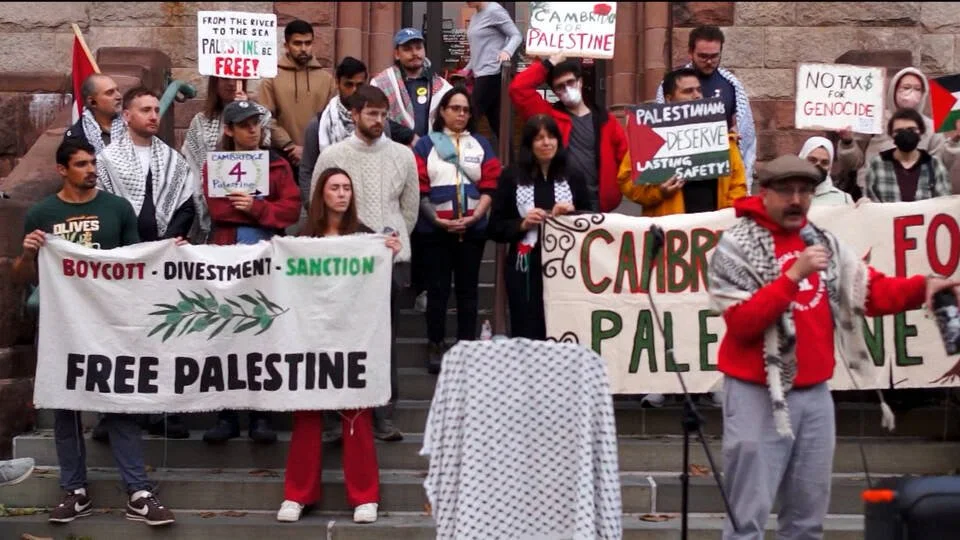
In Massachusetts, members of the group Cambridge for Palestine delivered an open letter Wednesday calling on Cambridge city officials to divest public money from companies they say are complicit in Israel’s genocide in Gaza. The letter was signed by nearly 2,000 people, including Jewish residents, who urged city councillors not to conflate antisemitism with anti-Zionism and pointed to Israel’s continued deadly strikes on Gaza despite the U.S.-brokered so-called ceasefire. Cambridge for Palestine says an investigation uncovered $28 million of city investments in weapons and surveillance companies that are directly complicit in Israel’s ongoing attacks on Palestinians. This is Ayah Al-Zubi, a democratic socialist and the youngest city councillor in Cambridge’s history.
Ayah Al-Zubi: “We are out here today because we are getting ready to launch our divestment campaign to the City Council, where hopefully we will call on the city to divest some of their financial funding out of companies that are invested in the genocide of Palestinians. … Cambridge has a history of standing up against abhorrent human rights abuses. We stood up against apartheid South Africa back in the late 1970s. We divested from Polaroid in its human rights abuses in apartheid South Africa. And three years later, after the stand that we took, Massachusetts also divested pension money out of South Africa.”
UN Human Rights Council Report - Database of all business enterprises...
The UN Human Rights Council has issued a report that includes the names of 124 companies, worldwide, who are engaged in illegal settlement activities in the occupied Palestinian territories. Here is the report. The list starts on page 10
Jewish Voice for Peace Health Advisory Council: Urgent Health Update 9/2/26
Action Alerts
Tell Congress to stop the $2.8 billion sale of bombs to Israel. Here. Phone bank to call their offices on 9/30 here: In just the past four years, Israeli soldiers and settlers have killed at least 9 US citizens in the West Bank. Say their names: Omar Assad, Shireen Abu Akleh, Tawfic Abdel Jabbar, Mohammad Khdour, Ayşenur Ezgi Eygi, Amer Rabee, Saifullah Kamel Musallet, Khamis Ayyad, and Nasrallah Abu Siyam. This resolution would force the State Department to report on what it knows about these killings and answer why Israel has failed to hold anyone accountable. Israel is the only country in the world that routinely subjects children to military detention, where they face systemic abuse. This resolution would also force the State Department to report on Israel’s abuse of Palestinian children, including through acts of torture, in military detention. SUPPORT S. Res 852 on Israel’s human rights violations in the West Bank. here. Do your Senators already support this resolution? Find out here and, if they don't, ask them to co-sponsor today.
Professional organizations
The California chapter of the American Psychological Association (APA) has cancelled a webinar on Antisemitism because it did not include criticism of the Israeli genocide in Gaza as antisemitic. See Roy Eidelson’s article here: substack
Palantir
Join the Palantir Week of Action online kick-off event Monday, 9/28, 9am PT / 12pm ET. Activists from the US, Mexico, Argentina, Chile, Brazil, South Korea, Australia, UK, Germany, & Norway are leading a global Week of Action against the villainous, destructive tech corporation instrumental in the Gaza genocide, ICE activity, and other authoritarian measures. NNU
JLens, the Anti-Defamation League affiliate responsible for a very odd exchange-traded fund that “empowers investors . . . [to] promote the Jewish value of Tikkun Olam” by owning shares in Palantir and Northrop Grumman, rolled out a new project last week. It’s a “tracker” that ranks big US corporations on “workplace policies and practices that are relevant to Jewish employees.” The project, every aspect of which reeks of having been generated by clankers, evaluates companies based on whether they, for example, “circulate an internal holiday calendar that acknowledges major religious holidays” or provide floating holidays to be used for religious observance. (Jewish Currents)
Webinars
JVP Health Advisory Council’s webinar: De-Healthification: Israel’s Engineered Collapse of Palestinian Life with Layth Malhis, Institute for Palestine Studies. 9/27, link to recording here. Article that is the basis for his appearance on our webinar: “De-Healthification: Israel’s Engineered Collapse of Palestinian Life.”
JVP Health Advisory Council’s webinar: Amy Hagopian and Mary Bassett discuss their struggles with and censorship by academic institutions. The use of excommunication and exclusion to shut down conversation and debate about Palestine within academic organizations, the example of Mary Bassett and Amy Hagopian11/22. 11 am pacific, 2 pm eastern, Stay tuned for details and registration.
Did you miss JVP Health Advisory Council’s webinar: Palantir in Our Hospitals: How the company powering the Gaza genocide and ICE surveillance is expanding into healthcare, with AFSC, No Palantir in the NHS Campaign, and National Nurses United? See the recording here.
New films
American Doctor films 3 US physicians of diverse backgrounds who travel to Gaza to provide medical aid during the genocide. It premiered in the US Documentary Competition at the 2026 Sundance Film Festival and was released in US last month by Watermelon Pictures. The film includes a scene at a panel organized by the JVP Health Advisory Council at the National JVP meeting in Baltimore last year! Highly recommended.
NAZA: A Window into Systems of Mass Killings is a documentary where Israeli military speaks about their murder of Palestinian civilians, soon to be shown on The Guardian’s website. See the trailer: The Guardian . Testimony from 24 Israeli military insiders on the secret systems used in the war on Gaza has been revealed in a new documentary film about the mass killing of Palestinian civilians. NAZA, a film from the Oscar-winning Israeli directors Yuval Abraham and Rachel Szor and produced by the Guardian, was shown at the Venice international film festival on 9/10 as the only documentary competing for its prestigious Golden Lion award. The film’s title comes from an Israeli military acronym used euphemistically to refer to civilians expected to be killed in a military attack. (Guardian 9/10). In Israel, filmmakers are experiencing lots of attacks and threats.
Reports
9/1, Physicians for Human Rights Israel (PHRI) published a position paper by Dr. Merav Amir, Dr. Hagar Kotef, and Dr. Guy Shalev documenting ethical breaches and failures in the treatment of Palestinian detainees in Israeli hospitals between10/2023 and 09/2025.
Drawing on testimonies from physicians within Israel’s public health system and other verified sources, the report exposes a series of severe ethical violations, including denial of care, substandard medical treatment, treating patients while physically restrained, returning detainees to facilities where they may have faced torture, and failing to keep their families informed. PHR-I
GAZA
The situation in Gaza remains dire, as Israeli airstrikes and other attacks on populated areas cause casualties and property damage and drive further displacement. Shortages of critical medical supplies undermine treatment for communicable and non-communicable diseases, while access to overstretched water and sanitation services remains precarious. 91% of households face moderate to high water insecurity. Funding shortages and Israeli restrictions on the entry of everything from food to fuel to pharmaceuticals curtail humanitarian efforts. The insecurity, repeated displacement and the wanton destruction particularly affects women. A new UN Women report finds that women-headed households have doubled (to 86,000 households) since 10/2023, nearly one in four families. This includes widows and women whose husbands are missing, detained, severely injured, or forcibly disappeared, or whose fate just remains unknown.
· As of 9/23, Palestinian deaths 10/7/23: 73,922 killed and 174,995 injured.
· Palestinian deaths since the “ceasefire:” 1,402 killed, 4,881 wounded
· 8/29, An Israeli airstrike targeted a tent serving as a medical supply warehouse inside the Al-Aqsa Martyrs Hospital compound in northern Gaza. It is the second time in about a month that Israel has targeted medical supply warehouses at the hospital. Doctors Without Borders said it was appalled by the strike, adding: “At a time when Israeli forces are routinely targeting hospitals, it is of utmost importance that all parties respect and preserve the neutrality and protection of medical facilities.” (This Week in Palestine 9/5)
· 9/1, A routine morning at a Gaza City nursery turned into chaos when an Israeli operation to detain a Hamas official unfolded around it, leaving nearly 200 children between the ages of 4 and 5 trapped between gunfire, airstrikes, and a staff trying to convince them it was fireworks. Zeteo
· 9/2-16, Israel killed 57 Palestinians in Gaza and injured 313 (not including those in the building collapse, see below).
· Israeli forces issued at least five forced displacement orders across Gaza. Orders were reported in Al-Bureij, Nuseirat, Gaza City near Al-Shifa Hospital, and at two locations in Al-Shati refugee camp. One of the warned sites, a home near Al-Shifa Hospital, was subsequently hit with three missiles.
· For more information, see: OCHAOPT
Israeli Attacks
· 9/8, an Israeli airstrike in Deir al Balah near 2 UN schools housing displaced people and a WFP bakery completely destroyed shelter for 24 families and damaged housing for 6 others.
· 9/14, Israeli forces shot and killed a Palestinian in the Al-Mawasi area. 3 Israeli drone strikes: hit a tent in Gaza City, wounding 10; a group near the Egyptian Committee headquarters in Al-Zawayda, seriously wounding several; and injured several more in near Khan Younis.
· 9/15, an Israeli drone killed 2 in an industrial area of Gaza City, and an Israeli sniper on a high-rise crane killed a man in a displacement camp in Jabalia.
· 9/16, 6 Palestinians were killed and 71 injured in attacks including a drone attack on a man in Gaza City, followed by an attack on the paramedic attempting to rescue him. Then an additional strike killed the paramedic and the 15-year-old boy who rushed over to help him. In Khan Younis, 3 strikes on tents sheltering displaced families in Al-Mawasi killed 2 (1 child) and wounded 14.
· 9/18, 2 women were wounded by Israeli gunfire toward residential homes and tents sheltering displaced Palestinians in the Nuseirat and Bureij refugee camps.
· 9/19, an Israeli strike killed 3 in Gaza City. Also on 9/19, Israeli forces targeted and killed Basir Al-Boursh, son of the Director General of the Gaza Ministry of Health, Dr. Muneer Al-Boursh, in a strike on Jabalia. “The occupation targeted him in his tent. He was only meters away from me. It killed my son before my eyes. This oppressive occupation tore him in half with modern missiles. This is the occupation.”
· 9/19, A Guardian investigation concluded that 15-year-old Mohammad Abdul Zinati was killed by a second Israeli strike after approaching a wounded paramedic who had been targeted moments earlier. Haaretz
· 9/20, Israeli forces shot and wounded a woman in Jabalia; and shot a girl in the thigh near Halawa camp. In Bureij refugee camp, an Israeli drone shot and wounded a child.
· 9/21, a child died after being shot by Israeli forces in Al-Mawasi; a man was shot in the head by an Israeli quadcopter in northern Gaza and died; Israeli gunfire killed a woman and injured a girl near tents between Bureij and Maghazi refugee camps.
· 9/23, as Trump’s Board of Peace unveiled its US$2.45 million recovery plan, Israeli attacks killed 6 Palestinians, including a drone strike near Al-Wafa Hospital that killed 1 and wounded several others. Another Israeli drone strike in Deir el-Balah killed one and wounded others. Haaretz
· 9/24, Israeli gunfire killed 1 man near Al-Zahra and another near the American Hospital in Al-Zawayda.
· 9/25, an Israeli airstrike targeted a vehicle in the Mawasi area of Khan Younis, killing one and wounding several. Haaretz
Building collapse disaster
· 9/16, a 6-story building in Gaza City collapsed killing 21 people (12 children) and injuring dozens more. Thousands remain sheltered in unsafe buildings for lack of other housing. Since the “ceasefire,” more than 630 bodies were recovered from beneath destroyed buildings, according to a statement by UN Human Rights Chief Volker Türk. The Civil Defense estimates the total missing under the rubble at over 8,000. Following the collapse of the building, the UN reiterated the urgent need for Israeli approvals to bring in more support and supplies, including road clearing, addressing unsafe buildings, managing debris and reconstruction.
The cumulative and continuing Israeli attacks, coupled with Israeli refusal to allow heavy machinery, specialized equipment, engine oil, spare parts, fuel, construction materials and transitional shelters required for rescue and critical clearing operations, worsens living conditions and exposes civilians to mounting life-threatening risks. Haaretz
Health & Hospitals
· Impetigo, a highly contagious bacterial skin infection primarily affecting children, continues to increase, with 45,190 cases reported between 8/2-9/12. A new case of acute flaccid paralysis was reported, bringing the 2026 total to 21. Health Cluster partners are assessing possible Hepatitis A transmission, including investigations of catchment areas and water sources in Gaza City. One case of TB was confirmed, bringing the 2026 total to 6.
· 9/7-13, over 304,000 health consults at 217 sites reported that communicable diseases accounted for 13% of all complaints, with acute respiratory infections, acute watery diarrhea and skin diseases the 3 most common.
· 9/1-15, 270 patients were evacuated via Rafah and Kerem Shalom crossings with 299 caregivers.
· 9/21, the Kuwait Specialized Field Hospital in Khan Younis suspended medical services as the WHO told the hospital that fuel deliveries would stop. With Gaza’s electrical grid down, the hospital depends entirely on generators. The fuel shortage has halted surgeries, C-sections, outpatient care, scans, laboratory work, ambulances and other essential services. The hospital treats more than 3,000 patients daily and serves roughly 700,000 displaced Palestinians. It needs at least 1,000 liters of fuel per day. Medical director Dr. Jamal Al-Hams called the deprivation of essential healthcare “deliberate killing,” and urged international pressure on Israel to open the crossings.
· Amid Israel’s genocide in Gaza, Palestinians with hearing impairments have been left particularly vulnerable, unable to hear incoming missiles or evacuation orders. Fadl Kuraz, a sign-language interpreter and trainer, is one of the few who have devoted their lives to helping them survive. Mondoweiss
· The Independent Commission for Human Rights (ICHR) warns of the serious consequences of the continued Israeli occupation's ban on the entry of vehicle spare parts, vehicle oils, lubricants, and tires, and its severe impact on public transportation in the Gaza Strip. This situation has led the Union of Owners of Public Bus Companies in the Gaza Strip to suspend the transportation of medical personnel and workers at public and international hospitals and medical centers to their workplaces, due to the failure to allow the entry of essential supplies required to operate and maintain buses. According to ICHR's follow-up with a number of doctors working at Al-Shifa Medical Complex, Nasser Medical Complex, and Al-Aqsa Martyrs Hospital, the administrations of these hospitals have issued instructions to suspend outpatient clinic services and postpone scheduled surgical procedures, limiting services to emergency and essential cases.
Water & Sanitation
· Two temporary dump sites have exceeded capacity and closed. Israeli restrictions on access to Gaza’s landfills near the Green Line are increasing public health risks.
· 9/1, WHO warned that the approaching rainy season could worsen Gaza’s public health crisis, with flooding threatening to spread sewage, waste, and contaminated water through overcrowded displacement camps. Microbiological contamination in tested water samples nearly tripled this year, while cases of acute watery diarrhea rose from about 27,000 in March to more than 48,000 in August. The organization called for the “unimpeded and expedited entry of humanitarian supplies” to prevent further deterioration. (Drop Site 9/2)
· 9/10, Oxfam repaired Jabalya’s damaged Serdah sewage pumping station and its generator. Between June and August, 19 water and sewage facilities were repaired, so they are technically operational but function at limited capacity due to electricity shortages.
· The sewage crisis in the Gaza Strip has reached unprecedented levels as the widespread collapse of wastewater infrastructure threatens public health, groundwater, and the Mediterranean Sea, according to Gaza’s Water Authority. Around 55,000 cubic meters of untreated sewage are discharged daily in Gaza, including 40,000 cubic meters pumped directly into the sea. Another 15,000 cubic meters seep into the surrounding environment through absorption pits and leaks in damaged sewage networks. (Palestine Chronicle 9/3)
· For displaced Palestinians crammed into makeshift tent camps amid ongoing military operations and restrictions, open sewage pits have become a hazardous necessity. Families are forced to dig primitive latrines because destroyed municipal sewage networks and damaged pumping stations have left them with few alternatives. Yet each new pit creates severe hazards: unstable and collapsing soil, overflowing wastewater, unbearable odors, and raw sewage contaminating the ground where children live and play. Gaza Herald
Aid & Incoming Supplies
· Trucks successfully offloaded at Kerem Shalom Crossing decreased over the past 2 weeks from 88% to 70%. The Egyptian corridor faced the highest levels of truck returns and rejections, with it’s offloading rates dropping from 72% to 35%. The Ashdod route accounted for about half of all trucks entering Gaza. The Zikim Crossing in northern Gaza remains closed (since 5/24). The UN only tracks the entry of UN 2720 supplies. See more information at UN 2720 Mechanism Dashboard.
· 884 commercial trucks entered between 9/7-13. 33% of them carried non-essential items, further limiting the entry of critical commodities. Inflation remains high, 200% above pre-10/2023 levels. While most basic commodity prices remain relatively stable, a 25 kilo bag of flour increased by 35%.
· In early September, the International Organization for Migration resubmitted a request to the Israeli authorities to import 37,000 pieces of timber and 660 Emergency Shelter Kits, twice rejected at the Kerem Shalom Crossing in the past month. Israel again denied entry. As winter approaches, this will further prevent more durable shelter solutions and impede repairs to damaged housing.
· The absence of reliable electricity in Gaza forces communities to depend on backup generators to keep services running, although these generators were not designed to run around the clock. Engine oil is essential to the generators that power wells, desalination plants, sewage pumping stations, hospitals, PHCs, blood banks and field hospitals. It is required for the vehicles and heavy machinery used for food distribution, solid waste collection, rubble removal and humanitarian transport.
· Since 3/1, 13,445 liters of engine – only fuel - 12.6% of what was requested – has been approved by Israel. Of the oil denied entry, 47% is intended for water, sanitation and hygiene and solid waste management; 25% for health services; 21% for general operations, logistics and multi-sector activities; and 7% for food security. Isreal’s refusal to allow in oil threatens access to safe water, sewage system functionality, and solid waste accumulation, all of which increase risk to public health and environmental risks.
· Israeli supported authorities continue to inspect humanitarian warehouses for “contraband,” disrupting operations and breaching the inviolability of UN premises. To date, no contraband has been found.
· The Australian Broadcasting Corporation (ABC) reported more than 900 wheelchairs, donated by two Australian charities to help injured children in Gaza, are stuck in warehouses in Jordan due to Israeli restrictions on aid deliveries into the war-ravaged strip. Two shipments from New South Wales-based charity Kids on Wheels Alliance arrived in Jordan in 02/2025, while a third, from Wheelchairs for Kids based in Western Australia, arrived in October 2025. Instead of being delivered to children with severe mobility issues inside Gaza, they remain sitting in storage facilities managed by the Jordan Hashemite Charity Organization (JHCO).
Food & Nutrition
· 9/1-15, 121,000 households (460,000 people) received one parcel and one 25-kilo bag of flour, covering about 50% of minimum caloric needs. Every day, 25 partners prepared 732,000 meals in 102 kitchens and delivered them to 1,104 locations. Meal production levels have remained largely stable since May.
· 22 subsidized bakeries produce 90,000 2-kilo bread bundles daily; 72% is sold through 160 outlets at a price of 3 NIS (US$0.93), while 28% is distributed free of charge to 300 shelters and community sites. In addition, 18 private bakeries receive free fuel to bake bread, now producing 62 metric tons daily.
· In the first half of August, 36,240 children <5 were screened and 7.25% were diagnosed with acute malnutrition, including 276 with severe malnutrition. 23,811 pregnant and breastfeeding women (PBW) were also screened, with 838 admitted for targeted supplementary feeding.
· At the malnutrition clinic at Nasser Medical Complex in Khan Younis, doctors are increasingly seeing children who are not simply underweight but failing to grow in height. Some were born to mothers who endured pregnancy during periods of severe food deprivation; others have themselves spent years without adequate access to protein, healthy fats, carbohydrates, vitamins, and other nutrients essential for growth. One of the most lasting consequences of Gaza’s hunger crisis may be a generation whose physical growth and development have been permanently altered or stunted by prolonged malnutrition. (Mondoweiss 9/9)
· Since 9/13, two 50 kilo bags of concentrate feed and one 50 kilo bag of barley has been distributed to 2,200 livestock holders. The entry of animal fodder remains critical to livestock survival and herd recovery since the 10/2025 “ceasefire.”
· Food is visible in Gaza’s markets for the first time in years, but hunger is not gone. According to the August 2026 IPC report, more than 1.4 million people, or two-thirds of Gaza’s population, are projected to face crisis conditions or worse through December 2026. The presence of goods on shelves has not translated into food security for the majority of Gaza’s population, whose purchasing power has been destroyed by more than two years of war, displacement, and economic collapse. (Mondoweiss 9/5)
Shelter
· 9/21, Gaza’s Ministry of Development called for the urgent entry of half a million shelter items as displaced Palestinians prepared for another winter in overcrowded camps, deteriorating tents, and damaged buildings. The ministry said between 1.2 million and 1.5 million displaced people were living in camps and exposed shelter areas that lacked basic necessities. Its estimate drew on data and reports from UN organizations. Years of use and exposure to the weather had damaged between 70% and 80% of existing tents and shelters, the ministry said. Families relying on them faced increasing difficulty protecting themselves from rain, wind and falling temperatures. (Palestine Chronicle 9/21)
Women
· Women whose husbands are missing or buried under the rubble are facing a little-known crisis. Without death certificates for their husbands, they’re locked out of bank accounts, aid, and custody rights, trapped in bureaucratic limbo and genocide. (Mondoweiss 9/22)
WEST BANK, including EAST JERUSALEM
So far in 2026, more than 1,500 Palestinians have been displaced due to lack-of-permit demolitions and over 2,600 due to settler violence and related access restrictions. More than 1,600 settler attacks have caused casualties, property damage or both in 275 Palestinian communities.
9/1-14, Israeli forces or settlers killed 6 and injured 58 Palestinians in the West Bank. Settlers have attacked 275 Palestinian communities so far in 2026, compared to 279 in all of 2025.
· For more information: OCHAOPT
· For a new map showing the Impact of West Bank Settler Attacks 1/2023-8/2026, see OCHAOPT
Health & Hospitals
· Health Cluster partners support life-saving and essential health services through 869 health service points: 60 hospitals, 478 PHCs, and 227 mobile clinics. Mobile clinics are particularly important for underserved communities, including in Area C, the “Seam Zone” and H2 area of Hebron, where access for health teams remained unpredictable. Shortages of essential medicines and funding constraints limit access to and delivery of health care.
Food & Nutrition
· A new World Food Program report found 12% of households had poor food consumption in the first quarter of 2026, compared to 5% in June 2022. 76% of households experienced a decline in income. The number of people in need of food assistance has increased from 353,000 to 900,000 over the past 3 years. At the same time, response capacity is contracting, with WFP reducing the number of people receiving food assistance from 400,000 to 200,000 from September due to funding constraints.
· 9/1 World Food Program said funding shortages are forcing it to halve food assistance in the occupied West Bank even as Israeli military operations, settler violence, movement restrictions, demolitions, and displacement drive growing food insecurity. “At a time when WFP should be scaling up assistance to reach more people, we are being forced to make difficult decisions, prioritizing the most vulnerable while cutting assistance to others despite widespread needs.” WFP warned that funding shortages are also affecting assistance to 1.5 million people in Gaza and that further cuts will be unavoidable without additional funding. (Drop Site 9/1)
Israeli Attacks
· 9/2, Israeli settlers stole 72 sheep from Al Mughayyir (Ramallah). Israeli media, citing the Israeli military, reported that Israeli forces entered the village to retrieve livestock belonging to Israelis. During the raid, Israeli forces shot and killed 2 children. So far this year, more than 56 settler attacks have been documented in Al Mughayyir, home to about 3,300 Palestinians surrounded by 8 settlement outposts, 5 of which have been established since mid-2024. Since January 2023, settler attacks on Al Mughayyir have killed 7 Palestinians and injured 150.
· 9/4, Israeli forces shot and killed a Palestinian man near Damascus Gate in East Jerusalem. The military claimed he attempted to stab soldiers. No Israeli injuries were reported.
· 9/7, Israeli forces shot and killed a man and injured 5 during a raid on Hajja (Qalqiliya), when Palestinians threw stones at the military.
· 9/7-8, Israeli forces shot and killed 2 men during separate operations in Nablus governate. In Qabalan, Israeli forces closed the village’s four main entrances and surrounded a home for 6 hours, shooting and killing a man and withholding his body. Israeli military claimed he had carried out a stabbing attack earlier that day near Osarin village. Tear gas fired near two schools injured 4 schoolgirls, and 30 men were later detained and interrogated in a Palestinian house for 5 hours and then released. In Aqraba, Israeli forces surrounded a home for 5 hours before shooting and killing a man. They fired projectiles at the house and used a military bulldozer to make it uninhabitable, displacing 2 women. Israeli military claimed the man attempted to attack soldiers during the operation.
· 9/24, Israeli forces raided the Palestinian Red Crescent Society headquarters in Salfit city, searched surveillance cameras, and held staff inside.
Demolitions and Displacement
· 9/8-14, Israeli authorities demolished or forced Palestinians to demolish 46 buildings for lacking Israeli-issued building permits, nearly impossible to obtain. 57 Palestinians were displaced, including 42 in Area C and 15 in East Jerusalem. Israeli forces displaced 2 people in Tubas governorate. 9/9, Israeli forces demolished 19 agricultural, commercial and livelihood structures in Arrana village (Jenin), affecting 19 families (81 people).
· 9/8 in Khirbet Al Fakheit, Masafer Yatta, within an area designated as “Firing Zone 918” for military training, Israeli authorities demolished 17 structures, including 4 residential shelters, 8 animal shelters, 4 latrines, a communal solar system, and 10 water tanks. 3 families (23 people, 11 children) were displaced. On the same day, other structures were demolished in another Masafer Yatta community, displacing a family of 11 (3 children). This followed the 9/2 demolition of 27 structures in nearby Khirbet at Tabban, which displaced 23 people. In a single week, demolitions in these 3 communities displaced 57 Palestinians. (OCHAOPT, Haaretz)
· Israeli authorities demolished 19 structures in 2 Bedouin communities in Area C of Jerusalem governorate, citing the lack of building permits. 9/8, 9 structures were demolished in South ‘Anata Bedouins (Wa’ar al Beik), displacing 9 people (5 children) and affecting 15 others (9 children). 9/15, 10 agricultural and livelihood structures were demolished in Tublas, affecting 3 households (28 people, 16 children). The demolitions included residential and agricultural structures, animal shelters, and water and solar infrastructure.
· The 2 communities are near the area designated for the E1 settlement expansion plan in eastern Jerusalem governorate. In 8/2025, the Israeli government approved the construction of more than 3,400 settlement housing units under the plan, which is intended to create a continuous built-up area between Ma’ale Adumim settlement and East Jerusalem, despite concerns that the E1 plan would forcibly displace 4,000 Palestinians in 18 mostly herding communities and further fragment the West Bank and undermine territorial continuity.
· In East Jerusalem, 3 households (15 people, 3 children) were displaced. A family of 5 In Jabal al Mukabbir was forced to demolish part of its home; in Silwan, the Jerusalem municipality with Israeli military demolished a building, displacing 2 households (10 people). In Wadi al Joz, an extended family was forced to demolish 2 structures housing 5 family businesses -- a bakery, shops and services. The demolition affected 5 households (22 people, 11 children)
· 9/23, Israeli forces began demolishing homes, agricultural structures, livestock pens, and water wells belonging to Palestinian families in Janba village in Masafer Yatta, south of Hebron, according to WAFA.
· Israel has extended its closure of Nur Shams refugee camp until November 30, barring 13,700 Palestinians from returning home after nearly 20 months of displacement. As the army prepares to maintain long-term control, residents face destroyed homes, mounting debt and limited aid. Mohammed Sleit, a 30-year-old photographer from Nur Shams emphasized that the clearest measure of how long the displacement has lasted is the camp's cemetery, one of the few places residents are still permitted to enter: "We are returning to Nur Shams, but we are returning one by one – to the Nur Shams cemetery. We are returning dead, one at a time, to be buried there." Haaretz
Settler Violence
· The Palestinian Information Center Ma’ati has documented 4,560 attacks carried out by illegal Israeli settlers across the occupied West Bank since the beginning of 2026, highlighting the scale of escalating settler violence against Palestinian communities. The tally encompasses attacks carried out in different areas of the occupied West Bank amid a broader expansion of Israeli settlement activity and mounting pressure on Palestinian communities. Settler attacks have repeatedly included assaults on Palestinians, raids on villages and agricultural areas, destruction of property and crops, attacks on livestock and attempts to seize or prevent Palestinian access to land. (Palestine Chronicle 8/31)
· 9/2-8, 32 settler attacks caused casualties, property damage or both. Water infrastructure was targeted in 4 incidents: In Al Hadidiya (Tubas), settlers took about 30 water tanks used for livestock and began fencing grazing land, further restricting Palestinian access; in Beit Imrin (Nablus), settlers damaged a waterline, denying water to a household for 4 days; waterlines were also damaged in Al Aqaba (Tubas) and East Tayba Bedouin community (Ramallah), forcing families to rely on trucked water.
· Settlers also targeted agricultural livelihoods and infrastructure: In Khallet al Louza (Bethlehem), settlers damaged seasonal crops planted on 6 dunums (1.5 acres) belonging to 3 families; in Silwad (Ramallah), they uprooted and destroyed 4 mature olive trees; in Beita (Nablus), settlers attacked livestock facilities and damaged electric and other infrastructure, injuring 4 Palestinians; in Al Masudiya (Nablus), damage to electricity infrastructure resulted in a 3-day outage for 12 families; in Khirbet Abu Falah (Ramallah), settlers dismantled parts of an agricultural structure and stole sheet metal, and prevented farmers from accessing their land.
· 9/5, Armed Israeli settlers entered the Sa’ir community, damaged homes and property, and fatally shot 16-year-old Karim Shalaldeh in the back as he sought shelter. His death followed repeated attacks associated with a nearby settler outpost that has left residents afraid to travel, work their land or leave their homes unguarded. Haaretz
· 9/8-14, more than 30 attacks by settlers damaged agricultural land, crops, trees, irrigation networks and farming assets in several communities, affecting livelihoods and agricultural production. About 100 trees were damaged in Sinjil (Ramallah), while in Khirbet Yarza (Tubas), damage to crops, trees, irrigation networks and beehives affected 3 farms. In Deir Ballut (Salfit), settlers burned down an agricultural structure.
· Settler attacks also damaged water infrastructure in Khirbet Yarza (Tubas), Ras Karkar and Deir Dibwan (both Ramallah), affecting water supply to agricultural and residential properties. In Burin and Madama (Nablus), settlers damaged electricity infrastructure, causing temporary outages. Settlers also damaged houses in Al Mughayyir, Burqa and Ras Karkar (all in Ramallah).
· 9/18, Masked Israeli settlers were filmed attacking the West Bank village of Burqa for the third time in one week, with videos showing a gun pointed toward homes and fires burning in agricultural land. There have been numerous recent incidents involving rock-throwing, arson, assaults, livestock theft and property destruction, amid the establishment of new settler outposts on or near privately owned Palestinian land. Haaretz
· Qusra, Nablus
After the 8/9 establishment of a settlement outpost near Qusra (Nablus), 3 Palestinian families in the Ras Al Ein (Ein Einia) area have been trapped in their home and isolated from the rest of Qusra by a continued presence of Israeli settlers and Israeli forces. The families are not allowed to routinely cross the Israeli military checkpoint, and outside access to them is restricted. Since school began on 9/6, the military and settlers have prevented a teacher and a 5 -year-old from reaching their workplace and kindergarten. 9/1, settlers also vandalized a house under construction, damaging 3 walls and stealing 2 doors.
Some food, water, hygiene items, medicines and basic medical equipment have reached the families through municipal deliveries after approval by Israeli authorities. 9/4, Israeli forces prevented 40 Israeli activists carrying food and water from reaching the families; the supplies were subsequently delivered by the municipality. 9/6, additional supplies could only be transported in a municipal waste collection vehicle.
Other families have had difficulty passing through the Israeli military checkpoint, adding to their concerns about accessing their agricultural land or houses under construction in the area.
· Umm Safa, Ramallah
Umm Safa, a village of about 800 residents north of Ramallah, has two main entrances connecting it to Road 465. While the village has long faced intermittent access restrictions, Israeli forces have closed both entrances since 10/7/23, one with a road gate and the other with an earthmound. When residents attempted to remove the earthmound, Israeli forces replaced it. In 2025, the entrances briefly opened on only two occasions, for about three hours each, to allow funeral processions to reach the village cemetery. Before the closures, Umm Safa was a transit point for 6 surrounding villages (15,000 people) to reach Road 465.
The closures have affected access to health care, education, livelihoods and basic municipal services. The Umm Safa clinic is open once every two weeks and its pharmacy often lacks essential medicines; emergency care is available in Ramallah. Since the closure, ambulance response times have increased from 10 to 25 minutes, and pregnant women must travel to Ramallah several days before delivery. Roundtrip transport costs to Ramallah have also increased from NIS 16 (about US$5) to about NIS 40 (about US$12), affecting those without private vehicles and university students. The detours have also disrupted waste collection.
The access restrictions have been accompanied by the establishment and expansion of outposts, and an increase in settler violence which have constrained access to agricultural land supporting around 80 households. Settler activity has also expanded north of the village, where bulldozing, damage to trees and water infrastructure, and blocked agricultural roads have further restricted access. 6/15, settlers damaged the main water supply pipe on the west side of the village, cutting water supply for 4 days.
One household to the east of Umm Safa has suffered recurrent settler harassment and intimidation: settlers grazing livestock around their home, entering their property, and threatening them. In April, they were assaulted while herding livestock and 4 sheep were stolen. In June, settlers erected a tent about 100 meters from the house. 8/26, settlers installed a gate on the household’s only access road, leaving them stranded between the gate and the existing closed gate separating it from the village. 9/4 and 9/6, settlers closed the new gate while intimidating the family in their home. The combination of recurrent settler attacks, intimidation and increasingly severe access restrictions has further isolated the family, constrained its access to livelihoods and essential services, and heightened concerns over possible displacement.
Education
· Teachers at private and Christian schools in occupied East Jerusalem launched an open-ended strike as the academic year began, protesting Israel’s requirement that all new first and seventh-grade classes at Palestinian-majority municipal schools use the Israeli curriculum exclusively, according to Al Jazeera. The change will affect more than 45,000 students, or one in three Palestinian students in the city. Israel has also blocked entry permits for more than 70 West Bank teachers and staff without warning, according to the General Secretariat for Christian Educational Institutions in Jerusalem, which called the abrupt reversal “unprecedented.” (Drop Site 9/2)
ISRAEL
· Israeli Defense Minister Israel Katz said Israel remains prepared to forcibly remove Palestinians from Gaza “by sea, by air, by every way possible,” describing the ethnic cleansing of the Strip as the “only solution.” Katz said Trump has not canceled the plan but “froze it” after pressure from Arab governments, while countries willing to receive Palestinians want US backing. He added Israel expects a future “green light” to advance militarily and territorially if Hamas is deemed to have violated its commitments. Jared Kushner, made a similar threat after meeting Netanyahu last month, saying that if Hamas failed to decommission its weapons, the U.S. would back Israel resuming the war to “finish the job.” (Drop Site 9/3)
· Seven aid workers killed in an airstrike in Gaza were marked as targets under an Israeli military practice of establishing guilt by association, a Guardian investigation shows. A top Israeli military prosecutor announced last month that he would not pursue criminal proceedings for the April 2024 incident in which drones fired missiles at three clearly marked World Central Kitchen (WCK) cars soon after they had escorted a food aid delivery to Gaza. Three British humanitarian workers along with an Australian, a Palestinian, a Pole and a dual US-Canadian national were killed. (Guardian 9/5)
· Celebrated as proof of Israeli liberalism and vilified by the right, Palestinian physicians are in fact being quietly shut out of the profession. As politicians rail against Arab medical workers for supposedly taking positions from Jewish graduates in Israeli hospitals, the data tells a very different story: Thousands of Arab doctors who have completed medical school, passed their licensing exams, and finished their internships are unable to find positions in Israeli hospitals and health clinics. +972
· A growing number of former Israeli generals, intelligence officials and prime ministers are accusing settlers in the West Bank of committing ethnic cleansing with government support. “Once a society behaves this way,” one said, “that society is doomed.” (NYT 9/2)
Prisons
· Dr. Hussam Abu Safiya, imprisoned director of Gaza’s Kamal Adwan Hospital, has provided new testimony describing continued physical abuse, sleep deprivation, and threats by Israeli prison guards, according to a written statement provided by his lawyer after a visit on 8/30. (Palestine Chronicle 9/3)
· Israeli prison units stormed several sections of Ganot Prison on 9/10, wounding two Palestinian detainees during an extensive raid and search operation, according to various Palestinian sources. The raid was carried out by Metzada and Yamaz, specialized units used by the Israel Prison Service to enter and suppress Palestinian prisoner sections. The Israeli forces used stun grenades and rubber bullets during the operation, injuring two detainees and creating a state of heightened tension inside the prison. Prison rooms were also searched, belongings were confiscated, and property inside the cells was damaged. The raid came amid mounting documentation of severe violence and deteriorating conditions facing Palestinian detainees inside Israeli prisons. (Palestine Chronicle 9/10)
· A female Palestinian prisoner held at Israel’s Damon prison said conditions are worsening, with prisoners facing overcrowding, inadequate food and deprivation of basic rights, according to the Palestinian Commission of Detainees and Ex-Detainees Affairs. Detained since February 9, she developed scabies and a urinary tract infection but said she has received no treatment. She also reported being strip-searched and severely beaten following her arrest, including blows to her head and face. At Damon, she said several female prisoners sleep on the floor and time outside cells is severely restricted. (Drop Site 9/21)
· Pregnant Palestinian detainee Baraa Abu Khadija, 36, from Tulkarm suffered abdominal pain and bleeding after being detained by Israeli forces and subjected to hours of restraint and a strip search, according to the Palestinian Commission of Detainees and Ex-Detainees Affairs . After transfer to Hasharon Prison, she was held in a filthy, insect-infested cell without adequate drinking water, clean bedding, a shower, or a change of clothes, before being moved to Damon Prison. She is now held in a room designated for pregnant detainees, where three women receive no specialized meals and are given an egg or a piece of meat about once every three or four days. (Drop Site 9/23)
UNITED STATES
· The Trump administration has approved a $2.8 billion sale of heavy bombs to Israel, according to a US official, in what would be among the largest deliveries of US munitions there even as American public support for the country declines. The proposed sale would include 40,000 one-ton bombs whose use by Israel in Gaza and Lebanon has drawn international anger because of the civilian harm caused by their wide blast radius. The State Department recently sent the proposed deal to two congressional committees to get informal approval, the U.S. official said.
· Robot cockroaches, “terror-network” mapping, and rapid missile guidance are just three examples of at least 70 research projects U.S. universities have conducted on behalf of the Israeli Ministry of Defense (IMoD). Over a thousand pages of internal university and US/Israeli military documents reveal a sweeping, decades-long program to sponsor military research collaborations with at least 30 U.S. universities, from Cornell to the University of California at San Diego, since at least 2009. (Truthout 9/3)
· HR 4795, the anti-boycott bill that could cut off federal funds to universities that don’t do business with Israeli settlements, passed the House on 9/3 with 237 in favor and 169 against. Thirty-three Democrats joined House Republicans in voting for the bill, including pro-Israel AIPAC-backed stalwarts Jared Moskowitz, Jake Auchincloss, and Debbie Wasserman Schultz. “Under this bill, US universities MUST work with Israel/settlements or they will be punished for boycotting, even if they do not have a policy of boycotting,” Foundation for Middle East Peace president Lara Friedman wrote. (Palestine Chronicle 9/3)
· In Providence, Rhode Island, Democrats chose democratic socialist and state representative David Morales as their candidate for mayor. Morales intertwined justice for Palestinians with a populist program of support for the working class in Providence. During his campaign, Morales proudly endorsed an upcoming city ballot initiative to cut an estimated $2.5 million in investments in Israel and other countries committing genocide. (JVP 9/10)
· Palestinian-American attorney and author Noura Erakat was arrested during a budget hearing in Palm Beach County, Florida and charged with trespass and obstruction. Erakat and dozens of other activists had shown up at the meeting to testify against the county investing over $1 billion in Israeli Bonds. The county’s mayor, Sara Baxter, reportedly told the attendees that they could only speak for one minute and that they'd be forcibly removed if they clapped at any time. According to Erakat, they were also told they couldn't address the bond questions because it was a "policy issue" and not a budget issue.
· Fly the friendly skies of United!...which is set to resume the shipment of military hardware to Israel - mostly for Elbit systems, a major arms manufacturer - aboard passenger flights, transporting military stuff that is then used to commit war crimes. United transported nearly 3,000 loads of military materiel over a seven-month period in 2025 and early 2026. The cargo ranged from critical components for fighter jets and tanks to helmet displays, electronics, and nuts and bolts. The transfers stopped only amid the outbreak of war with Iran. The Intercept
Universities
· New ACLU and Amnesty International USA report uncovers widespread suppression of pro-Palestine speech across college Campuses. Findings Show Concerted Efforts to Censor and Retaliate Against Speech in support of Palestinian Rights in Colleges and Universities. ACLU
· District Judge Noël Wise ruled that the Trump administration could not use immigration powers to punish international students for pro-Palestinian speech and criticism of Israel. The case was brought by The Stanford Daily, which said foreign students had censored their journalism and political expression because they feared deportation. Wise warned that allowing the policy to continue could ultimately threaten “anyone in the United States” expressing views disliked by the government. (Palestine Chronicle 8/30)
· City University of New York (CUNY) has agreed to disclose all its stock and bond holdings following a Freedom of Information lawsuit filed by CUNY Law student Sarah Southey on behalf of CUNY Law SJP and CUNY for Palestine. Under the settlement, CUNY will provide records identifying holdings registered in its name for every fiscal year since 2020, including contracts with 30 companies—Boeing, Lockheed Martin, Northrop Grumman, Caterpillar, Chevron, Hewlett Packard Enterprise, and others complicit in Israeli settler colonialism. The university also dropped its appeal and will pay $20,000 in legal fees to the NYCLU. The full settlement agreement can be read at CUNY, Truthout
· A whistleblower disclosure by a former US Department of Justice civil rights lawyer reveals how the Trump administration rigged federal anti-Semitism investigations of Harvard, Columbia and Brown universities to reach politically predetermined conclusions and intimidate Muslim professors. The administration also used billions of dollars in federal funding to blackmail the institutions. Congressman Jamie Raskin called the investigations “fake, a pre-baked frame-up operation thoroughly political in nature.” He is asking an administration official to appear before his committee and demanding government records. (Electronic Intifada 8/23)
· Three-quarters of US college students agree that Israel is committing genocide in Gaza, according to a new survey from Brandeis University. Even among students the researchers classified as “Israel Supporters,” one in four agreed. It is the headline finding of “American Undergraduates and the Israeli-Palestinian Conflict,” a report by the Cohen Center for Modern Jewish Studies. The survey’s results are fundamentally unfavorable to Israel but the authors devote much of the report attempting to diminish its significance. (Electronic Intifada 9/3)
· Five Stanford University students who faced prison sentences in connection to a campus protest against Israel’s war on Gaza have had all charges dropped. Meanwhile, a jury has convicted a Vermont man of attempted murder in the shootings of three Palestinian college students who were walking near his home. (Guardian 9/22)
LEBANON
Despite the “ceasefire,” Israel continues to use planes, artillery, drones and bulldozers to destroy houses and entire villages, local government structures, and burn fields and orchards throughout southern Lebanon. Lebanese Prime Minister Nawaf Salam said Israel’s offensive has cost Lebanon between $3 and $4 billion and that the country lacks the resources to finance reconstruction.
9/1, Lebanon’s MoH says Israeli attacks have killed 4,386+ and wounded 12,413+ since 3/2. 9/2, Israel has killed an average of seven children per day in March despite agreements aimed at ending the fighting, Save the Children said.
· 9/1, Israel detonated 1,100 tons of explosives beneath the Ali Al-Taher ridge in southern Lebanon on 9/1, with Israel claiming to have destroyed an underground complex belonging to Hezbollah. The blast registered like a 4.2-magnitude earthquake. The force of the explosion sent rocks and debris onto the Khiam–Marjayoun road, leaving it completely blocked; nearby village residents also appealed for water supplies after dust and debris from the blast covered homes, roads, and vehicles. Israel continued attacks across other districts in southern Lebanon, blowing up most of a public school. (Drop Site 9/11)
· 9/6, Israeli attacks killed four people and wounded 20, including three children in Lebanon, while strikes completely destroyed Ghandour Hospital in Nabatieh al-Fawqa and struck residential areas despite the ceasefire agreement. (Palestine Chronicle 9/6)
· 9/14, Israeli forces opened heavy machine-gun fire on the outskirts of Chaqra and Baraachit in the Bint Jbeil district, intimidating residents who had attempted to return to their homes.
· 9/15, Israeli forces shot and killed a 70-year old Lebanese teacher from Baraachit. They also fired on UN peacekeeping forces in Hanine. In Nabatieh, Israeli forces demolished the Martyr Mahmoud Fakih Public School on the first day of the new school year. In Tyre, Israeli forces
...
[Message clipped] View entire message