A safe space for Gaza women: A sanctuary to speak, heal and share amid war - Israel-Palestine conflict News | Al Jazeera
Deir el-Balah, Gaza Strip – Every day at around 9am, after providing for her five children’s needs, Ola Saleh steps out of the tent sheltering her family in al-Amal camp.
Some five minutes later, the 39-year-old arrives at another tent in the camp and, for a few hours, she steps away from the demands of motherhood, displacement and grief.
This is a women-only safe space where daily sessions are held as part of a wider programme run by Collective Development Projects, an organisation offering psychological support, group discussions and practical guidance for coping with the pressures of war.
Here, Saleh has the chance to speak with others who understand her feelings without needing to explain them. Surrounded by psychologists and women carrying losses of their own, she finds something she has struggled to feel since Israel’s genocidal waragainst Palestinians in Gaza took so much from her.
An estimated 16,000 women across Gaza have lost husbands since the start of war in October 2023, according to UN Women – roughly one in seven families in Gaza is now headed by a woman.
For most, there has been little space or time to grieve. Living in tents without electricity or ventilation, they are occupied with securing food, water and the basics of daily survival.
Alaa Daoud, the field coordinator of the women’s safe space, says the initiative was designed to give women a safe environment to express themselves freely and receive psychological and practical support.
READ the whole article here.
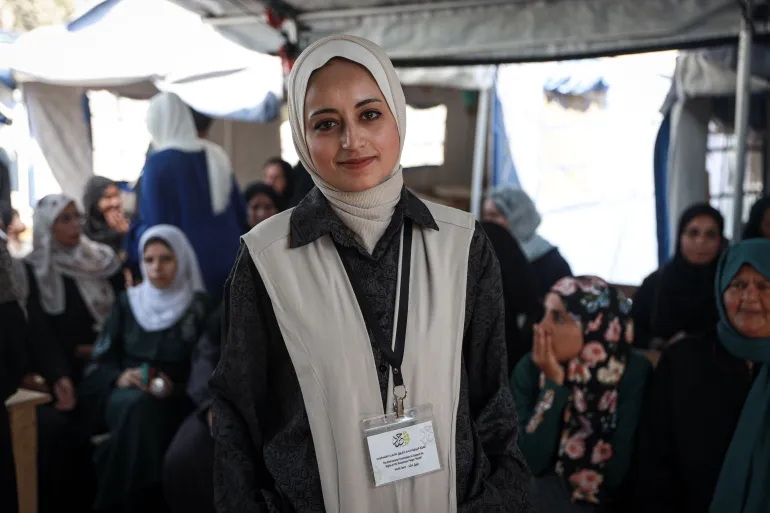
Alaa Daoud says attendance has grown quickly since the sessions began [Abdelhakim Abu Riash/Al Jazeera]
Abdul El-Sayed Wins Democratic Senate Primary in Michigan in a Victory for the Left
VIA The New York Times
By Reid J. Epstein
Aug. 5, 2026
Dr. Abdul El-Sayed narrowly won the Democratic primary race for Senate in Michigan on Tuesday, according to The Associated Press, giving progressives a victory that signaled liberal voters’ anti-establishment mood and shifting sentiment against Israel.
Dr. El-Sayed, 41, a former public health official, narrowly defeated Representative Haley Stevens, a four-term moderate, in a hostile race that was dominated by the politics of Israel and the role of big money in American elections.
He fiercely criticized Israel’s actions in Gaza and promised to pull back American military support, while she vowed to continue sending U.S. military aid to Israel without conditions.
While most Michigan political observers expected in the campaign’s final days that Dr. El-Sayed would prevail, and polls showed him leading by a significant amount, the close margin between him and Ms. Stevens pointed to the tough general-election battle to come for Democrats.
Dr. El-Sayed overcame more than $60 million in super PAC spending on behalf of Ms. Stevens, including at least $30 million tied to the American Israel Public Affairs Committee, the nation’s most influential pro-Israel group. Another $30 million came from so-called dark-money groups whose donors remain hidden.
But even as he was vastly outspent on advertising, Dr. El-Sayed turned Ms. Stevens’s financial advantage into a liability, casting his bid as a grass-roots campaign up against the well-funded establishment. “The money against the many,” as he put it in stump speeches.
His primary victory delivers another shock to a Democratic Party in which left-wing challengers across the country have ousted longtime incumbents or beaten rivals supported by party leaders in Washington.
Dr. El-Sayed was backed by leading progressives, including Senator Bernie Sanders of Vermont and Representative Alexandria Ocasio-Cortez of New York, who went to Michigan to campaign for him. Ms. Stevens was supported by Senator Chuck Schumer of New York, the minority leader, as well as Gov. Gretchen Whitmer of Michigan and other prominent state Democrats.
In the general election, Dr. El-Sayed will face former Representative Mike Rogers, a Republican, in a race widely seen as crucial for control of the Senate. Mr. Rogers was a moderate Republican during his seven House terms, but like many others in his party, he has become an acolyte of President Trump. Mr. Rogers narrowly lost a 2024 Senate bid to Elissa Slotkin, even as Mr. Trump carried the state on his way back to the White House.
Democratic leaders worried — and Ms. Stevens argued — that Dr. El-Sayed could be the weaker candidate in the general election. He is a notably left-wing candidate in a battleground state, with his calls for abolishing Immigration and Customs Enforcement and ushering in universal health care.
“We’ve got to do one thing, and that’s go beat Mike Rogers,” Ms. Stevens said in an interview last month. “We’ve got to be eyes on the prize, and that’s winning in November.”
The Michigan-born son of Egyptian immigrants, Dr. El-Sayed made no secret of his ambitions of progressive leadership within the Democratic Party. He said that he hoped to recalibrate the party’s politics on Israel and wanted to make opposition to funding its military a litmus test for Democrats running for president in 2028.
Defanging AIPAC, he argued, was crucial: “I want AIPAC to cease to be a force in Democratic primaries,” he said in an interview last month. “The best way to do that is to defeat them in a state like Michigan.”
He made much of his campaign pitch a rebuke of both the group and corporate politics. At his events, attendees chanted his slogan along with him: “Money out of politics, money in your pocket, Medicare for all.”
It was no accident that Israel emerged as a fault line in a major Democratic primary in Michigan. The state, which has large numbers of Muslim and Jewish voters, delivered a rebuke to President Joseph R. Biden Jr. in 2024, when 13 percent of Democratic primary voters voted for “uncommitted” in protest of his policy on Israel amid its war with Gaza.
Dr. El-Sayed’s base was seen as the state’s Arab and Muslim voters, as well as younger and more liberal Democrats. Ms. Stevens had pushed to win over the state’s Black voters, whom AIPAC had targeted with a flood of advertisements featuring a clip of former President Barack Obama praising Ms. Stevens during her first run for Congress in 2018.
The contest, which until early July also included Mallory McMorrow, a state senator who sought a middle ground between Ms. Stevens and Dr. El-Sayed, became quite nasty in its final weeks.
So many of Dr. El-Sayed’s supporters mocked Ms. Stevens’s mannerisms and Michigan accent that he urged them to stop making fun of her “for things that have nothing to do with her policies or politics.” In the final days before the primary, Ms. Stevens lashed out at Dr. El-Sayed, posting on social media, “Everyone in America understands you want to blame all of your problems on Jewish Americans.”
Now, Dr. El-Sayed will face the task of uniting Michigan Democrats for the general election.
——————
Via the Other 98%:

Israel wipes genocide evidence in Gaza, carting off rubble and remains in 100 trucks daily
Source: Euro-Med Human Rights Monitor
Palestinian Territory – The Israeli forces, along with Israeli civilian contractors, are conducting a wide and organised operation to process and clear the rubble from neighbourhoods and facilities they have destroyed in the Gaza Strip and relocate it from areas under their military control to outside the Strip.
This is occurring without any official record of the quantities removed or independent oversight, and before international and local investigative committees have had the chance to survey, examine, and document the sites. This risks destroying crucial evidence of genocide and the remains of victims still unaccounted for under the rubble.
These operations are not part of organised humanitarian efforts to rescue the missing, open roads, or prepare for reconstruction. Instead, Israel is acting unilaterally within closed areas under its military control by demolishing remaining buildings and then crushing, mixing, and transporting the rubble before forensic teams, evidence experts, and unexploded ordnance specialists can examine, document, and preserve the sites, along with the evidence and human remains.
At least 10 million tonnes of rubble have been removed, crushed, or moved from their original sites within the areas under Israel’s unlawful military control, which encompass about 66% of the Gaza Strip
The Gaza Rapid Damage and Needs Assessment, published jointly by the World Bank, the United Nations, and the European Union in April 2026, estimated that approximately 68 million tonnes of rubble are spread across the Gaza Strip, based on damage reports up to October 2025. This figure does not necessarily account for damage caused by later demolition and destruction operations.
According to its initial field data, Euro-Med Human Rights Monitor estimates that at least 10 million tonnes of rubble have been removed, crushed, or moved from their original sites within the areas under Israel’s unlawful military control, which encompass about 66 per cent of the Gaza Strip.
Approximately 400 heavy pieces of excavation, demolition, crushing, and transport machinery, operated by Israeli civilian companies under military protection, are active across eastern and southern Gaza. They demolish remaining structures, crush rubble from destroyed neighbourhoods, and load the debris onto trucks for transportation away from the original sites.
In recent weeks, Euro-Med Monitor tracked nearly 100 Israeli trucks daily leaving the Gaza Strip with debris. These trucks carry rubble to undisclosed sites within Israel and further south of the occupied West Bank. The Israeli authorities have not provided details on the quantities removed, the routes taken, the destination sites, or how the material is utilised. They also have not permitted independent oversight of the sorting, weighing, or transport processes. This lack of transparency makes it very difficult to trace the transported material, identify evidence, or recover any human remains that might be present.
The systematic removal of rubble at this pace conceals the evidence of appalling crimes Israel committed in Gaza, especially those related to genocide, such as summary executions and killing unarmed civilians. These sites need careful examination and thorough criminal investigation before any intervention that might change or erase their features.
The debris scattered throughout the Gaza Strip includes possible locations of unlawful killings and bombings that targeted entire families, as well as sites believed to contain mass graves or bodies buried within destroyed homes, hospitals, shelters, and civilian facilities.
These sites hold evidence critical for identifying the weapon, attack sequence, victim and attacker positions, firing ranges, cause and manner of death, as well as fragments, projectiles, spent cartridges, biological traces, and personal belongings.
Crushing, mixing, and transporting rubble can erase evidence, location details, and connections within the crime scene. This process also disrupts the chain of custody, potentially making it impossible to trace where evidence was collected or to link it to a particular incident or victim. This damage cannot be reversed by aerial photographs or subsequent testimony, as investigating international crimes also requires tangible evidence that can be examined, compared, and legally verified.
These operations pose a direct risk to the remains of thousands of missing persons, estimated by Gaza’s Civil Defence to be around 8,500 in July 2026. Using crushers and heavy machinery without prior forensic and humanitarian surveys could crush or scatter the remains, mix them with rubble, and separate them from belongings and documents vital for victim identification. This process may also lead to transporting the remains to unknown locations that may become impossible to access later.
This conduct infringes on the families’ right to know the fate of their missing relatives and to recover and bury their remains with dignity. It also contradicts international standards that call for searching for the deceased, collecting and safeguarding information about them, and ensuring proper identification and recording. Additionally, removing sites before investigation breaches the guidelines outlined in the Minnesota Protocol on the Investigation of Potentially Unlawful Death. This protocol emphasises securing and documenting the scene, gathering evidence while preserving its chain of custody, and recovering and examining remains with scientific methods that uphold the victims’ dignity and their family’s rights.
The debris in the Gaza Strip comprises more than just rubble; it includes private and public property, essential building materials like steel, stone, and concrete that can be recycled and reused, as well as other valuable assets necessary for Palestinians to reconstruct their homes, roads, and infrastructure. It may also contain property documents, official records, and personal belongings that are part of individuals’ and families’ rights and memories.
Removing rubble from the Gaza Strip and commercially exploiting it without the owners’ consent or compensation may, depending on the circumstances and intent of the seizure, constitute unlawful confiscation or pillage. Such acts are prohibited under international humanitarian law, especially Article 33 of the Fourth Geneva Convention and the relevant provisions of the Rome Statute.
These actions are part of a broader pattern that has involved bulldozing sites believed to contain mass graves, storming and damaging hospitals and medical facilities after they were suspected of being sites of grave crimes, ongoing demolition of buildings in military-controlled zones, and targeting Palestinian journalists. Additionally, international investigators and independent media have been prevented from accessing the most heavily destroyed areas.
This deliberate removal of evidence occurs when the International Criminal Court (ICC) is still investigating crimes in Palestine, alongside other cases under universal jurisdiction in national courts. Destroying crime scenes before investigations are finished hampers legal accountability and complicates efforts by international investigators and prosecutors to establish facts, as vital evidence may be lost once removed from the Gaza Strip.
Moreover, Article 70(1)(c) of the Rome Statute considers “destroying, tampering with or interfering with the collection of evidence” as criminal acts that hinder the ICC’s justice mission when done deliberately. The ICC Prosecutor should investigate these actions as deliberate interference with evidence collection related to the ongoing investigation into the Situation in the State of Palestine, which also includes unlawful destruction, seizure, or pillage of property.
The large-scale crushing and removal of rubble not only destroys evidence but also erases land boundaries, house foundations, street networks, and neighbourhood features. This process strips Palestinians of the physical markers of ownership and their connection to the land, making it more difficult for them to return and rebuild their communities as they once were.
Transforming forcibly depopulated Palestinian towns and neighbourhoods into levelled, open spaces under Israeli control is a concrete act that deepens the displacement and ethnic cleansing. This process is inseparable from Israeli settler colonialism, which involves uprooting Palestinians, erasing signs of their presence, and redefining the land without them. This sets the stage for Israel’s efforts to re-establish settlements in Gaza and displace Palestinian residents, advancing a new phase of colonisation and the ongoing denial of land and the right of return.
The international community, including the Security Council, the UN General Assembly, and states parties to the Rome Statute, must urgently intervene to halt the systematic removal and transport of rubble from the Gaza Strip. They should also advocate for independent international forensic and criminal investigation teams to be granted access to assess and document the destruction sites before any further removal or transport occurs, ensuring that physical evidence is preserved to hold those responsible for genocide accountable.
Euro-Med Monitor urges the international community to push Israel to immediately and fully stop all rubble removal and transport activities. This includes requiring detailed disclosures of transported materials, weighing logs, truck routes, ultimate destinations, company and contractor names, beneficiary parties, payment information, machinery and truck registration numbers, and tracking data, as well as transparency regarding any sale, recycling, or commercial use of materials extracted from Gaza.
Furthermore, removing rubble or recyclable materials from the Gaza Strip should be prohibited until a transparent Palestinian and international system for managing these materials is put in place. This system should ensure that any unlawfully transported materials are either returned or their full value is compensated to the owners. Additionally, rubble suitable for reuse should be allocated to local reconstruction projects that benefit the Palestinian population and protect individual and public property rights.
States where the implicated companies or machinery manufacturers are based should mandate a halt to any actions that could lead to property demolition, evidence removal, or rubble seizure. They must also preserve all relevant contracts, correspondence, and operational data, and carry out independent investigations into the accountability of their directors and staff. Euro-Med Monitor urges targeted measures against individuals and companies found to have known about and taken part in these illegal activities, such as exclusion from public contracts, freezing assets, and criminal prosecution.
Any efforts to remove rubble or rebuild in the Gaza Strip must be led by Palestinians, involving local residents, property owners, and families of the missing. These initiatives should ensure the protection of evidence, recovery of remains, clearance of unexploded ordnance, sorting of hazardous materials, local reuse of rubble, preservation of property maps and urban fabric, and prevent reconstruction from being used to cement control or alter the enclave’s geographic or demographic makeup.
Euro-Med Monitor affirms that a ceasefire or political agreements do not erase crimes or their evidence. Reconstruction and rubble removal should happen alongside preserving evidence, discovering the fate of the missing, recovering property, holding perpetrators accountable, and ensuring victims’ rights to truth, justice, and reparation.
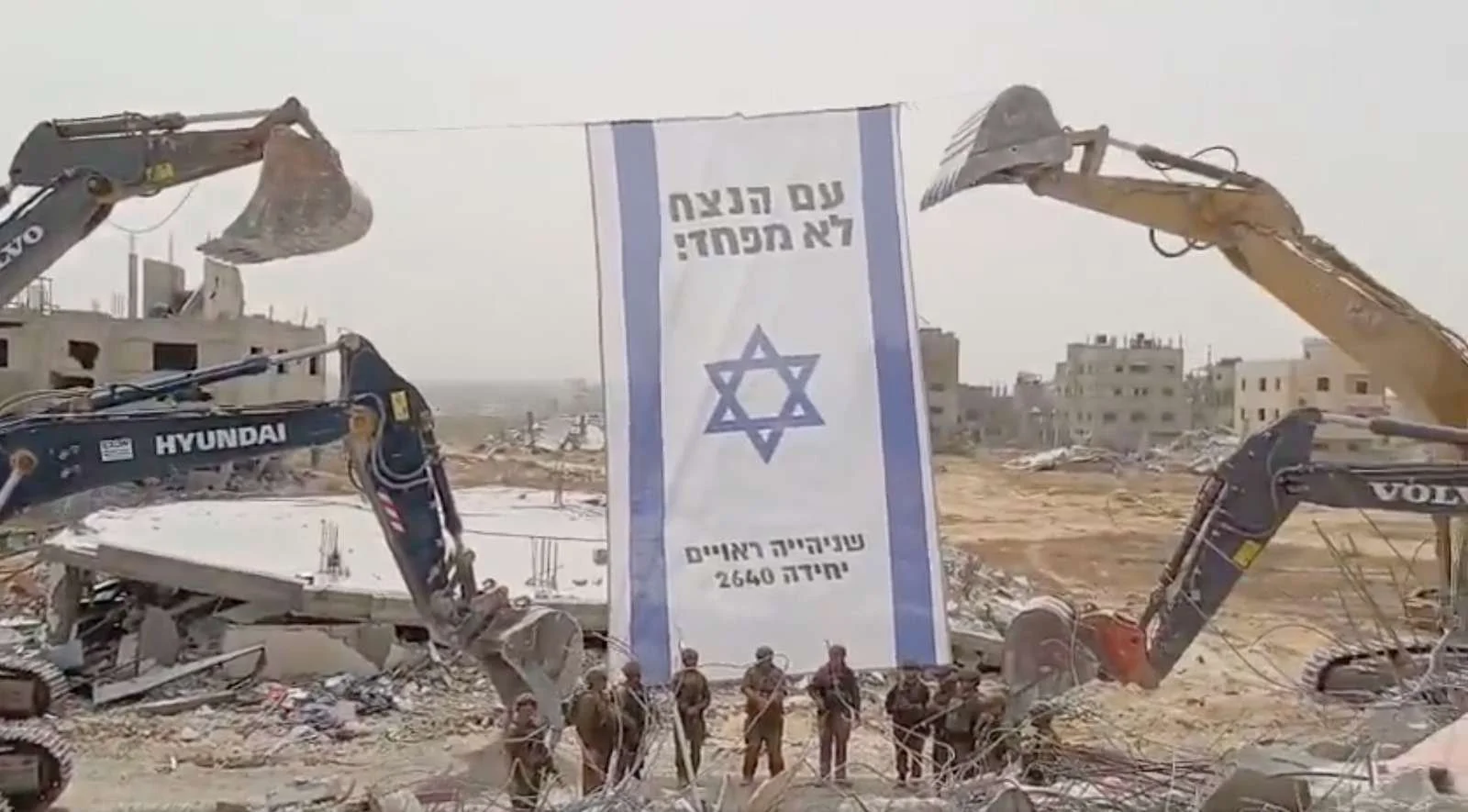
Members of the Israeli Military Unit 2640 - Uriah (An irregular unit operating under the Gaza Division's command and whose tasks are focused on demolishing homes), Gaza Strip. July 21, 2025 (Ha-Macom newspaper)